Two Visions of the Future (OCR GCSE Geography B (Geography for Enquiring Minds)): Revision Notes
📚Revision Notes
Two Visions of the Future
Introduction to food security and population
The world's population currently stands at 7.6 billion people and is projected to reach 9 billion by 2050. This rapid growth raises a critical question: can we produce enough food to feed everyone? Food security—ensuring everyone has reliable access to sufficient, safe, and nutritious food—is one of the most important global challenges we face.
Two contrasting theories offer different perspectives on whether humanity can overcome this challenge. These theories, developed centuries apart, present opposing views on the relationship between population growth and food supply.
Note
Food security goes beyond simply having enough food—it encompasses reliable access, safety standards, and nutritional value. All three components must be met for true food security to exist.
Malthus's theory (1798)
The pessimistic view
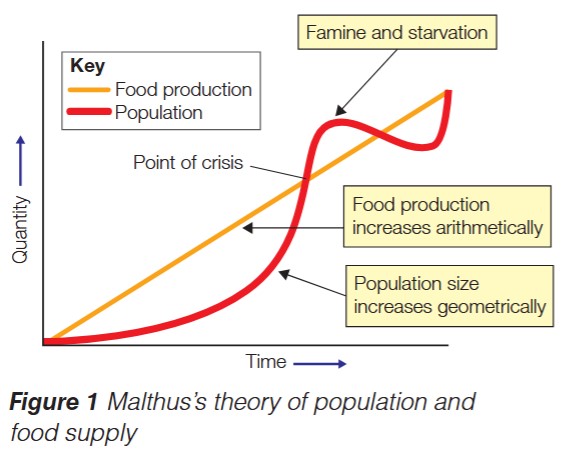
In 1798, Thomas Malthus proposed a theory that painted a rather grim picture of humanity's future. He argued that population and food production grow at fundamentally different rates, which would inevitably lead to disaster.
Key principles of Malthusian theory
Population growth: Malthus observed that population grows exponentially, or at a geometric rate. This means it doubles at regular intervals—for example: , and so on. Each generation is approximately twice the size of the previous one when left unchecked.
Food production growth: In contrast, Malthus believed food supply could only increase steadily and slowly, at an arithmetic rate. This means it grows by adding the same amount each time—for example: , and so on.
Important
The Critical Problem
The crucial issue with these different growth rates is that population will eventually overtake food supply. When this happens, there simply won't be enough food to feed everyone, leading to famine and starvation. This crisis point occurs when population size exceeds the available food supply.
Checks on population growth
Malthus identified two types of mechanisms that would control population growth and bring it back in line with food availability:
Positive checks: These are tragic events that reduce population size by increasing death rates. Examples include disease epidemics, famines, and wars. Whilst Malthus called them "positive," they are actually negative in human terms—they reduce population through suffering and death.
Preventative checks: These are actions people take voluntarily to limit population growth. Examples include delaying marriage, having smaller families, and practising family planning. These measures prevent the population from exceeding food supply in the first place.
Note
Understanding "Positive" Checks
The term "positive" in Malthusian theory doesn't mean "good"—it refers to checks that actively add to (or positively affect) the death rate. This is one of the most misunderstood aspects of his theory, so be careful when using this terminology in exams.
The Malthusian conclusion
According to Malthus, humanity faces an unavoidable cycle: population grows until it exceeds food supply, causing crisis and suffering, which then reduces population back to sustainable levels. This pessimistic view suggests we cannot escape this pattern.
Boserup's theory (1965)
The optimistic view
In 1965, over 150 years after Malthus, Esther Boserup challenged his pessimistic theory with a more hopeful perspective. She argued that humans are resourceful and innovative, especially when facing challenges.
Key principles of Boserupian theory
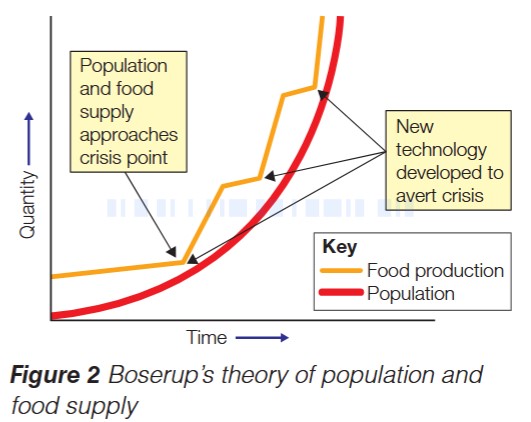
Boserup proposed that when population size approaches the limits of food supply, it creates an incentive rather than a crisis. People are motivated to develop new technologies and methods to increase food production. Rather than accepting famine, humans innovate their way out of trouble.
Technological solutions
Boserup identified several examples of how technology can boost food production:
- Irrigation systems: These allow farmers to divert water to previously unusable land, bringing more area under cultivation and enabling crops to grow in drier regions
- New seed varieties: Improved seeds can produce higher yields, resist diseases better, and grow in a wider range of conditions
- Fertilisers and tractors: Chemical fertilisers enhance soil productivity, whilst tractors allow farmers to work larger areas more efficiently
These innovations mean that as population grows, food production can grow alongside it. The two remain in balance because human ingenuity prevents crisis.
Note
The Green Revolution
Boserup's theory was validated by the Green Revolution of the 1960s-1980s, which used new seed varieties, fertilisers, and irrigation to dramatically increase food production in developing countries. This real-world example demonstrates how technological innovation can expand food supply in response to population pressure.
The Boserupian conclusion
According to Boserup, population pressure is actually beneficial—it drives progress and innovation. Rather than leading to inevitable disaster, population growth stimulates the development of new agricultural technologies that increase food supply. Humans can feed a growing population through clever thinking and technological advancement.
Comparing the two theories
The fundamental difference between these theories lies in their view of human capability:
Malthus saw population growth as a problem that would inevitably overwhelm food production. He believed nature's checks (famine, disease) were the only solution, painting a pessimistic picture where humans are powerless against mathematical reality.
Boserup saw population growth as a challenge that would stimulate human innovation. She believed in humanity's ability to solve problems through technology and creativity, presenting an optimistic vision where humans control their own destiny.
Note
Different eras, different perspectives
It's worth noting that Malthus wrote during the late 18th century, before the Industrial Revolution transformed agriculture. Boserup wrote in the mid-20th century, after witnessing tremendous technological progress. Historical context matters when evaluating these theories—each theorist was influenced by the world they observed around them.
Evidence today: The world's population has grown from about 1 billion in Malthus's time to 7.6 billion today, yet widespread famine has not occurred as he predicted. This suggests Boserup may have been more accurate. However, challenges remain: climate change, water scarcity, and soil degradation threaten food security in many regions.
Important
The Verdict Isn't Final
While Boserup's theory seems more accurate based on historical evidence, we cannot definitively say she was "right" and Malthus was "wrong." Climate change, resource depletion, and environmental degradation present new challenges that neither theorist fully anticipated. The question of whether humanity can sustainably feed 9 billion people by 2050 remains open.
Exam guidance
When answering questions about these theories, remember to:
- Describe: Clearly explain the key features of each theory, including growth rates and outcomes
- Explain: Show understanding of why each theorist believed what they did, and the logic behind their arguments
- Compare: Highlight the contrasts between pessimistic and optimistic views
- Evaluate: Assess which theory better explains the world today, using evidence such as technological progress in agriculture or ongoing food insecurity in certain regions
Example
Worked Example: Comparing the Theories
Question: Compare Malthus's and Boserup's views on the relationship between population and food supply.
Answer Structure:
- Introduction: Briefly state that both theories address population growth but reach opposite conclusions
- Malthus: Explain geometric vs. arithmetic growth, leading to inevitable famine
- Boserup: Explain how population pressure drives innovation and technological solutions
- Comparison: Contrast pessimistic vs. optimistic views, historical context (1798 vs. 1965)
- Evaluation: Use modern evidence—population has grown but famine hasn't been universal, showing Boserup's theory has merit, though challenges remain
Remember!
Summary
Key Points to Remember:
- Malthus (1798) believed population grows geometrically () whilst food supply grows arithmetically (), inevitably leading to famine and starvation
- Boserup (1965) argued that population pressure motivates technological innovation, allowing food production to keep pace with population growth
- Positive checks reduce population through increased deaths (disease, famine), whilst preventative checks limit population growth through human choices (smaller families, delayed marriage)
- Key difference: Malthus was pessimistic about humanity's ability to feed itself; Boserup was optimistic about human innovation and problem-solving
- Current world population is 7.6 billion and predicted to reach 9 billion by 2050—the question remains whether Malthus or Boserup will prove correct in the long term