Cambridge An Economic Hub (OCR GCSE Geography B (Geography for Enquiring Minds)): Revision Notes
📚Revision Notes
Cambridge an economic hub
Why Cambridge is an important economic centre
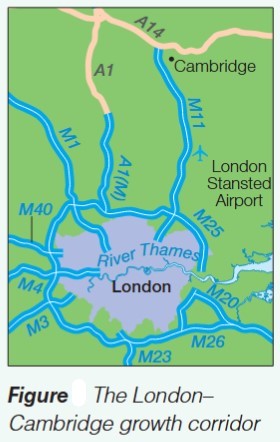
Cambridge has developed into a major economic hub in south-east England, positioned along the London-Cambridge growth corridor. This strategic location has enabled the city to emerge as one of the UK's leading centres for high-technology industries in the 21st century.
The city's economic success is built on several centuries of academic excellence. Cambridge University, established over 800 years ago, has created a foundation of research, innovation and skilled graduates that modern industries can draw upon. In recent decades, this academic heritage has been transformed into commercial success, with the city becoming home to over 1500 bio-tech and IT companies.
Note
Cambridge's transformation demonstrates how traditional academic institutions can evolve into drivers of modern economic growth. The city has successfully bridged the gap between pure research and commercial application, creating a unique ecosystem where education and business reinforce each other.
The growth of hi-tech industries
Cambridge's transformation into a technology hub represents a significant shift in the UK's economic landscape. The concentration of hi-tech and bio-tech companies demonstrates how traditional university cities can evolve into centres of cutting-edge innovation. These industries form part of the quaternary sector, focusing on research, development and information-based activities.
The Cambridge Science Park has become a focal point for these new industries, clustering similar companies together and creating opportunities for collaboration and knowledge exchange. This agglomeration effect has attracted even more companies to the area, creating a self-reinforcing cycle of growth.
Note
The agglomeration effect works by bringing similar companies into close proximity, allowing them to share knowledge, compete for talent, and benefit from specialized suppliers and services. This clustering makes the entire area more attractive to new businesses, creating momentum that continues to drive growth.
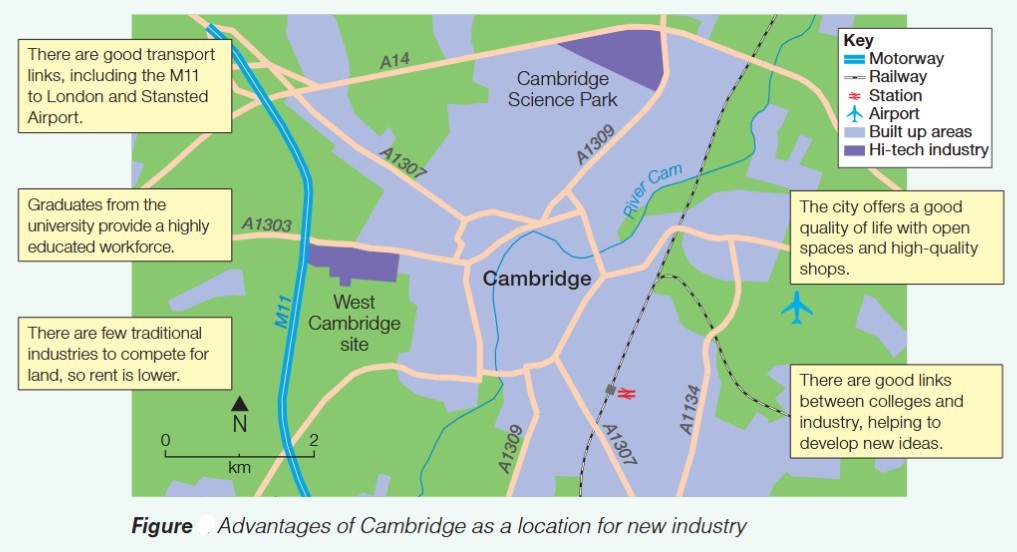
Location advantages for new industry
Cambridge offers several key advantages that make it attractive to modern hi-tech businesses:
Transport connectivity
The city benefits from excellent transport links that connect it to national and international markets. The M11 motorway provides direct access to London and Stansted Airport, enabling rapid movement of people and goods. The A14 offers connections to other parts of East Anglia, while railway links facilitate commuting and business travel. Stansted Airport, in particular, provides crucial international connections for global companies.
Highly educated workforce
Cambridge University produces a continuous supply of highly educated graduates who can fill skilled positions in technology companies. Many staff working in bio-tech and IT firms hold advanced qualifications, including PhDs. This educated workforce understands complex scientific and technical challenges and can drive innovation forward.
Important
The availability of PhD-qualified staff is particularly crucial for bio-tech and advanced technology companies. These highly specialized roles require deep scientific knowledge that cannot be easily found elsewhere, giving Cambridge a significant competitive advantage over other locations.
Quality of life
The city offers an attractive living environment that helps companies recruit and retain talented staff. Open green spaces provide recreational opportunities, while high-quality shops and cultural facilities make Cambridge a desirable place to live. This quality of life is particularly important for attracting professional workers who have choices about where to work.
Availability of land
Unlike more established industrial areas, Cambridge has relatively few traditional industries competing for land. This means that land costs are lower than they might otherwise be, and new companies can find suitable sites more easily. The absence of declining heavy industry also means the area doesn't face regeneration challenges.
Industry-education links
Strong connections exist between the university colleges and local companies. These partnerships enable businesses to access cutting-edge research, recruit graduates directly, and collaborate on developing new ideas. Universities benefit from commercial partnerships through funding and real-world applications of their research.
Important
The Power of University-Industry Partnerships
These links create mutual benefits that drive innovation:
- Companies gain access to the latest research and cutting-edge facilities
- Universities receive funding and real-world applications for their work
- Students get exposure to industry challenges and career opportunities
- New technologies move from laboratory to market more quickly
This symbiotic relationship is one of Cambridge's most significant competitive advantages.
Case study: Abcam
Example
Case Study: Abcam - University Spin-out Success
Abcam demonstrates how Cambridge's advantages can be transformed into commercial success. Founded by graduates from Cambridge University, this bio-tech company specializes in producing antibodies for disease treatment research.
Key Success Indicators:
- Company valuation: £1 billion
- Workforce: Approximately 200 staff with PhD qualifications
- Specialization: Production of antibodies for disease research
- Origin: University spin-out from Cambridge
What This Shows:
- University research can be successfully commercialized
- Access to highly qualified staff enables specialized work
- Local knowledge and networks support business growth
- Cambridge provides the right environment for bio-tech success
Abcam's development illustrates how the concentration of academic talent, research facilities, and business support in Cambridge creates ideal conditions for transforming scientific research into profitable businesses.
The London-Cambridge growth corridor
Cambridge's economic development doesn't occur in isolation. The city forms part of the London-Cambridge growth corridor, a zone of economic expansion stretching along the M11 motorway.
Note
Regional Context: Why Location Matters
This corridor benefits from:
- Proximity to London's markets and financial services
- Access to Stansted Airport for international connections
- Multiple transport routes linking the two cities
- Overspill of economic activity from London
This regional context helps explain why Cambridge has been particularly successful compared to other university cities. Its position within commuting distance of London, combined with lower costs than the capital, makes it an attractive alternative location for businesses.
Economic impacts
The growth of hi-tech industries in Cambridge has created several positive economic effects:
Employment opportunities: Over 1500 companies provide thousands of skilled jobs, attracting workers from across the UK and internationally.
Economic multiplier effects: Hi-tech workers spend their salaries locally, supporting shops, restaurants and service businesses. This creates additional employment in supporting sectors.
Property market impacts: Demand from well-paid professionals has driven up house prices, creating wealth for existing homeowners but making housing less affordable for lower-paid workers.
Innovation and research: The concentration of technology companies has made Cambridge a centre for innovation, with new products and treatments being developed that have national and global significance.
Important
Balancing Growth and Challenges
While economic growth creates obvious benefits like jobs and wealth, it also creates challenges that need careful management:
- Housing affordability becomes an issue as prices rise
- Transport congestion increases with more commuters
- Income inequality may widen between high-tech workers and service sector employees
- Pressure on local infrastructure and services increases
Understanding both the positive and negative impacts is crucial for evaluating Cambridge's development as an economic hub.
Exam guidance
Important
Exam Success Strategies
When answering questions about Cambridge as an economic hub, remember to:
For 'describe' questions: Focus on factual details such as the number of companies, types of industries, and specific examples like Abcam. Use data and figures where available.
For 'explain' questions: Link advantages to outcomes. For example, explain how university graduates provide skilled workers, which enables companies to undertake complex research, which leads to successful products.
For 'assess' or 'evaluate' questions: Consider both positive and negative impacts. While economic growth creates jobs and wealth, it may also cause housing affordability issues or transport congestion. Weigh up different factors and make a balanced judgement.
Using the case study: Abcam provides specific evidence you can use in exam answers. Learn the key facts (£1 billion value, 200 PhD staff, antibody production) and be ready to explain how it illustrates Cambridge's advantages.
Remember!
Summary
Key Points to Remember:
Cambridge's Economic Profile:
- Cambridge has over 1500 bio-tech and IT companies, making it a major hi-tech hub
- Location advantages include excellent transport links (M11, Stansted Airport), highly educated workforce from the university, good quality of life, and strong industry-education partnerships
- Abcam is a £1 billion bio-tech company employing 200 PhD-qualified staff, showing successful commercialization of university research
- Cambridge forms part of the London-Cambridge growth corridor, benefiting from proximity to the capital
- The city demonstrates how traditional university towns can transform into centres of quaternary sector activity
Key Terms:
- Economic hub: A centre of concentrated economic activity and growth
- Hi-tech industries: Businesses focused on advanced technology, requiring highly skilled workers
- Bio-tech: Industries involving biological processes, particularly in medicine and healthcare
- Growth corridor: A zone of economic expansion linking two or more major centres
- Quaternary sector: Industries focused on knowledge, research, development and information
Critical Processes:
- Agglomeration: Similar industries clustering together, creating advantages through proximity
- Economic multiplier: How spending by one group creates additional economic activity
- University spin-outs: Companies created from university research and graduates