London’s Place in the UK Economy (OCR GCSE Geography B (Geography for Enquiring Minds)): Revision Notes
📚Revision Notes
London's Place in the UK Economy
London and the UK economy
The economic gap between London and other parts of the UK has become increasingly pronounced since the late 1990s. This disparity reveals important patterns about how wealth is generated and distributed across the country.
Despite containing only 13% of the UK's total population, London generates 22% of the nation's wealth. This shows that the capital city has a disproportionately large economic output compared to its population size. In other words, London is far more economically productive per person than the UK average.
Note
This economic disparity means that each person in London, on average, contributes significantly more to the national economy than people in other regions. This reveals fundamental differences in the types of economic activities and industries present in different parts of the country.
Regional economic performance has varied significantly over the past two decades. Data comparing two time periods (1997-2007 and 2008-2011) reveals several key trends:
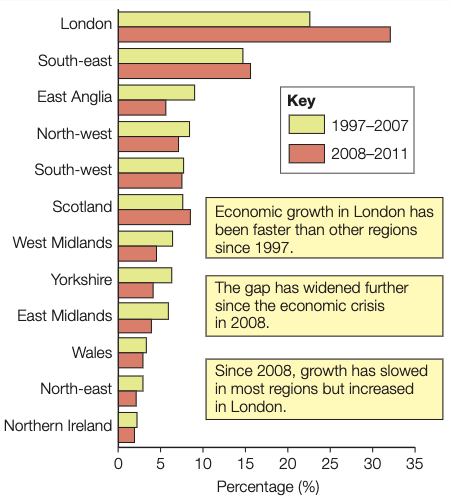
Regional economic growth patterns
London has experienced faster economic expansion than all other UK regions since 1997. While London's economy continued to grow strongly, other regions showed more modest growth rates.
The South East also performed relatively well, benefiting from its proximity to London and connections to the capital's economy. However, its growth rate still lagged behind London's.
Following the 2008 economic crisis, growth slowed across most UK regions. Notably, while London's growth rate decreased, it still outpaced other areas. In contrast, many regions outside London actually saw their economies slow down more dramatically or even contract.
Note
The widening economic divide has important implications for regional inequality, employment opportunities, and government policy decisions about investment and infrastructure development. This pattern raises questions about how to achieve more balanced economic growth across the UK.
Important
Exam tip: When describing regional economic patterns, always support your points with specific data. Use comparative language like "faster than", "in contrast to", or "whereas" to show differences between regions.
The hi-tech industry in London
London has emerged as one of Europe's leading centres for high-technology companies, particularly in the digital and creative sectors. This concentration of tech businesses creates what geographers call an agglomeration effect, where similar companies cluster together for mutual benefit.
Old Street Roundabout: London's 'Silicon Roundabout'
The area around Old Street Roundabout in East London has become a focal point for the UK's hi-tech industry. This location is sometimes referred to as 'Silicon Roundabout', deliberately echoing California's famous Silicon Valley.

Several factors explain why this area attracts technology companies:
Excellent public transport connections: London's transport network, particularly the Underground system, means workers can easily commute to Old Street from across the city and beyond. This reduces the need for employees to own cars and makes the location accessible to a large pool of potential workers.
Concentration of start-up companies: Many new, small technology businesses have established themselves in this area. These start-ups benefit from being close to each other because they can share knowledge, form partnerships, and learn from one another's experiences. Workers can also move between companies more easily.
Presence of major technology corporations: Large, established technology companies like Facebook and Google have invested in offices near Old Street. This creates opportunities for smaller companies to potentially work with or supply services to these major players. It also adds prestige to the area.
Availability of qualified workers: London attracts young people with relevant qualifications in computing, digital media, and related fields. Universities in and around London produce graduates with the skills tech companies need. The concentration of companies in one area makes it easier for qualified workers to find employment and for businesses to recruit talent.
Support services: Similar companies in close proximity can share resources and support each other. For example, they might use the same legal advisors, accountants, or marketing services. Staff can network and exchange ideas, leading to innovation and collaboration.
Important
Exam tip: When explaining why industries cluster in particular locations, use geographical terms like "agglomeration" and "multiplier effect". Always link your points back to specific advantages this brings to businesses.
Economic significance
The concentration of hi-tech industry in London reinforces the capital's economic dominance within the UK. These companies tend to be highly profitable and pay relatively high wages, contributing significantly to London's wealth generation. This sector attracts investment from around the world and helps establish London as a global city competing with other major tech hubs like San Francisco, Singapore, and Berlin.
However, this concentration also raises questions about regional balance and whether government policies should encourage more tech development in other UK cities to reduce economic inequality.
Summary
Remember:
-
Disproportionate wealth creation: London contains 13% of the UK's population but produces 22% of national wealth, showing its outsized economic importance.
-
Growing regional divide: Economic growth in London has consistently outpaced other UK regions since 1997, and this gap widened further after the 2008 financial crisis.
-
Agglomeration effects: The clustering of hi-tech companies around Old Street Roundabout (Silicon Roundabout) creates mutual benefits through shared resources, knowledge exchange, and access to qualified workers.
-
Transport as a locational factor: Excellent public transport connections are crucial for attracting hi-tech businesses to London, as they enable companies to recruit from a wide geographical area.
-
London as a global tech hub: The concentration of both start-ups and major corporations like Facebook and Google establishes London as a leading international centre for digital and creative industries.