Post Industrial UK (OCR GCSE Geography B (Geography for Enquiring Minds)): Revision Notes
📚Revision Notes
Post Industrial UK
Understanding post-industrial economy
The UK has transitioned into a post-industrial economy. This means the economy is now dominated by the service sector (also called tertiary industry) rather than manufacturing or primary industries. The service sector includes jobs in areas like retail, healthcare, education, finance, and hospitality.
Note
This shift has brought significant changes to how people work, what jobs are available, and the flexibility of working patterns in the 21st century. Understanding these changes is crucial for grasping modern UK economic geography.
Changes at work in the post-industrial economy
Growth of the service sector
In a post-industrial economy, the majority of workers are now employed in service-based jobs. This represents a major shift from the industrial economy of the 20th century, where manufacturing and factory work dominated employment.
Important
This transition marks one of the most significant economic transformations in UK history. The service sector now employs more people than manufacturing and primary industries combined, fundamentally changing the nature of work in Britain.
Key employment changes
Several important changes have occurred in UK employment patterns since 2000:
Gender and employment:
- The number of male and female workers has changed over time
- Employment rates differ between men and women, though the gap has been narrowing
- Both male and female unemployment levels fluctuate but show important trends
Note
The narrowing of the gender employment gap reflects changing social attitudes, improved childcare provision, and legal protections against workplace discrimination. However, significant differences remain in terms of pay and senior positions.
Self-employment:
- An increasing percentage of workers are now self-employed
- People are choosing to work for themselves rather than for traditional employers
- This trend reflects greater entrepreneurship and changes in how businesses operate
Types of work:
- The nature of jobs available has transformed significantly
- Professional and managerial roles have expanded
- Factory work and unskilled jobs have declined
More flexible working patterns
To compete successfully in the global economy, the UK needs a flexible and highly qualified workforce. The government has promoted various flexible working arrangements to help achieve this goal.
Note
Flexible working patterns benefit both employers and employees. Employers gain access to a wider talent pool and can adapt more quickly to changing market demands, while employees achieve better work-life balance and increased job satisfaction.
Types of flexible working
Part-time work:
- Allows workers to work fewer hours than full-time
- Helps people balance family responsibilities with employment
- Enables workers to hold multiple jobs if needed
Flexi-time:
- Workers can choose when to start and finish their working day
- Provides autonomy over working hours within agreed limits
- Helps accommodate personal commitments and preferences
Job sharing:
- Two people share the responsibilities of one full-time position
- Each person works part-time but together they cover all duties
- Offers flexibility while maintaining full coverage for employers
Sub-contracting:
- An outside company or self-employed person is hired to complete specific work
- Businesses use external expertise rather than permanent employees
- Provides flexibility for both companies and workers
Important
Zero-hours contracts are particularly controversial. While they offer maximum flexibility for employers and some workers value the freedom, they provide no guaranteed minimum hours of employment. This means workers face income uncertainty and difficulty accessing benefits like mortgages or loans that require proof of regular income.
Teleworking/homeworking:
- Working from home using a computer or phone
- Reduces commuting time and costs
- Enables people to work from anywhere with internet connection
Note
The COVID-19 pandemic dramatically accelerated the adoption of teleworking, demonstrating that many jobs can be performed effectively from home. This has led to permanent changes in working patterns for millions of UK workers.
Employment trends 2000-2020
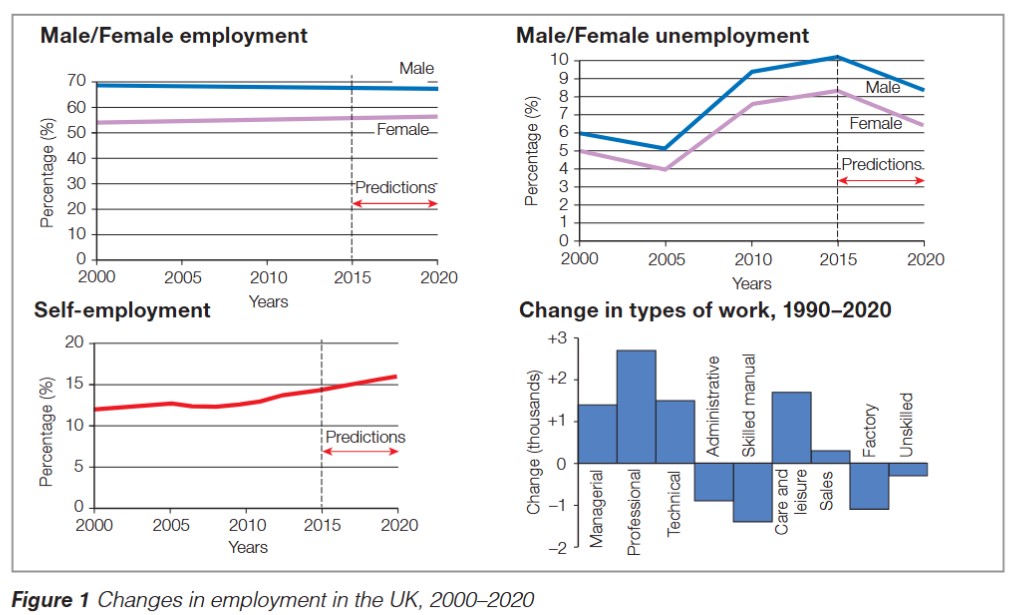
Male and female employment rates
Male employment rates have consistently remained higher than female employment rates, typically around 70% for men compared to 50-60% for women. However, the gap between male and female employment has been narrowing over the two-decade period from 2000 to 2020.
Unemployment patterns
Unemployment rates for both men and women have fluctuated considerably between 2000 and 2020. Both genders experienced rising unemployment during economic downturns, with peaks occurring around 2010-2015 during and after the financial crisis. Male and female unemployment rates have generally followed similar trends, though at slightly different levels.
Note
The 2008 financial crisis had a profound impact on UK employment. The subsequent recession led to significant job losses across many sectors, particularly affecting manufacturing, construction, and retail. Recovery took several years, with unemployment remaining elevated until around 2015.
Self-employment growth
Self-employment has shown steady growth from 2000 to 2020. The percentage of self-employed workers increased gradually from approximately 12% to around 15% over this period. This upward trend reflects changing attitudes towards entrepreneurship and the growth of the gig economy.
Changes in types of work
Between 1990 and 2020, the UK experienced major shifts in the types of jobs available:
Growing sectors:
- Managerial positions increased significantly
- Professional roles expanded substantially
- Technical jobs grew moderately
Important
The expansion of professional, managerial, and technical roles reflects the UK's transition to a knowledge-based economy. These jobs typically require higher qualifications, emphasizing the importance of education and training for economic success in the modern UK.
Declining sectors:
- Factory work decreased dramatically
- Unskilled jobs fell considerably
- Traditional manual labour roles reduced
Stable or mixed sectors:
- Administrative roles showed some decline
- Skilled manual work decreased
- Caring and leisure services remained relatively stable
- Sales positions experienced moderate decline
These changes demonstrate the transition from an industrial economy focused on manufacturing to a post-industrial, service-based economy requiring higher qualifications and different skill sets.
Summary
Key Points to Remember:
- The UK is now a post-industrial economy dominated by the service sector (tertiary industry)
- Employment rates are higher for men than women, but this gap is narrowing over time
- Self-employment has grown steadily, reflecting changing work patterns and entrepreneurship
- Flexible working arrangements (part-time, flexi-time, job sharing, sub-contracting, zero-hours, teleworking) help the UK compete globally
- Types of work have shifted dramatically from factory and unskilled jobs towards professional, managerial, and technical roles
Key Terms:
- Post-industrial economy - economy dominated by service sector rather than manufacturing
- Service sector/tertiary industry - jobs providing services rather than making products
- Self-employment - working for yourself rather than an employer
- Flexible working - various work patterns that differ from traditional full-time employment
- Zero-hours contract - employment with no guaranteed hours
Critical Process: The transition from industrial to post-industrial economy involves: declining manufacturing → growth of service sector → changing employment patterns → increased need for flexible working → shift towards professional and technical jobs