Retirement Dreams (OCR GCSE Geography B (Geography for Enquiring Minds)): Revision Notes
📚Revision Notes
Retirement dreams
Where older people live in the UK
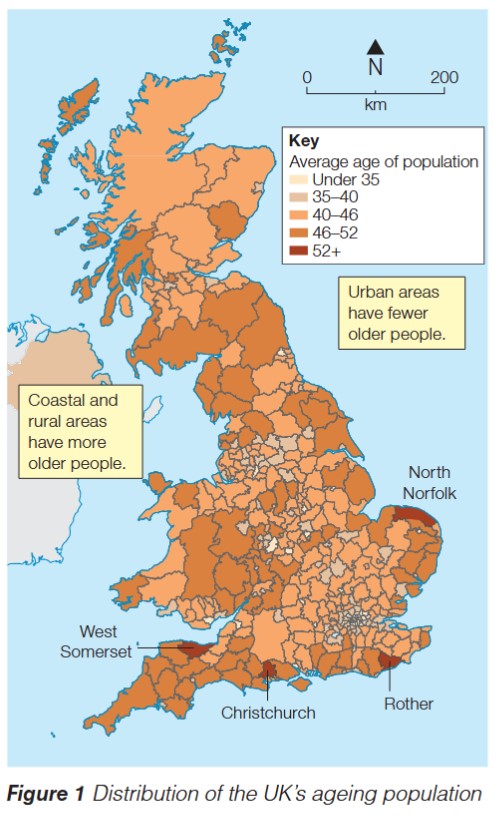
The UK's older population is not evenly distributed across the country. Some regions have significantly higher proportions of elderly residents than others, creating distinct geographic patterns.
Note
Understanding the distribution of older populations helps explain the varying demands on services and resources across different regions of the UK.
Geographic patterns of distribution
Coastal and rural areas contain higher concentrations of older people, whilst urban areas tend to have younger populations. This uneven distribution is visible across England, Scotland, Wales, and Northern Ireland.
Reasons for the distribution patterns
Three key factors explain why older people cluster in certain areas:
- Retirement migration – Many retirees choose to relocate to seaside or countryside locations after finishing work, seeking quieter environments and pleasant surroundings.
- Youth migration to cities – Younger people frequently move to urban areas to access employment opportunities, leaving behind communities with older age profiles.
- Higher birth rates in cities – Urban populations have higher birth rates, resulting in more children and younger demographic structures overall.
Note
These three factors work together to create the concentration of older people in coastal and rural areas. As younger people leave for cities and retirees move in, the age profile of these communities shifts significantly.
Case study: Rother, East Sussex
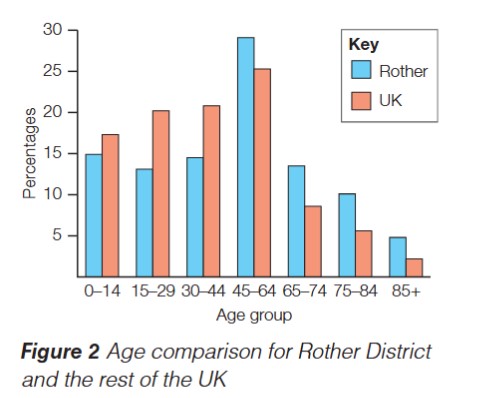
Rother District in East Sussex provides an important example of a UK location with an ageing population structure. It has one of the highest proportions of older people in the entire country.
Example
Case Study Analysis: Comparing Rother to the UK Average
The bar chart comparison reveals that Rother has a significantly different age structure compared to the UK average:
- The 65-74 age bracket contains approximately 28% of Rother's population, compared to roughly 25% nationally
- The 85+ category also shows higher representation in Rother
- This demonstrates how retirement migration has created a distinctly older population profile in this coastal district
Challenges of an ageing population
Areas with high proportions of older residents face several specific challenges:
Important
Key Challenges to Consider:
-
Increasing care requirements – As people age, they need more medical support and social care services, placing pressure on local healthcare providers and social services.
-
Changing housing needs – Older people may require different housing types, such as bungalows, sheltered accommodation, or care homes rather than family houses.
-
Mobility issues – Reduced mobility in older age groups increases demand for accessible transport, home adaptations, and support services.
Opportunities of an ageing population
However, areas with older populations also experience positive impacts:
- Economic contribution – Older residents receive income through pensions and personal savings, which they spend in local shops, services, and businesses, supporting the local economy.
- Volunteering and skills – Retired people often have time available to volunteer and contribute expertise to community organisations.
- Demand for services – The needs of older populations create employment opportunities in healthcare, social care, and related sectors.
Note
It's important to recognise that ageing populations bring both challenges and opportunities. While they create pressure on services, they also contribute significantly to local economies and communities.
Exam guidance
Important
Essential Exam Strategy:
When answering questions about ageing populations:
-
Describe questions require you to identify patterns (e.g., "coastal areas have more older people") using evidence from maps or data.
-
Explain questions need you to give reasons for patterns (e.g., retirement migration, younger people moving to cities).
-
Case study questions require specific place details – learn the location, characteristics, and both challenges and opportunities of your chosen example.
Use comparative language when discussing data: "higher proportion", "significantly more", "compared to the national average".
Summary
Key Points to Remember:
-
The UK's older population concentrates in coastal and rural areas, whilst urban areas have younger populations.
-
Three main factors explain distribution patterns: retirement migration to seaside/countryside, youth migration to cities for work, and higher urban birth rates.
-
Rother in East Sussex has one of the UK's highest proportions of older people, creating both challenges and opportunities.
-
Challenges include increased care needs, changing housing requirements, and mobility support demands.
-
Opportunities include economic contributions through pensions, volunteering potential, and employment creation in care services.