The UK in the Middle East (OCR GCSE Geography B (Geography for Enquiring Minds)): Revision Notes
📚Revision Notes
The UK in the Middle East
Introduction
The Middle East is a strategically important region for the United Kingdom. Understanding the UK's relationship with this area requires examining both historical connections and current political and economic interests. This relationship has evolved significantly since the days of the British Empire, but the region remains crucial to UK foreign policy.
Note
The UK's relationship with the Middle East has transformed from direct colonial control to a complex web of diplomatic, economic, and security interests. This evolution reflects broader changes in global politics and the decline of European empires.
The UK's historical role in the Middle East
The British Empire period
During the era of the British Empire, the UK held significant political power and influence across the Middle East region. Britain controlled or heavily influenced many territories in this area, establishing administrative systems, borders, and political structures that still impact the region today.
Important
The borders drawn by British colonial administrators during this period continue to influence modern conflicts and disputes in the Middle East. Many current territorial disagreements have their roots in these colonial-era decisions.
Decline of British influence
Following the 20th century, countries across the Middle East gained independence from colonial rule. This led to a substantial reduction in the UK's direct political control and influence. However, despite this decline in formal power, Britain has maintained important political interests in the region.
Current UK interests in the Middle East
The UK continues to have two primary political concerns in the Middle East:
Growing trade relationships
Commercial ties between the UK and Middle Eastern countries have expanded significantly. This growing economic relationship means the UK government carefully monitors developments in the region that might affect trade.
Security concerns
Islamic terrorism, which has connections to the Middle East, poses a security threat to the UK. This means the British government must stay engaged with regional politics and conflicts to protect national security.
UK and Middle East trade
The importance of trade
The UK's approach to Middle Eastern policy is primarily driven by trade considerations. Economic relationships shape how the British government engages with countries in this region.
Important
Trade is the cornerstone of UK Middle East policy
Economic interests often take precedence over other considerations when the British government formulates its approach to the region. This means that maintaining stable trade relationships can sometimes influence decisions about diplomatic engagement and conflict involvement.
UK exports to the Middle East
Britain sells high-value goods to Middle Eastern countries, including:
- Aircraft
- Weapons and military equipment
These exports represent important revenue for UK industries and support employment in the defence and aerospace sectors.
UK imports from the Middle East
The UK depends on the Middle East for crucial energy resources:
- Oil
- Natural gas
These imports are essential for the UK economy, powering homes, businesses, and transport.
Note
The UK's energy dependence on the Middle East creates a strategic vulnerability. Disruptions to oil and gas supplies from the region can have immediate impacts on fuel prices and energy security in Britain, making political stability in the Middle East a critical concern for UK policymakers.
Government strategy
The British government's priority is maintaining positive diplomatic relations with Middle Eastern countries. By keeping these relationships friendly and stable, the UK aims to protect and expand trade opportunities.
Major conflicts affecting UK policy
Several conflicts in the Middle East have directly involved the UK or significantly influenced British foreign policy.
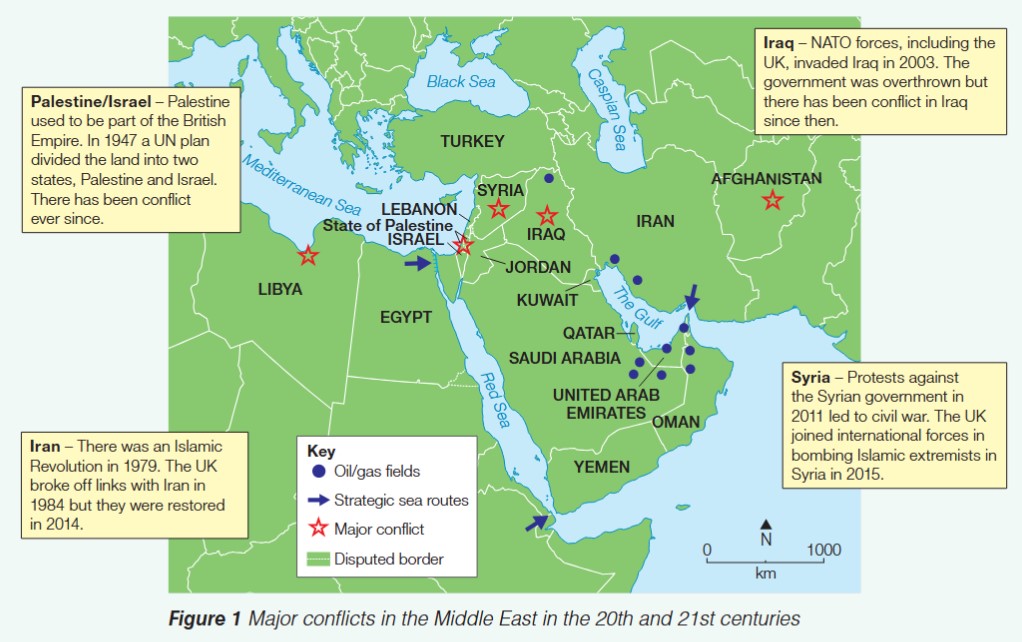
The Palestine-Israel conflict
This long-running dispute has its roots in the British Empire period. In 1947, a United Nations plan divided the former British territory into two states: Palestine and Israel. This partition has never been fully accepted by all parties, and conflict has continued ever since. The disputed status of these territories remains a sensitive diplomatic issue for the UK.
Example
Historical Context: The 1947 Partition
When the UN proposed dividing the British-controlled territory in 1947:
- Palestine was designated for the Arab population
- Israel was established as a Jewish state
- Jerusalem was to be internationally administered
However, this plan led to immediate conflict, and the territorial disputes arising from this partition continue to affect the region over 75 years later.
The Iraq conflict
In 2003, NATO forces, including British military personnel, invaded Iraq. The UK government took the controversial decision to join this military intervention. The overthrow of Saddam Hussein's government led to prolonged instability, and conflict has persisted in Iraq ever since. This involvement has had lasting implications for UK foreign policy and public opinion about military interventions.
Important
The Iraq War's lasting impact
The 2003 Iraq invasion remains one of the most controversial foreign policy decisions in modern British history. The subsequent instability and questions about the justification for war have made the UK government more cautious about military interventions in the Middle East and have significantly influenced public attitudes toward foreign conflicts.
Relations with Iran
Iran experienced an Islamic Revolution in 1979, which brought significant political changes. The UK government broke off diplomatic links with Iran during this period due to political differences and concerns about the new regime. These diplomatic ties were not restored until 2014, demonstrating how political changes in the Middle East can affect UK relations for decades.
Note
The 35-year break in UK-Iran diplomatic relations (1979-2014) illustrates how regime changes can fundamentally alter international relationships. The restoration of ties in 2014 reflected changing priorities and the need for diplomatic engagement, even with ideologically different governments.
The Syrian civil war
Protests against the Syrian government in 2011 escalated into a full civil war. This conflict became increasingly complex, with various groups fighting for control. In 2015, the UK joined an international military coalition conducting air strikes against Islamic extremist groups in Syria. This marked another direct British military involvement in the region.
Strategic features of the Middle East
The Middle East's strategic importance to the UK stems from several key geographic and economic features:
Oil and gas fields
The Middle East contains some of the world's largest oil and gas reserves. These energy resources are vital to the global economy and particularly important to the UK, which imports substantial quantities of these fuels. The location and control of these fields directly influences UK policy decisions.
Note
Energy dependence creates strategic priorities
The concentration of global oil and gas reserves in the Middle East means that any disruption to production or distribution in this region can affect fuel prices worldwide. For the UK, which imports significant amounts of Middle Eastern energy, maintaining access to these resources is a fundamental foreign policy objective.
Strategic sea routes
Important shipping lanes pass through the Middle East, particularly through the Red Sea, the Suez Canal, and the Persian Gulf. These routes are essential for global trade, including British exports and imports. The UK has a strategic interest in ensuring these sea routes remain open and secure.
Important
The Suez Canal alone handles approximately 12% of global trade volume. Any blockage or security threat to this waterway or other Middle Eastern shipping routes would have immediate economic consequences for the UK and the global economy.
Disputed borders
Several territorial disputes exist across the Middle East. These contested boundaries can lead to conflict and instability, which affects trade and security. The UK monitors these disputes as they can impact British interests in the region.
Remember!
Summary
Key Points to Remember:
-
The UK's influence in the Middle East declined after the British Empire ended, but the region remains politically important to Britain due to trade growth and security concerns from Islamic terrorism.
-
Trade is the key driver of UK policy in the Middle East: Britain exports aircraft and weapons while importing essential oil and gas supplies.
-
The UK has been directly involved in several Middle Eastern conflicts, including the 2003 Iraq invasion and 2015 air strikes in Syria against Islamic extremists.
-
Major ongoing conflicts affecting UK interests include the Palestine-Israel dispute (since 1947) and instability in Iraq (since 2003).
-
Strategic features that make the Middle East vital to UK interests include oil and gas fields and important shipping routes through the region.