Birmingham on the Map (OCR GCSE Geography B (Geography for Enquiring Minds)): Revision Notes
📚Revision Notes
Birmingham on the Map
Introduction
Birmingham is a major urban centre located in the West Midlands region of England. As the UK's second most populous city after London, Birmingham plays a crucial role in the nation's economy and society. The city has approximately 1.1 million residents and serves as a key hub for transport, culture and commerce in the Midlands.
Note
Understanding Birmingham's location, development and connections helps us explore the challenges and opportunities facing modern UK cities, particularly in relation to transport infrastructure, cultural diversity and economic regeneration.
Birmingham's changing role
Birmingham's development illustrates how cities evolve over time in response to economic and social changes. The city's origins stretch back over a thousand years when it began as a small Saxon settlement. However, the most dramatic transformation occurred during the Industrial Revolution of the 19th century.
During this period, Birmingham rapidly expanded as manufacturing industries flourished. The city became internationally renowned as "the workshop of the world" due to its dominant position in producing manufactured goods. Factories and industrial premises spread across the urban area, attracting workers from across Britain and beyond.
Important
In recent decades, traditional manufacturing has significantly declined as economic patterns have shifted. Birmingham has responded by reinventing itself as a modern service-based economy.
Today, the city presents itself as a young, vibrant and multi-cultural urban centre. It has developed new strengths in areas such as retail, culture, education and business services, moving away from its industrial heritage whilst maintaining its importance as a major UK city.
Birmingham's location and transport connections
Birmingham occupies a strategically important position in the centre of England, making it highly accessible from all parts of the country. The city sits at the heart of the West Midlands region, surrounded by neighbouring towns including Wolverhampton, Walsall, West Bromwich, Dudley and Solihull.
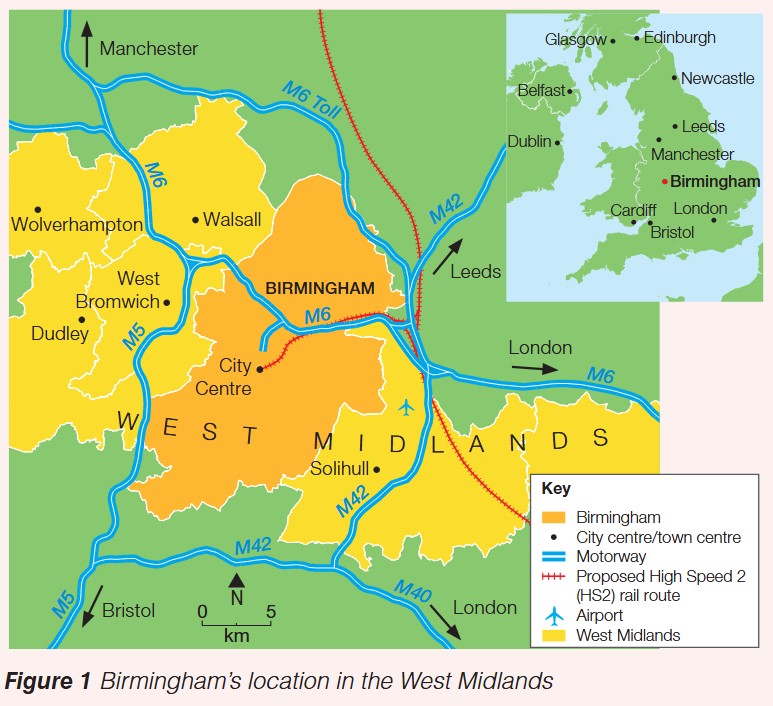
The city benefits from exceptional transport connections that link it to the rest of the UK. An extensive motorway network radiates from Birmingham, with major routes including the M5, M6, M40, M42 and M50 providing fast road access to other cities. These motorways connect Birmingham to London, Manchester, Leeds, Bristol and Wales, reinforcing its role as a central hub.
Important
High Speed 2 (HS2) Railway
Birmingham is set to benefit from the proposed High Speed 2 (HS2) railway line. This major infrastructure project will create a high-speed rail connection between Birmingham and London, significantly reducing journey times and strengthening economic links between the two cities. The HS2 route will also extend northward to Manchester and Leeds, positioning Birmingham at the centre of a national high-speed rail network.
The city also operates an international airport, providing direct connections to destinations across Europe and beyond. This combination of road, rail and air connections makes Birmingham one of the most accessible cities in the UK.
Birmingham's global connections
Birmingham's character as a multi-cultural city reflects its extensive international connections, which have developed over many decades. These global links manifest in various ways, from population diversity to economic relationships.
International migration and communities
The city has attracted successive waves of migration that have shaped its diverse population. From the 1950s onwards, workers arrived from Asia and the West Indies to fill labour shortages in Birmingham's industries. This created established communities that continue to thrive today.
Note
Following the expansion of the European Union in 2004, significant numbers of migrant workers arrived from Eastern European countries, adding further diversity to the city's population.
Birmingham now hosts one of the world's largest Pakistani communities outside Pakistan itself. The city also contains England's largest Irish community, reflecting historical migration patterns between Ireland and industrial British cities.
Educational and economic connections
Birmingham attracts thousands of international students annually, who come to study at the city's universities and colleges. This creates cultural exchange and brings economic benefits while strengthening Birmingham's reputation as an educational centre.
Economic globalisation is evident through Birmingham's business connections:
Example
Cadbury's Global Supply Chain
Cadbury's chocolate production in Birmingham uses cocoa imported from Ghana in West Africa, illustrating how local manufacturing depends on global supply chains. This demonstrates the interconnected nature of modern industry, where raw materials are sourced internationally but processed locally.
Example
Jaguar Land Rover and International Ownership
The Jaguar Land Rover automotive company, which has significant operations in the Birmingham area, is owned by Tata, an Indian multinational corporation. This demonstrates how Birmingham's economy is integrated into global networks of ownership and investment, with local operations managed by international companies.
These international connections have transformed Birmingham from an inward-looking industrial city into an outward-facing global urban centre, bringing both opportunities and challenges for its residents and planners.
Summary
Summary
Key Points to Remember:
-
Birmingham is the UK's second largest city with a population of approximately 1.1 million, located in the West Midlands region of central England.
-
The city transformed from a Saxon village to become "the workshop of the world" during the 19th century Industrial Revolution, though manufacturing has since declined significantly.
-
Birmingham occupies a central location with excellent transport links, including an extensive motorway network (M5, M6, M40, M42, M50) and the planned HS2 high-speed rail connection.
-
The city is highly multi-cultural with diverse communities from Asia, the West Indies, Eastern Europe, Pakistan and Ireland, established through successive waves of migration since the 1950s.
-
Birmingham has reinvented itself as a modern service-based city focused on retail, culture and education, with strong global economic connections including international companies like Tata (Jaguar Land Rover) and global supply chains (Cadbury's cocoa from Ghana).