Come to Birmingham (OCR GCSE Geography B (Geography for Enquiring Minds)): Revision Notes
📚Revision Notes
Come to Birmingham
Birmingham's changing population
Historical population growth
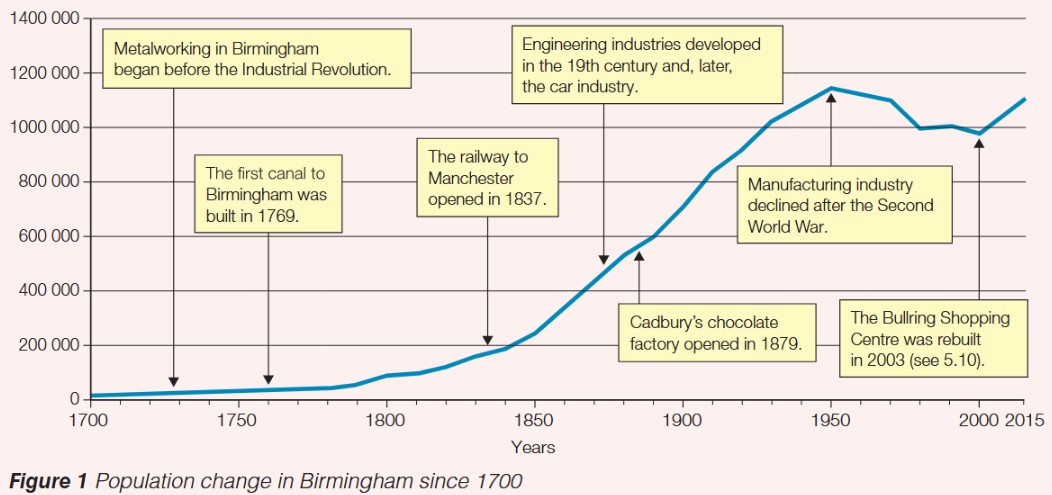
In 1700, Birmingham was a small market town with approximately 10,000 residents. The city experienced rapid population expansion during the 19th and early 20th centuries, driven primarily by rural-urban migration. People moved from the countryside to Birmingham seeking employment opportunities created by the Industrial Revolution.
The city's population reached its peak in 1950, with just over 1.1 million people living there. This dramatic growth transformed Birmingham from a modest market settlement into one of Britain's major industrial cities within just 200 years.
Note
This remarkable transformation – from a small market town to a major industrial city in just 250 years – represents one of the most dramatic urban growth stories in British history. The population increased more than 100-fold during this period.
Key factors driving population growth
Several important developments contributed to Birmingham's rapid expansion:
Pre-Industrial Revolution foundations
- Metalworking industries were established in Birmingham before the Industrial Revolution began
- This early industrial base provided a foundation for future growth
Transport infrastructure developments
- The first canal to Birmingham was constructed in 1769, improving the transport of raw materials and finished goods
- The railway line to Manchester opened in 1837, further enhancing Birmingham's connectivity
Industrial expansion
- Cadbury's chocolate factory opened in 1879, creating hundreds of jobs
- Engineering industries developed throughout the 19th century
- The car industry later emerged, becoming a major employer
Important
The development of transport infrastructure was crucial to Birmingham's growth. The canal system and later the railways allowed Birmingham to efficiently receive raw materials and distribute manufactured goods, making it a competitive industrial centre.
Population decline and recovery
Following the Second World War, Birmingham's manufacturing sector began to decline. This deindustrialization led to job losses and population decrease. People moved away to find employment elsewhere, causing the population to fall from its 1950 peak.
However, recent decades have seen urban regeneration efforts. The Bullring Shopping Centre was rebuilt in 2003, forming part of wider efforts to revitalize Birmingham's city centre and attract new residents and visitors.
Note
The cycle of growth, decline, and regeneration that Birmingham has experienced is typical of many industrial cities. The shift from a manufacturing-based economy to a service-based economy required significant urban renewal and economic restructuring.
Birmingham's population characteristics today
Cultural diversity
Birmingham has become one of the most diverse cities in the United Kingdom. The city's character has changed significantly with the arrival of new cultures, languages, and businesses. This diversity has enriched Birmingham's cultural life, with varied shops, restaurants, and community facilities reflecting different ethnic backgrounds.
Age structure
Birmingham has a notably younger population compared to the national average for England. The city contains a higher proportion of people under 40 years old, and fewer people over 40, than the England average.
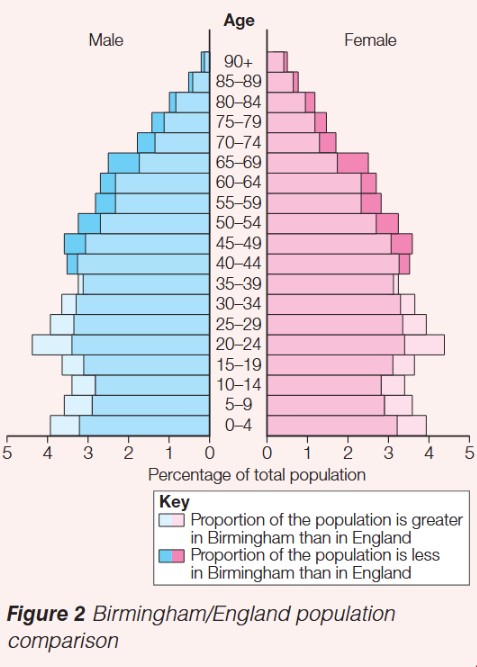
This younger age structure has several implications:
- Greater demand for schools and youth services
- A larger working-age population
- Different housing needs compared to areas with older populations
- More dynamic and changing social and economic environment
Important
Birmingham's younger age profile distinguishes it from many other UK cities and has significant implications for service provision, economic development, and future planning. Understanding this demographic characteristic is essential for effective urban management.
What this means for Birmingham
The combination of youth and diversity creates both opportunities and challenges for the city:
Opportunities:
- Younger workforce to support economic growth
- Cultural richness and innovation from diverse communities
- Potential for regeneration and development
Challenges:
- Need for adequate educational facilities
- Providing employment for a large working-age population
- Managing cultural integration
- Ensuring housing supply meets demand
Note
Successfully managing these opportunities and challenges will determine Birmingham's future prosperity. The city's young, diverse population is a valuable asset, but requires careful planning and investment in infrastructure, services, and community cohesion initiatives.
Summary
Key Points to Remember:
- Birmingham grew from 10,000 people in 1700 to over 1.1 million by 1950, driven by the Industrial Revolution and rural-urban migration.
- Key developments included canals (1769), railways (1837), Cadbury's factory (1879), and engineering/car industries.
- Population declined after WWII due to manufacturing industry decline, but recent regeneration (like the 2003 Bullring rebuild) has helped recovery.
- Modern Birmingham is one of the UK's most diverse cities with a younger population than the England average – more people under 40 and fewer over 40.
- The city's young, diverse population creates both opportunities (dynamic workforce, cultural richness) and challenges (need for schools, jobs, housing, and integration support).