Congested Istanbul (OCR GCSE Geography B (Geography for Enquiring Minds)): Revision Notes
📚Revision Notes
Congested Istanbul
Why Istanbul faces congestion problems
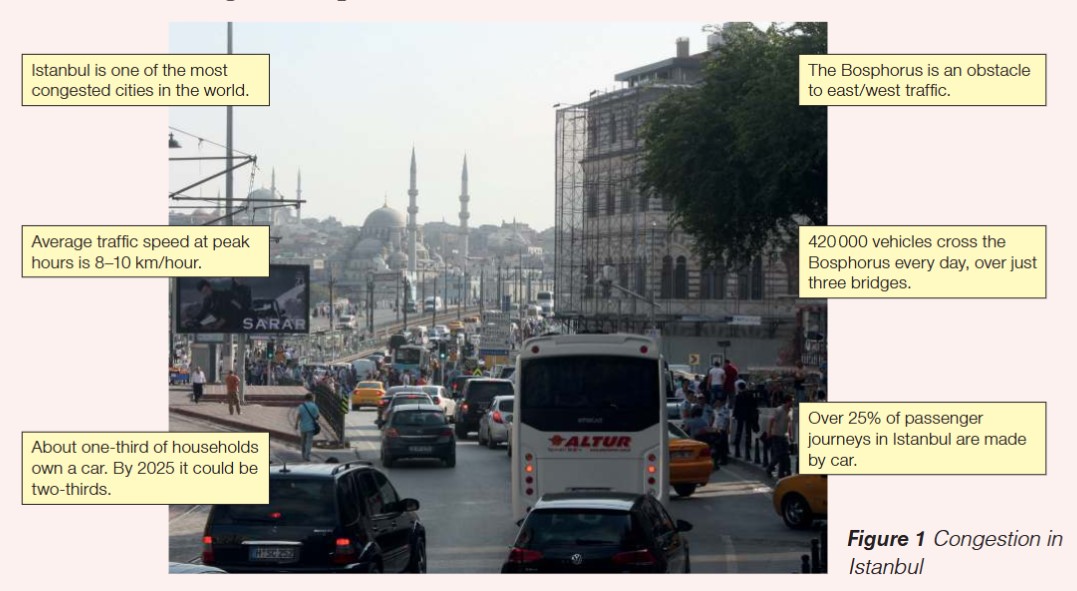
Istanbul experiences severe traffic congestion, making it one of the world's most gridlocked cities. The congestion is caused by several interconnected factors that have created a major urban transport challenge.
Note
Istanbul's congestion problem is not caused by a single factor, but rather by a combination of geographical constraints, rapid car ownership growth, and insufficient transport integration working together to create severe gridlock.
Traffic statistics
The scale of Istanbul's congestion problem becomes clear when examining traffic data. During peak hours, average traffic speeds drop to just 8-10 kilometres per hour, which is slower than the pace of a bicycle. This extreme slowness affects productivity, air quality, and quality of life for Istanbul's residents.
Important
Peak-hour traffic speeds of 8-10 km/h represent one of the world's worst congestion rates. At these speeds, a car journey becomes slower than cycling, highlighting the severity of Istanbul's transport crisis.
The Bosphorus barrier
A key geographical factor contributing to congestion is the Bosphorus strait, which creates a natural obstacle to east-west traffic movement. The strait divides the European and Asian sides of Istanbul, forcing traffic to concentrate on just three bridges. Every day, approximately 420,000 vehicles must cross these bridges, creating bottlenecks and severe congestion points.
Note
The Bosphorus acts as a physical barrier that cannot be removed. This geographical constraint means that any solution to Istanbul's congestion must either provide alternative crossing points or reduce the number of vehicles needing to cross.
Rising car ownership
Car ownership in Istanbul is increasing rapidly. Currently, about one-third of households own a car. However, projections suggest that by 2024, this figure could rise to two-thirds of households. This means the number of vehicles on Istanbul's roads could potentially double within a few years, significantly worsening congestion unless alternative solutions are implemented.
Important
The Doubling Effect
If car ownership rises from one-third to two-thirds of households as projected, Istanbul could face a near-doubling of vehicle numbers. Without intervention, this would transform severe congestion into complete gridlock.
Despite these high car ownership rates, cars account for over 26% of all passenger journeys in Istanbul. This demonstrates the city's heavy reliance on private vehicles for transport.
Developing an integrated transport solution
Existing transport alternatives
Istanbul already has various alternative transport modes available to residents, including:
- Taxis and minibuses
- Buses and trams
- Trains
- Ferries
- Bicycles
However, the critical problem is that these different transport modes do not always connect effectively with each other. Poor integration between services makes it difficult for passengers to switch between different transport types, reducing the attractiveness of public transport options.
Note
The Integration Gap
Having multiple transport options is not enough if they don't work together. When passengers struggle to transfer between buses, trains, and ferries, they often choose the convenience of private cars instead, worsening congestion.
The integrated transport system concept
An integrated transport system provides a sustainable solution to congestion by ensuring all forms of transport link together efficiently. This approach allows passengers to move seamlessly between different transport modes, making public transport more convenient and competitive with private cars.
When transport systems are properly integrated, passengers can plan multi-modal journeys more easily, reduce journey times, and avoid the need for private vehicles.
The Marmararay Rail Project
Project overview
The Marmararay rail line represents a significant example of integrated transport planning. Opened in 2013, this major infrastructure project addresses Istanbul's congestion problem directly.
Key features
The Marmararay project connects both sides of Istanbul through a rail tunnel constructed beneath the Bosphorus strait. This underwater tunnel eliminates the need for vehicles to cross the congested bridges, providing a fast, reliable alternative for commuters.
Note
By creating a rail link under the Bosphorus, Marmararay bypasses the bottleneck created by the three bridges entirely. This represents a direct solution to the geographical barrier problem.
By linking the European and Asian sides of the city through rail, the project removes the geographical barrier that previously forced all traffic onto the bridges.
Expected impact
Transport planners expect the Marmararay Rail Project to significantly shift passenger behaviour. Current estimates suggest the proportion of passengers using rail transport will increase from just 5% to 30%. This six-fold increase would remove substantial numbers of vehicles from the roads, particularly from the critical Bosphorus crossing points.
Example
Projected Modal Shift Impact
Before Marmararay:
- Rail passengers: 5% of journeys
- Most Bosphorus crossings by road
After Marmararay:
- Rail passengers: 30% of journeys (six-fold increase)
- Reduced pressure on the three bridges
- Fewer vehicles contributing to congestion
Role in the integrated system
The Marmararay Rail Project functions as part of a broader integrated transport system strategy. By improving rail connections across the Bosphorus, it makes public transport a more viable alternative to cars and encourages modal shift away from private vehicles.
Exam guidance
Important
Exam Strategy for Istanbul Case Study
When answering questions about congestion in Istanbul, remember to:
- Describe congestion using specific statistics (e.g., peak speeds of 8-10 km/h, 420,000 daily vehicle crossings)
- Explain geographical factors, particularly the Bosphorus as a barrier to traffic flow
- Assess how the Marmararay Rail Project addresses congestion through integration
- Use the case study to demonstrate understanding of sustainable urban transport solutions
- Link the case study to broader themes of urban sustainability and management
Remember!
Summary
Key Points to Remember:
-
Istanbul suffers severe congestion: Peak-hour traffic speeds drop to just 8-10 km/h, making it one of the world's most congested cities
-
The Bosphorus creates a bottleneck: Only three bridges serve 420,000 daily vehicles crossing between Europe and Asia
-
Car ownership is rising rapidly: Household car ownership could increase from one-third to two-thirds by 2024, potentially doubling vehicle numbers
-
Integration is key: An integrated transport system links different transport modes together, making public transport more attractive than private cars
-
Marmararay Rail Project provides a solution: The 2013 rail tunnel under the Bosphorus aims to increase rail passenger numbers from 5% to 30%, significantly reducing road congestion