Expanding Istanbul (OCR GCSE Geography B (Geography for Enquiring Minds)): Revision Notes
📚Revision Notes
Expanding Istanbul
Overview of Istanbul's growth
Istanbul is one of the world's major cities and has experienced dramatic population growth over the past 70 years. Understanding how and why Istanbul has expanded provides important insights into the challenges and opportunities facing modern cities, particularly in rapidly developing regions.
Note
The study of Istanbul's expansion offers valuable lessons about urbanization patterns in rapidly developing regions, particularly regarding the interplay between migration, geography, and urban planning.
Istanbul's population growth
Historical population trends
Istanbul's population has grown dramatically since the mid-20th century. In 1950, the city had a population of approximately one million people. By 2015, this figure had increased to around 15 million, representing a fifteen-fold increase over 65 years. Projections suggest the population will reach 20 million by 2025.
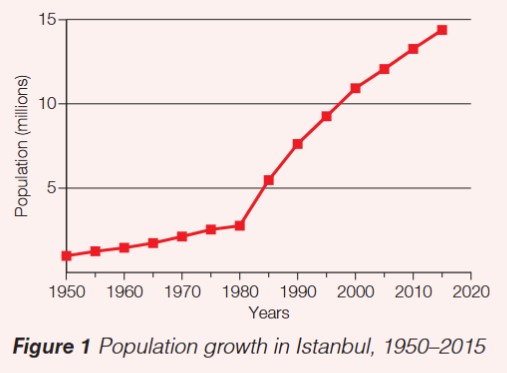
The population growth was relatively slow between 1950 and 1980, remaining below 3 million. However, from 1980 onwards, the city experienced rapid exponential growth, with the steepest increases occurring after 1990.
Important
The transition from slow to exponential growth after 1980 represents a critical turning point in Istanbul's development. This rapid expansion created significant challenges for urban planning, infrastructure, and service provision that the city continues to address today.
Drivers of population growth
National migration is the primary driver of Istanbul's population increase. People have moved to Istanbul from other regions of Turkey in search of employment opportunities and better living standards. This internal migration has been the most significant factor in the city's expansion.
Interestingly, only 29% of Istanbul's current population was actually born within the city itself. This statistic highlights the importance of internal migration in shaping Istanbul's demographic profile.
Note
The fact that over 70% of Istanbul's residents were born elsewhere in Turkey demonstrates the city's role as an economic magnet, drawing people from rural and less developed regions seeking better opportunities.
Tourism and international visitors
While international migration to Istanbul remains relatively limited, the city has become an increasingly important tourist destination. Turkey now ranks among the world's most popular tourism destinations, and Istanbul is the Turkish city that attracts the most international visitors. This growing tourism sector adds to the city's economic importance and contributes to its development.
The city's spatial expansion
Geographical location and constraints
Istanbul occupies a unique geographical position, divided between two continents. The city straddles Europe and Asia, with the Bosphorus Strait forming a natural boundary between the two sides. This strategic location has shaped the city's growth pattern.
The city's expansion is significantly constrained by its topography. Inland areas consist of steep hills covered by forest, which limits the space available for urban development. These geographical barriers have prevented the city from expanding far inland.
Important
Topographical Constraints on Urban Growth
Istanbul's inland areas present significant barriers to expansion:
- Steep hills make construction difficult and expensive
- Forest coverage limits available buildable land
- These natural barriers have forced the city to develop alternative expansion patterns
Understanding these physical constraints is essential for explaining why Istanbul has grown in its distinctive elongated pattern rather than in a more typical circular urban sprawl.
Pattern of urban spread
As a result of these topographical constraints, Istanbul has expanded primarily along its coastlines. The city now stretches approximately 100 kilometres from west to east along the coast. The urban area has spread along both the Bosphorus Strait and the Sea of Marmara.
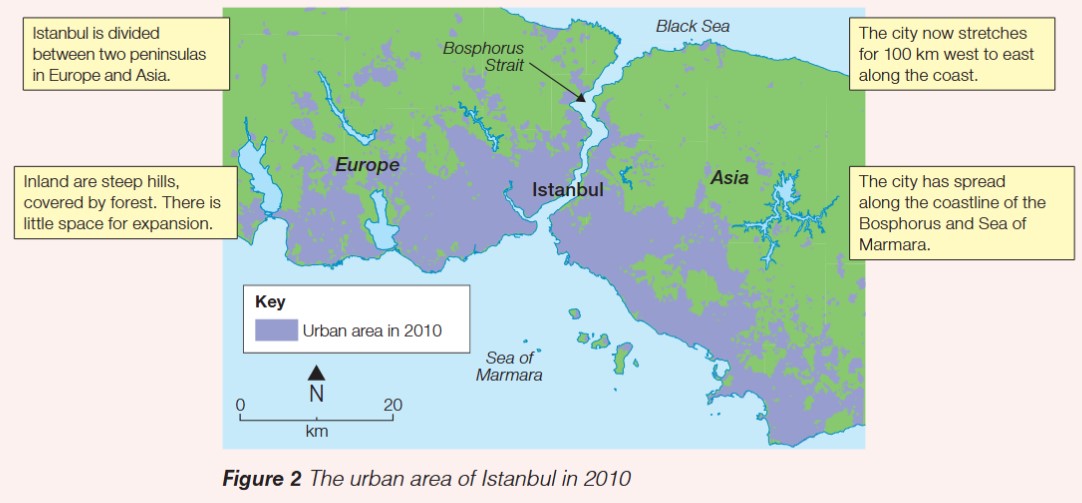
By 2010, the built-up area of Istanbul formed a distinctive pattern, following the waterways rather than spreading uniformly in all directions. This coastal expansion has created an elongated urban form, with development concentrated along accessible flat land near the water.
Note
The coastal expansion pattern creates both opportunities and challenges. While waterfront access provides economic benefits and attractive living environments, it also puts pressure on marine ecosystems and creates transportation challenges due to the elongated city shape.
Exam guidance
Important
How to Approach Istanbul Exam Questions
When answering questions about Istanbul's expansion, use different techniques depending on the command word:
For 'describe' questions: Focus on observable features such as population figures, growth rates, and spatial patterns shown on maps. Use evidence from graphs and maps, including specific data points and scale information.
For 'explain' questions: Identify causes and reasons. Link national migration to job opportunities, connect topographical constraints to expansion patterns, and explain why the city has grown into its current shape.
For case study questions: Be prepared to provide specific facts and figures (e.g., 1 million in 1950, 15 million in 2015, only 29% born in city) and named geographical features (Bosphorus Strait, Sea of Marmara).
Remember!
Summary
Key Points to Remember:
- Istanbul's population grew from 1 million (1950) to 15 million (2015), with projections of 20 million by 2025
- National migration is the main driver of growth – only 29% of residents were born in Istanbul
- The city is uniquely positioned between Europe and Asia, divided by the Bosphorus Strait
- Steep forested hills inland force the city to expand along coastlines instead
- The urban area now stretches 100 km west to east along the Bosphorus and Sea of Marmara
Key Terms:
- National migration: Movement of people from other parts of Turkey to Istanbul seeking jobs and opportunities
- Bosphorus Strait: The waterway dividing Istanbul between Europe and Asia
- Sea of Marmara: The body of water along which southern Istanbul has expanded
Critical Concepts:
- Topographical constraints limiting urban expansion
- Coastal expansion pattern due to inland barriers
- Exponential population growth driven by internal migration rather than natural increase