Explore Birmingham (OCR GCSE Geography B (Geography for Enquiring Minds)): Revision Notes
📚Revision Notes
Explore Birmingham
Introduction to Birmingham city centre regeneration
Birmingham, the UK's second-largest city, has undergone significant transformation in its city centre over recent decades. Like many British cities, Birmingham faced challenges from urban decline in the late 20th century. The city has responded through major regeneration projects aimed at revitalising the urban core, improving quality of life for residents, and enhancing Birmingham's image as a modern, vibrant city. These projects demonstrate how strategic urban planning and investment can breathe new life into declining urban areas.
The regeneration of Birmingham city centre focuses on several key areas: retail and commercial development, cultural facilities, transport infrastructure, and public spaces. Each project contributes to the broader goal of creating a more attractive, accessible, and economically successful city centre.
Note
Birmingham's regeneration serves as an excellent case study for understanding how cities can transform themselves from post-industrial decline into modern, thriving urban centres through strategic planning and investment.
The Bullring Shopping Centre
Historical development
The Bullring area has been central to Birmingham's commercial life for centuries, originally functioning as the city's traditional market place. However, by the mid-20th century, this historic character was dramatically altered. During the 1960s, urban planners redeveloped the site into a large concrete shopping centre, surrounded by an urban ring road. This modernist approach, typical of 1960s planning, prioritised car access but created a physical barrier that isolated the shopping centre from the surrounding city.
By the 1990s, the Bullring had become run-down and severely congested with traffic. The once-busy shopping area struggled to attract visitors, and the urban ring road made access difficult for pedestrians. The site had reached a point where demolition and complete redevelopment became the preferred option.
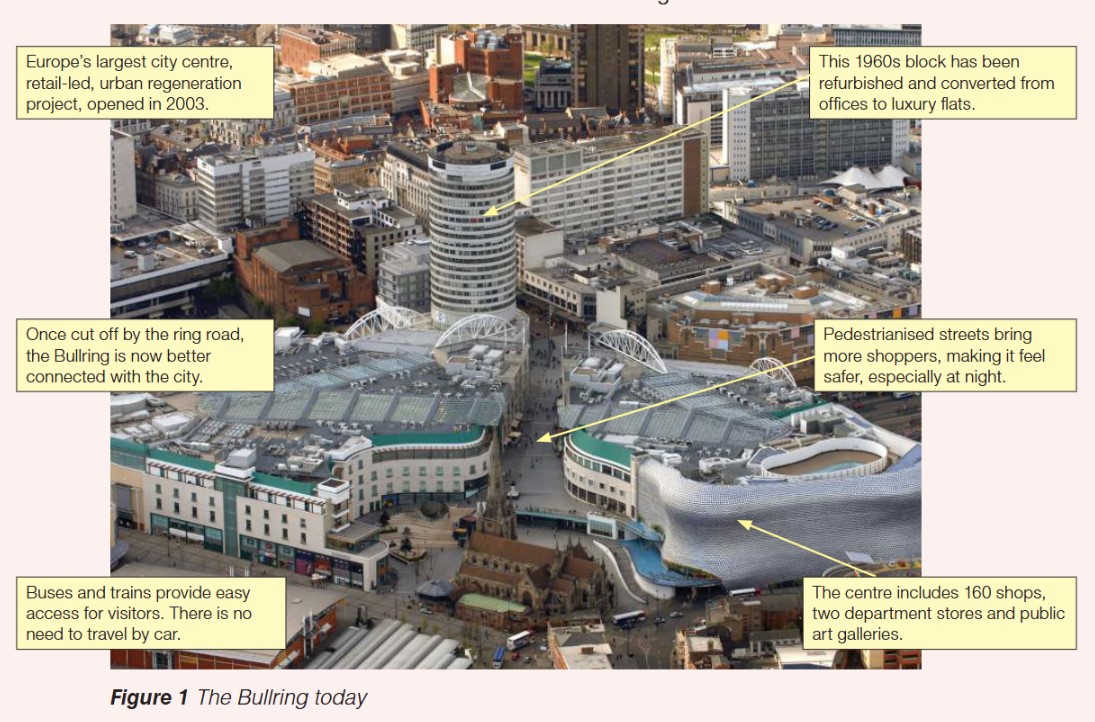
The 2003 regeneration
Birmingham City Council took the bold decision to demolish the old Bullring and regenerate the entire site. The redevelopment, completed in 2003, created what became Europe's largest city centre, retail-led urban regeneration project. This ambitious scheme transformed the area into a modern, attractive shopping destination that has become a symbol of Birmingham's revival.
Important
The Bullring regeneration demonstrates how outdated 1960s developments that created barriers and congestion can be completely transformed through bold redevelopment decisions and comprehensive planning.
Key features of the modern Bullring
The regenerated Bullring includes several important improvements:
Retail facilities: The centre contains 160 shops, two major department stores, and public art galleries, creating a diverse and attractive shopping environment.
Improved connectivity: The urban ring road that once isolated the Bullring has been cut through, allowing better connection with the rest of the city centre. This makes it easier for shoppers to move between the Bullring and other parts of Birmingham.
Pedestrianisation: Streets have been pedestrianised throughout the development, making the area feel safer and more pleasant, particularly during evening hours. Pedestrians no longer have to compete with heavy traffic, creating a more relaxed shopping environment.
Public transport access: Buses and trains provide easy access for visitors, eliminating the need to travel by car. This sustainable transport approach reduces congestion and makes the centre accessible to everyone.
Quality architecture: The development includes distinctive modern buildings, including a renovated 1960s block that has been converted from offices to luxury flats, demonstrating how older structures can be successfully repurposed.
Note
The removal of the urban ring road was a crucial decision that reconnected the Bullring to the wider city centre. This demonstrates how transport infrastructure designed for cars in the 1960s had actually become a barrier to pedestrian movement and urban connectivity by the 1990s.
Other city centre regeneration projects
Brindleyplace
Brindleyplace represents another major regeneration scheme in Birmingham city centre. This development focuses on an area around the city's old canal network, transforming formerly industrial waterfront land into a mixed-use development. The area includes the National Indoor Arena, which hosts major sporting and entertainment events, and the International Convention Centre, which attracts business conferences and exhibitions from across the world. These facilities have enhanced Birmingham's reputation as a destination for events and tourism.
Library of Birmingham
Opened in 2013, the Library of Birmingham is the largest public library in the United Kingdom. This striking modern building serves multiple purposes in the regeneration of Birmingham. Beyond its function as a library, the building acts as a cultural landmark that has helped change the city's image, demonstrating Birmingham's commitment to education, culture, and public services. The library attracts visitors from across the region and has become an architectural icon for the city.
Note
The Library of Birmingham represents a shift towards cultural regeneration, showing how public buildings can serve both functional and symbolic purposes in transforming a city's image and attracting visitors.
High Speed 2 (HS2)
Looking to the future, Birmingham is preparing for the arrival of High Speed 2, a new high-speed railway connecting London to Birmingham, scheduled to open in 2026. The new Curzon Street Station will serve as the Birmingham terminus for this line. The station and surrounding area will become a focus for further regeneration, potentially bringing new investment, jobs, and development to the eastern part of the city centre. HS2 will significantly reduce journey times between London and Birmingham, strengthening economic links between the two cities.
Benefits and impacts of regeneration
The regeneration projects in Birmingham have delivered multiple benefits:
Enhanced shopping experience: The new Bullring provides a modern, attractive retail environment with a wide variety of shops and facilities. The quality of the shopping experience has improved dramatically compared to the run-down 1990s centre.
Improved access to the city centre: Better public transport links, pedestrianised streets, and the removal of barriers like the ring road have made the city centre much more accessible. Visitors can reach Birmingham by bus or train without needing a car.
Better quality of life: Residents and visitors benefit from improved public spaces, cultural facilities like the Library of Birmingham, and safer, more pleasant pedestrianised areas. The regeneration has created spaces where people want to spend time.
Enhanced safety: Pedestrianised streets and improved lighting make the city centre feel safer, especially during evening hours. The removal of traffic from key areas has eliminated conflicts between pedestrians and vehicles.
Improved city image: Modern developments like the Library of Birmingham and the regenerated Bullring have transformed perceptions of Birmingham, helping to attract investment, tourists, and new residents to the city.
Note
These benefits are interconnected - improved transport access supports the shopping experience, better public spaces enhance quality of life, and all these factors contribute to an improved city image that attracts further investment.
Exam guidance
Important
When answering questions about urban regeneration projects like Birmingham, the command word determines your approach:
-
Describe questions require you to identify features and characteristics. For Birmingham, you could describe the transformation from a run-down 1960s shopping centre to a modern retail destination.
-
Explain questions need you to give reasons why changes occurred or what their effects were. Consider explaining why the Bullring needed regeneration (decline, traffic congestion) and how regeneration addressed these problems.
-
Assess or evaluate questions require balanced judgements. You could assess whether the benefits of regeneration (improved shopping, access, safety) outweigh any negative impacts (costs, disruption during construction, potential displacement of local businesses).
Always use specific details from the Birmingham case study, such as the 2003 opening date, the 160 shops in the Bullring, or the Library of Birmingham being the UK's largest public library.
Example
Worked Example: Answering an 'Explain' Question
Question: Explain how the regeneration of the Bullring has improved access to Birmingham city centre. (4 marks)
Answer approach:
Step 1: Identify the access improvements made during regeneration
- The urban ring road was cut through, removing a physical barrier
- Streets were pedestrianised throughout the development
- Public transport links (buses and trains) were improved
Step 2: Explain how each improvement enhances access
- Cutting through the ring road improved connectivity between the Bullring and the rest of the city centre, making it easier for shoppers to move around (1 mark)
- Pedestrianisation made the area safer and more pleasant for people on foot, encouraging walking rather than driving (1 mark)
- Improved public transport eliminated the need for car access, making the centre accessible to people without cars and reducing congestion (1 mark)
- These changes created a more welcoming and accessible environment that attracts more visitors to the city centre (1 mark)
Remember!
Summary
Key Points to Remember:
-
Birmingham's Bullring was regenerated from a run-down 1960s shopping centre into Europe's largest retail-led urban regeneration project, opening in 2003
-
The regeneration removed barriers like the urban ring road and pedestrianised streets, improving connectivity and safety
-
Other major projects include Brindleyplace (canals, National Indoor Arena, Convention Centre), Library of Birmingham (2013, UK's largest), and preparation for HS2 (opening 2026)
-
Benefits include improved shopping facilities (160 shops), better access via public transport, enhanced quality of life, and improved city image
-
The projects demonstrate how strategic regeneration can transform declining urban areas into vibrant, successful city centres
Key Terms:
-
Regeneration: The process of improving and redeveloping run-down urban areas
-
Urban ring road: A major road circling the city centre, which can create barriers between areas
-
Pedestrianisation: Converting streets from vehicle use to pedestrian-only use
-
Retail-led regeneration: Urban regeneration focused on shopping and commercial development
-
Quality of life: The overall wellbeing and living conditions experienced by people in an area
Critical Processes and Frameworks:
-
Urban regeneration follows stages: decline → decision to regenerate → demolition → redevelopment → ongoing management
-
Successful regeneration requires addressing multiple factors: retail, transport, public spaces, culture, and connectivity
-
Partnership between local councils and private developers is essential for large-scale regeneration projects
-
Regeneration aims to create sustainable urban environments that balance economic, social, and environmental needs