Explore Istanbul (OCR GCSE Geography B (Geography for Enquiring Minds)): Revision Notes
📚Revision Notes
Explore Istanbul
Learning objectives
You need to understand:
- What has happened to the historic core of Istanbul
- Where people and business have relocated
- How ways of life in the city are changing
Key question: What are the challenges and opportunities for cities today?
Changes in Istanbul
Istanbul has expanded beyond its traditional city centre over recent decades. The old city centre remains the cultural and historical centre of Istanbul, attracting large numbers of tourists. It is a vibrant mix of diverse activities including traditional markets and mosques, ferry services and fishermen, and tourist facilities such as trams.
Note
The historic core's transformation reflects a common pattern in many major cities worldwide, where traditional centres adapt to modern pressures while preserving their cultural significance.
However, as the old city has experienced increased traffic and overcrowding, residents and businesses have relocated. Residents have moved to outer residential areas. Business activity has shifted to new high-rise commercial centres in other parts of Istanbul, transforming the city's economic geography.
Important
The process of suburbanization - where people and businesses move from the city centre to suburban areas - is a key characteristic of Istanbul's urban development.
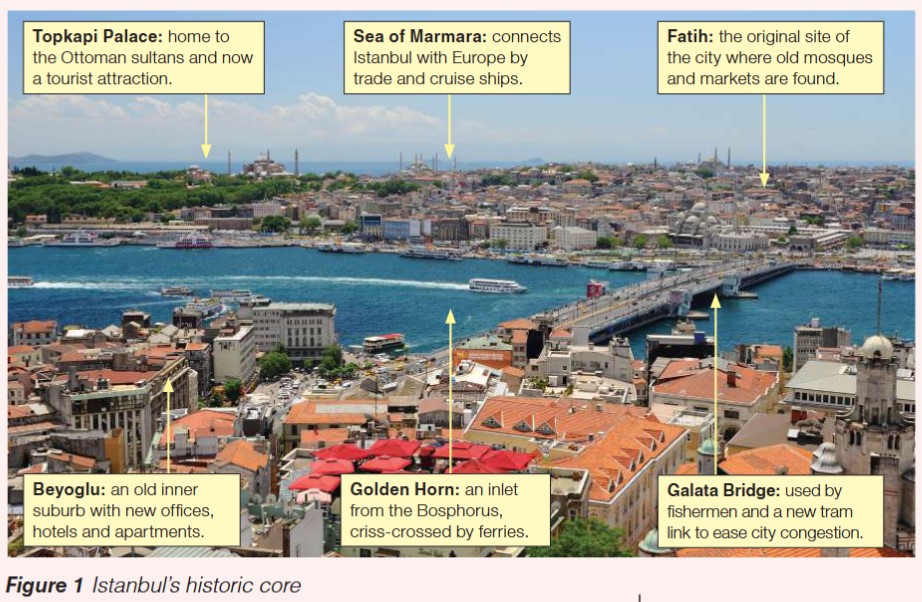
Istanbul's historic core
The historic core of Istanbul contains several important districts and landmarks that define the city's character and history.
Key districts:
Fatih represents the original site of the city where traditional old mosques and markets are located. This area preserves the city's Ottoman heritage.
Beyoglu is a historic inner suburb that has undergone transformation, now containing new offices, hotels and apartments. It demonstrates how older areas can be regenerated for modern use.
Important landmarks and features:
Topkapi Palace was the residence of the Ottoman sultans and has been converted into a major tourist attraction, drawing visitors from around the world.
Sea of Marmara provides Istanbul with vital connections to Europe through trade routes and cruise ship operations, supporting the city's economy.
Golden Horn is an inlet from the Bosphorus waterway that is criss-crossed by ferry services, providing important transport links across the city.
Galata Bridge serves multiple functions - it is used by local fishermen and now features a new tram link designed to reduce city congestion by providing public transport alternatives.
Population trends in Istanbul (1985-2012)
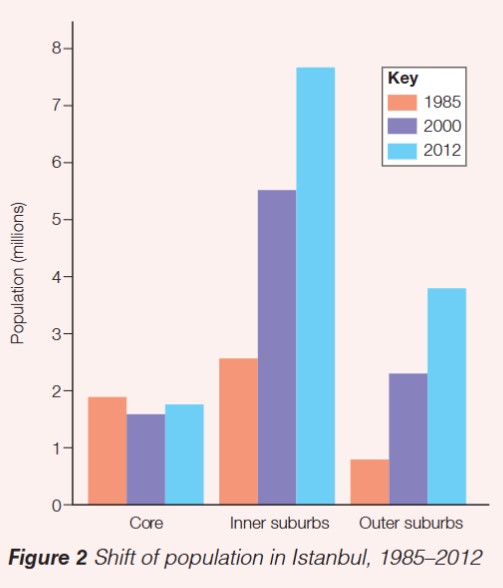
Istanbul has experienced dramatic population shifts between different parts of the city over a 27-year period. The data reveals clear patterns of suburbanization.
Important
Critical Population Data:
- Core: 1985: ~1.9m → 2000: ~1.6m → 2012: ~1.7m (relatively stable/slight decline)
- Inner suburbs: 1985: ~2.5m → 2000: ~5.5m → 2012: ~7.6m (more than tripled)
- Outer suburbs: 1985: ~0.8m → 2000: ~2.3m → 2012: ~3.8m (significant growth)
The core: The historic centre has seen relatively stable population numbers, with approximately 1.9 million people in 1985, declining slightly to 1.6 million in 2000, then recovering slightly to 1.7 million by 2012. This stability or slight decline indicates people leaving the congested centre.
Inner suburbs: This zone has experienced the most dramatic growth, with population increasing from approximately 2.5 million in 1985 to 5.5 million in 2000, and reaching 7.6 million by 2012. This represents more than a threefold increase over the period, making the inner suburbs the most populous part of Istanbul.
Outer suburbs: These areas have also grown significantly, from 0.8 million people in 1985 to 2.3 million in 2000, and 3.8 million by 2012. This demonstrates continued urban expansion into peripheral areas.
Explaining the trends
These population shifts demonstrate classic suburbanization, where residents relocate from the congested historic centre to newer residential developments in suburban areas. The inner suburbs have become the primary residential zone for Istanbul's population, while the outer suburbs continue to expand as the city grows. Business activity has followed this pattern, with new high-rise commercial centres developing away from the historic core.
Note
The pattern of population movement from core to suburbs is driven by several factors including congestion, desire for more space, and better living conditions in newer developments. However, the historic core retains its importance as a cultural and tourist centre.
Remember!
Summary
Key Points to Remember:
- Istanbul has experienced outward urban growth, with the historic core remaining as the cultural and tourist centre
- Population has shifted dramatically to the suburbs, with inner suburbs more than tripling between 1985 and 2012
- The core population has remained relatively stable or declined slightly, indicating people moving out due to congestion
- Business has relocated to new high-rise commercial centres in other parts of the city
- Key areas include Fatih (original city site), Beyoglu (regenerated inner suburb), Topkapi Palace (tourist attraction), Golden Horn (transport inlet), and Galata Bridge (fishermen and tram link)