Super Sized Cities (OCR GCSE Geography B (Geography for Enquiring Minds)): Revision Notes
📚Revision Notes
Super Sized Cities
Understanding megacities and world cities
A megacity is defined as any city with a population exceeding 10 million people. The number of megacities has grown dramatically since 1950, and most are now located in Asia.
A world city is defined by its economic importance rather than population size. World cities are the most significant centres in the global economy, serving as major hubs for international trade and global communications networks. They host headquarters of multinational corporations, major financial institutions, and international organisations.
Important
Critical Distinction
Not all megacities are world cities, and not all world cities are megacities. For example, London and New York are the two most important world cities globally, yet London does not have a population of 10 million and therefore is not classified as a megacity. This distinction shows that economic influence and population size are separate characteristics.
Factors driving megacity growth
Several key factors explain why cities grow into megacities:
Natural population increase occurs when the birth rate exceeds the death rate within a city. Urban areas often have young populations with high birth rates, and better healthcare access than rural areas leads to lower death rates. This creates natural population growth that expands the city's population.
Note
Cities typically have younger demographic structures, which contributes to higher birth rates. Combined with improved medical facilities and sanitation compared to rural areas, this creates sustained population growth even without migration.
Migration is a major driver of megacity growth. This includes both rural-urban migration, where people move from countryside to cities seeking better opportunities, and international migration, where people move between countries. Cities attract migrants because they offer employment, education, healthcare, and other services unavailable in rural areas.
Coastal location gives cities advantages for growth. Coastal cities have access to ports, which facilitates international trade and attracts businesses. This creates employment opportunities and economic growth, drawing more people to the city. Many of the world's largest megacities are located on coasts.
Note
Coastal locations have historically been advantageous for trade-based economies. Access to shipping routes allows cities to become major import/export centres, creating jobs in logistics, manufacturing, and services. This economic activity then attracts more residents, reinforcing the city's growth.
Economic development creates opportunities that attract people to cities. Cities offer diverse employment in manufacturing, services, and technology sectors. They also provide better wages than rural areas, drawing workers seeking to improve their living standards. As cities grow economically, they attract more businesses and workers, creating a cycle of growth.
The global distribution of megacities
The number and distribution of megacities has changed dramatically over the past 70 years, showing a clear shift in global urbanisation patterns.
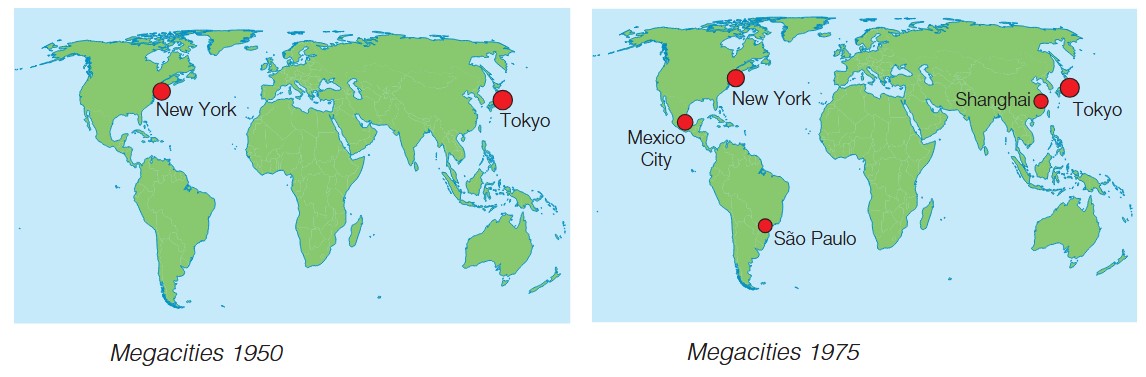
In 1950, there were only two megacities globally: New York in North America and Tokyo in Asia. This reflected the concentration of economic power in developed countries following World War II.
By 1975, the number of megacities had doubled to four. Mexico City and São Paulo joined the list, marking the beginning of rapid urbanisation in Latin America. This showed that megacity growth was spreading beyond developed regions.
Note
The expansion from 2 to 4 megacities between 1950 and 1975 represented a 100% increase over 25 years. However, the growth rate would accelerate even more dramatically in the following decades, particularly in Asia.
By 2015, the number of megacities had increased significantly, with the clear majority located in Asia. The map below shows this dramatic change in global distribution.
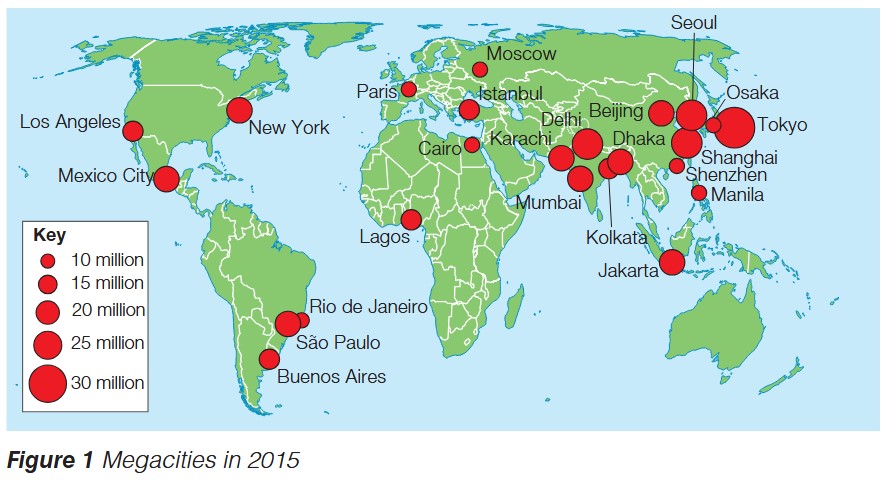
The 2015 distribution reveals several important patterns. Asia dominates, containing cities such as Tokyo, Delhi, Shanghai, Beijing, Mumbai, Dhaka, Karachi, Manila, and Osaka. Africa has emerging megacities including Lagos and Cairo. Latin America has several megacities such as Mexico City, São Paulo, Rio de Janeiro, and Buenos Aires. Europe has fewer megacities, with cities like Paris, Moscow, and Istanbul. North America has Los Angeles and New York.
Key examples and patterns
Tokyo stands out as the world's largest megacity, being the only city with a population exceeding 30 million people. Its massive size reflects Japan's concentration of economic activity and population in its capital region.
Important
World Cities vs Megacities: A Key Example
London and New York are recognised as the top two world cities globally. They are centres of international finance, business, culture, and political influence. However, London's population is below 10 million, demonstrating that world city status depends on economic and political importance rather than population size alone. This is a crucial distinction for understanding urban hierarchies.
The concentration of megacities in Asia reflects several factors. Many Asian countries have experienced rapid economic development and industrialisation, creating employment opportunities in cities. High population growth rates in countries like India and China mean cities grow through both natural increase and migration. Coastal locations of many Asian megacities, such as Shanghai, Mumbai, and Manila, have facilitated trade and economic growth.
Exam guidance
When answering questions about megacities and world cities, remember to:
- Define terms clearly: Always state that megacities have populations over 10 million, and that world cities are important economically, not just by size
- Use specific examples: Reference named cities like Tokyo, London, or Delhi to support your points
- Explain patterns: Don't just describe where megacities are located; explain why they are concentrated in particular regions
- Compare time periods: Show understanding of how urbanisation patterns have changed from 1950 to 2015
- Distinguish between the terms: Make clear that megacity and world city are different concepts with different criteria
Summary
Key Points to Remember:
- A megacity has a population over 10 million people; a world city is economically important as a hub for international trade and communications
- Four main factors drive megacity growth: natural population increase, migration, coastal location, and economic development
- The number of megacities has grown from just 2 in 1950 (New York and Tokyo) to many more by 2015
- Most megacities are now located in Asia, reflecting rapid urbanisation and economic development in that region
- Tokyo is the only megacity with over 30 million people
- London and New York are the top world cities, but London is not a megacity, showing that economic importance and population size are different measures