The Future of Cities (OCR GCSE Geography B (Geography for Enquiring Minds)): Revision Notes
📚Revision Notes
The Future of Cities
Global urbanisation trends
By 2050, urbanisation will reach unprecedented levels globally. Current projections indicate that 70% of the world's population will live in cities by this date. This represents a significant shift in how human populations are distributed across the planet. Urbanisation continues at a rapid pace with no indication of slowing down, particularly in developing and emerging economies.
Note
This level of urbanisation represents one of the most significant demographic transitions in human history. Understanding urban trends is essential for planning sustainable, liveable cities that can accommodate billions of additional urban residents.
The movement of people from rural to urban areas is driven by the opportunities that cities offer. However, this rapid urbanisation also creates substantial challenges that cities must address to remain liveable and sustainable.
Urban opportunities and challenges
Cities represent both promise and problems for their inhabitants. While urban areas offer significant advantages that attract migrants, they also face serious challenges in accommodating growing populations.
Note
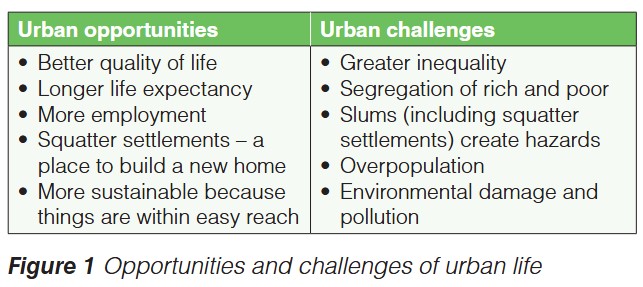
The table above illustrates the dual nature of urbanisation. Every opportunity cities provide comes with corresponding challenges that must be managed. Understanding both sides is crucial for planning successful urban development.
Urban opportunities
Cities provide numerous benefits that explain why people continue to migrate to urban areas:
Better quality of life: Urban areas typically offer superior access to services, amenities, and infrastructure compared to rural regions. Residents can access healthcare facilities, educational institutions, cultural venues, and recreational spaces more easily.
Longer life expectancy: The availability of better healthcare services, including hospitals, clinics, and specialist medical care, contributes to increased life expectancy in cities. Urban residents generally have quicker access to emergency services and preventative health programmes.
More employment: Cities concentrate economic activity, creating diverse job opportunities across multiple sectors. The variety of industries and businesses in urban areas provides employment options that may not exist in rural locations. This economic activity generates wealth and supports livelihoods.
Squatter settlements as housing opportunities: Although often viewed negatively, squatter settlements provide informal housing solutions for new urban arrivals who cannot afford formal accommodation. These settlements allow people to establish themselves in cities and represent a first step toward urban integration for many migrants.
More sustainable living: Cities can potentially be more environmentally sustainable than dispersed rural settlement patterns. Higher population density allows for more efficient public transport systems, shared infrastructure, and reduced per-capita resource consumption. Cities can implement sustainability initiatives more effectively due to their concentrated populations.
Urban challenges
Despite the opportunities, cities face significant problems that threaten quality of life and sustainability:
Greater inequality: Urban areas often display stark wealth disparities, with affluent and poor populations living in close proximity. This inequality can create social tensions and limit opportunities for disadvantaged groups.
Segregation of rich and poor: Cities frequently develop segregated neighborhoods where wealthy and poor residents live separately. This spatial segregation reinforces social divisions and can limit social mobility and integration.
Important
Common mistake to avoid: Students often describe squatter settlements as purely negative. Remember that while they create hazards, they also provide essential housing opportunities for new migrants who cannot afford formal accommodation. Always consider both perspectives when discussing informal settlements.
Slums and squatter settlements creating hazards: While squatter settlements provide housing, they also pose serious risks. These informal settlements often lack basic services like clean water, sanitation, and electricity. They may be built on dangerous sites prone to flooding, landslides, or other hazards. Overcrowding and poor construction standards increase fire risks and disease transmission.
Overpopulation: Rapid urban growth can overwhelm city infrastructure and services. Overpopulation strains housing supplies, transport networks, water systems, and waste management facilities, reducing quality of life for residents.
Environmental damage and pollution: Cities generate significant environmental impacts. Air pollution from vehicles and industry damages health and contributes to climate change. Water pollution affects rivers and groundwater. Waste generation creates disposal challenges. The concentration of people and activities intensifies environmental pressures.
Metacities
The future urban landscape will be increasingly dominated by extremely large urban centers. Metacities are cities with populations exceeding 20 million people. These enormous urban agglomerations represent a new scale of urban development.
Current projections suggest there will be more metacities in the future, with most located in China or India. These two countries are experiencing rapid urbanisation as their economies develop and rural populations migrate to cities seeking opportunities. One metacity in China could potentially reach a population of 120 million people, representing an unprecedented concentration of human settlement.
Important
Understanding scale: A metacity of 120 million people would have a population nearly twice that of the entire United Kingdom. This extraordinary concentration of people requires infrastructure, services, and planning on a scale never before attempted in human history.
The emergence of metacities presents both opportunities and challenges at a massive scale. Managing such large populations requires sophisticated planning, substantial infrastructure investment, and effective governance systems.
Geographic distribution of future urban populations
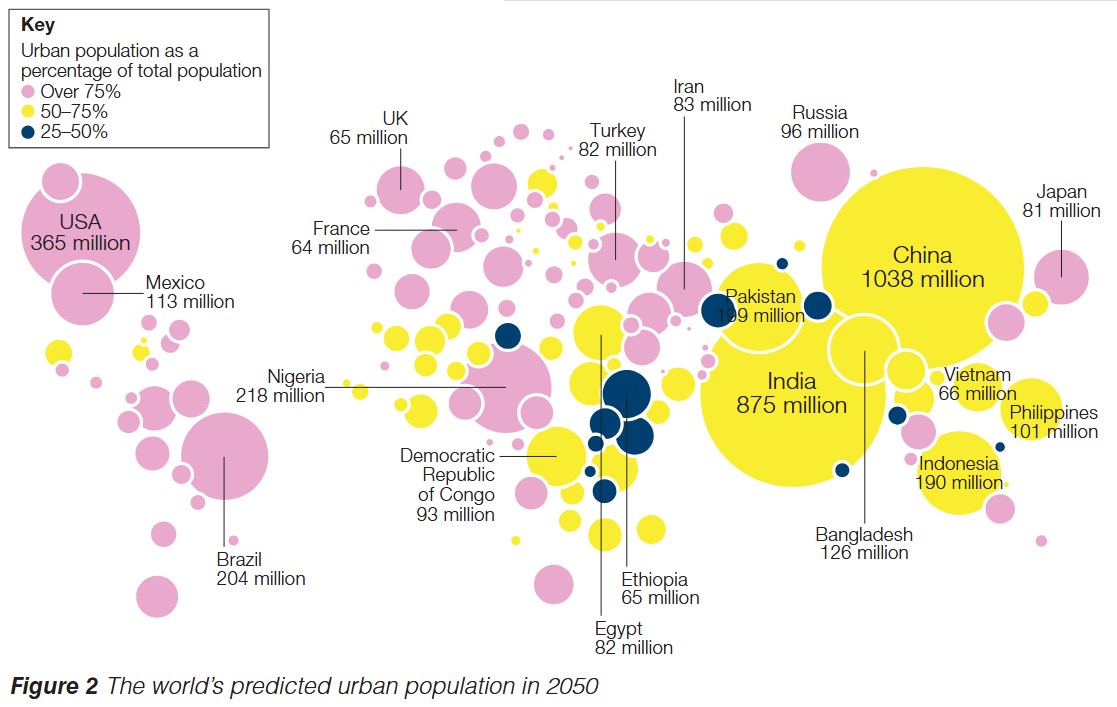
The distribution of urban populations in 2050 will be highly uneven globally, with significant regional variations in urbanisation levels and total urban populations.
Asia will dominate global urban populations. China is projected to have the world's largest urban population at 1,038 million people, followed by India with 875 million urban residents. These two countries alone will account for a substantial proportion of global urban dwellers. Other Asian countries with significant urban populations will include Indonesia (190 million), Pakistan (99 million), Bangladesh (126 million), Japan (81 million), the Philippines (101 million), and Vietnam (66 million).
Africa will experience rapid urbanisation. Nigeria is projected to have 218 million urban residents by 2050, while Egypt will have 82 million and Ethiopia 65 million. The Democratic Republic of Congo will have approximately 93 million urban dwellers. African countries are urbanising rapidly as their populations grow and economies develop.
The Americas will remain highly urbanised. The USA will have approximately 365 million urban residents, maintaining its status as a highly urbanised society. Brazil will have 204 million urban dwellers, while Mexico will have 113 million. These countries already have high urbanisation rates that will continue to increase.
Europe will be predominantly urban. European countries will maintain very high urbanisation levels, with most countries exceeding 75% urban population. The UK is projected to have 65 million urban residents, France 64 million, and Russia 96 million.
Note
Regional patterns reflect development levels: Generally, more developed regions have higher urbanisation percentages but smaller total population increases, while developing regions experience both rapid urbanisation and substantial population growth. This pattern explains why Asia and Africa will see the largest absolute increases in urban populations.
Exam guidance
Important
Exam Success Strategies
When answering questions about the future of cities:
-
For "describe" questions: Focus on patterns and trends visible in data, such as which regions have the highest urbanisation or largest urban populations.
-
For "explain" questions: Discuss reasons why urbanisation is occurring, linking opportunities (employment, services, quality of life) to migration patterns. Explain why challenges arise from rapid urban growth.
-
For "assess" or "evaluate" questions: Balance opportunities against challenges, considering how different groups experience urbanisation. Discuss whether benefits outweigh problems, or how challenges can be managed.
-
Use specific evidence: Reference population figures, percentages, and named countries to support your answers. For example, "China will have 1,038 million urban residents by 2050" is more effective than "China will have lots of urban people."
-
Link to wider themes: Connect urbanisation to economic development, sustainability, inequality, and quality of life to demonstrate understanding of interconnected geographic concepts.
Remember!
Summary
Key Points to Remember:
- By 2050, 70% of the world's population will live in cities, representing a major shift in global population distribution
- Metacities (cities over 20 million people) will become more common, especially in China and India
- Cities offer significant opportunities including better quality of life, longer life expectancy, more employment, housing (including squatter settlements), and potential sustainability
- Cities also face serious challenges: inequality, segregation, slums and hazards, overpopulation, and environmental damage and pollution
- Asia (particularly China and India) will dominate future urban populations, though Africa will experience the most rapid urbanisation rates
Key Terms:
- Urbanisation: The increasing proportion of a population living in urban areas
- Metacities: Cities with populations exceeding 20 million people
- Squatter settlements: Informal housing developments built by residents without legal permission
- Segregation: The spatial separation of different social or economic groups within cities
Critical Concepts:
- Urbanisation creates both opportunities and challenges that cities must balance
- The scale of future urbanisation requires careful planning and investment in infrastructure and services
- Geographic patterns of urbanisation reflect economic development levels and demographic trends
- Sustainability in cities depends on managing environmental impacts while maintaining quality of life