The Urban Explosion (OCR GCSE Geography B (Geography for Enquiring Minds)): Revision Notes
📚Revision Notes
The Urban Explosion
Introduction to urbanisation in Africa
Africa represents an important case study in global urbanisation patterns. Currently, it is the least urbanised continent in the world, yet it is experiencing the most rapid rate of urban growth. This creates unique challenges and opportunities for African cities and their populations.
Note
Approximately 40% of Africa's population currently lives in urban areas (cities and towns), and this figure continues to increase on a daily basis. The speed of this urban transformation is unprecedented and has significant implications for urban planning, infrastructure development, and resource management across the continent.
Understanding urban growth in Africa
Urban growth in African cities occurs through two primary mechanisms, both of which work together to drive the rapid expansion of urban populations.
Rural-urban migration
Rural-urban migration describes the movement of people who relocate from countryside locations to urban centers. This process is driven by a combination of push and pull factors that either force people to leave rural areas or attract them to cities.
Important
Push factors are conditions in rural areas that encourage or compel people to leave. Pull factors work in the opposite direction, attracting people to cities with the promise of better opportunities. Understanding the distinction between these two types of factors is essential for explaining migration patterns.
Push factors are conditions in rural areas that encourage or compel people to leave. In Africa, these factors create difficult living conditions that make urban life appear more attractive:
Economic challenges form a major category of push factors. Rural areas often suffer from limited employment opportunities, making it difficult for people to earn a living. Income levels tend to be low, and in many cases, they are declining further due to agricultural difficulties or environmental pressures. This economic hardship pushes people to seek better prospects elsewhere.
Note
Social and infrastructure limitations also drive migration. Rural communities frequently have poor access to essential services such as healthcare, education, and clean water. Transport infrastructure is often inadequate, making it difficult to access markets or services. Some rural areas experience overpopulation, where too many people compete for limited land and resources.
Conflict and instability represent serious push factors in many African regions. Civil wars and political instability force people to flee rural areas for safety. This displacement is often sudden and can affect large populations.
Environmental pressures increasingly drive rural-urban migration. Climate change affects rainfall patterns and agricultural productivity. Natural disasters such as droughts, floods, or locusts can destroy crops and livelihoods. Food shortages resulting from these environmental challenges make rural life unsustainable for many families.
Pull factors work in the opposite direction, attracting people to cities with the promise of better opportunities. While not explicitly detailed in all sources, these typically include greater employment prospects, improved access to services like healthcare and education, higher potential incomes, better transport networks, and increased safety and stability.
Internal growth
The second major factor driving urban growth is internal growth, which refers to the natural increase in population within cities themselves. This occurs when birth rates exceed death rates in urban areas.
Note
African cities tend to have relatively young populations, and birth rates remain high in many urban centers. At the same time, death rates are generally lower in cities than in rural areas due to better access to healthcare and medical facilities. This combination creates a natural population increase that contributes significantly to urban expansion, even without migration from rural areas.
Patterns of urban growth across Africa
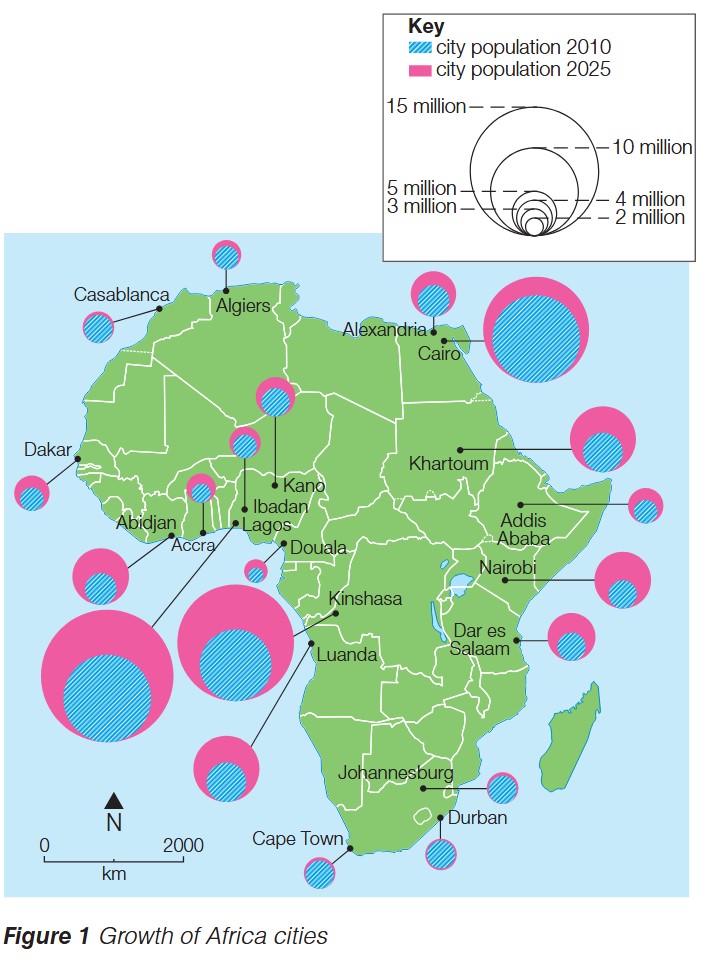
The growth of African cities is not uniform across the continent. Figure 1 in the source material illustrates how different cities are experiencing various rates of growth, with projections showing significant expansion between 2010 and 2025.
Major cities experiencing substantial growth include:
- Cairo in Egypt (northern Africa)
- Lagos in Nigeria (western Africa)
- Kinshasa in the Democratic Republic of Congo (central Africa)
- Nairobi in Kenya (eastern Africa)
- Johannesburg and Cape Town in South Africa (southern Africa)
The map reveals that urban growth is occurring in cities of all sizes across the continent, from mega-cities with populations exceeding 10 million to smaller urban centers with populations of 2-4 million. This widespread urbanisation reflects the continent-wide nature of the factors driving urban growth.
Note
Cities along coastal areas and major transport routes tend to show particularly strong growth, as these locations offer better access to trade and economic opportunities. However, inland cities are also expanding rapidly, driven by their roles as regional administrative and economic centers.
Exam focus: command words and key concepts
Important
Understanding Command Words
When answering exam questions about urban growth in Africa, pay careful attention to command words:
- Describe: Present the pattern or trend shown in data or images (e.g., "Describe the pattern of urbanisation in Africa")
- Explain: Give reasons why something happens, linking causes and effects (e.g., "Explain why rural-urban migration occurs in Africa")
- Assess or Evaluate: Consider different viewpoints and reach a balanced conclusion about the relative importance of factors
For questions about push and pull factors, structure your answer by:
- Defining the terms clearly
- Providing specific, relevant examples
- Explaining how each factor influences migration decisions
- Where appropriate, linking factors together to show how they interact
Remember!
Summary
Key Points to Remember:
-
Africa is the world's least urbanised continent, with approximately 40% of its population living in cities, but it is urbanising at the fastest rate globally
-
Urban growth in Africa results from two main processes: rural-urban migration (people moving from countryside to cities) and internal growth (natural population increase within cities due to higher birth rates than death rates)
-
Push factors forcing people to leave rural areas include limited job opportunities, poor access to services, declining incomes, rural overpopulation, inadequate transport, civil war, natural disasters, climate change, and food shortages
-
Pull factors attracting people to cities are typically the opposite of push factors and include better employment prospects, improved services, higher incomes, and greater safety
-
Major African cities such as Cairo, Lagos, Kinshasa, Nairobi, and Johannesburg are experiencing rapid population growth, with projections showing continued expansion through 2025 and beyond