America’s expansion 1789–1838 (OCR GCSE History B (Schools History Project)): Revision Notes
📚Revision Notes
The removal of Indigenous people from the East, 1830–1838
The Indian-Removal Act of 1830 was the removal of southeastern Indian nations from their lands for westward expansion. Some removal operations were forced and thousands died in the process.
Note
The act created the establishment of a Permanent Indian Frontier, which was a boundary between the U.S. and the Indian territory. As a result of this, the Indian's territory shrank.
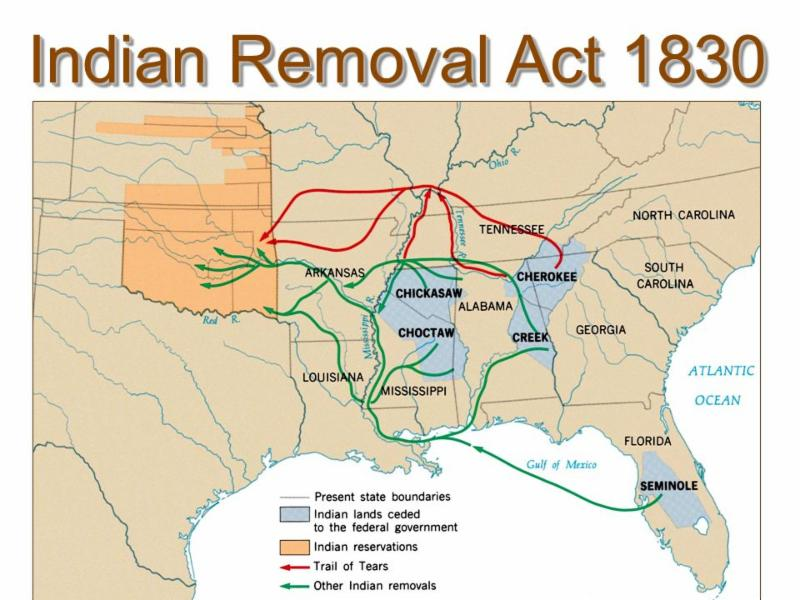
Map showing the Permanent Indian Frontier and the movement of Indians to new territory
Note
Before the colonies and the United States were established, the North American territory was originally inhabited by the Indian Nations. They were considered to be sovereign nations but, later on, were seen as "barriers" to U.S. expansion.
Note
By 1830, President Jackson believed that Indians were not entitled to own land and he signed the Indian-Removal Act, which gave over land west of the Mississippi River in exchange for their holdings in the east.
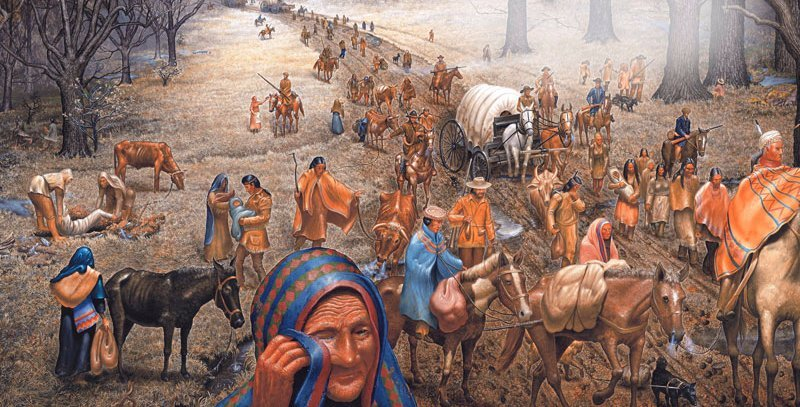
Illustration depiction of the Cherokee nation during the Trail of Tears
Note
As a result of about 70 removal treaties, over 46,000 eastern Indians moved west. Some nations, including the Cherokee and Seminole, were removed by force. Among the tragic experience was the Cherokee's Trail of Tears from Georgia to the new Indian territory, a journey that saw the death of thousands of individuals.

Glossary of Terms
Louisiana Purchase
The purchasing of Louisiana in 1803 that became the greatest land bargain in U.S. history
Transcontinental Treaty
The treaty made by U.S. and Spain in 1819 to settle the boundaries over territory after the Louisiana Purchase
Manifest Destiny
The belief of many Americans of their divine mission to expand territories from coast to coast in North America
Cotton Gin
Invented in 1793 by Eli Whitney, it revolutionised the cotton industry in the south of the U.S.
Cotton Boom
The considerable increase of cotton farming in 1812
King Cotton
The slogan that rose within the southern states to indicate the importance of cotton production economically and politically
Indian-Removal Act
The removal of southeastern Indian nations from their lands for U.S. expansion
Trail of Tears
The forced relocation of southeast Indians, specifically the Cherokee nation, to Indian Territory west of the Mississippi River
Exam Practise

Task 1: Inferencing
Note
Make an inference on the words of Steven Deyle in 1860 regarding the value of enslaved people in the south.
"[Slaves were] roughly three times greater than the total amount invested in banks… equal to about seven times the total value of all currency in circulation in the country, three times the value of the entire livestock population, twelve times the value of the entire U.S. cotton crop and forty-eight times the total expenditure of the federal government that year."
- Steven Deyle, 1860
Task 2: Quoting
Note
Read the quote from the letter of Chief John Ross of the Cherokee nation. How did this show the impact of the westward expansion on the Native Americans?
"…We are stripped of every attribute of freedom and eligibility for legal self-defence. Our property may be plundered before our eyes; violence may be committed on our persons; even our lives may be taken away, and there is none to regard our complaints. …We have neither land nor home, nor resting place that can be called our own…"
- "Our Hearts are Sickened": Letter from Chief John Ross of the Cherokee (1836)
Task 3: Analysing Images
Note
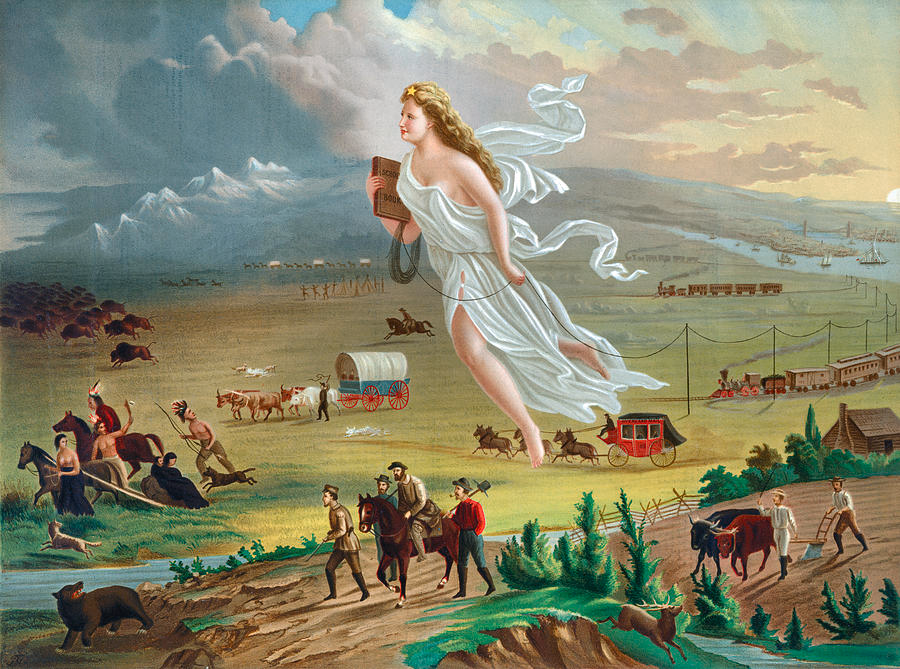
Analyse the 1872 painting of John Gast entitled "American Progress". Point out the allegories and symbolisms in the image. How did this show the concept of Manifest Destiny?