The West 1839–1860 (OCR GCSE History B (Schools History Project)): Revision Notes
📚Revision Notes
The Californian Gold Rush (1848–1849) and The Pikes Peak Gold Rush (1858–1859)
The California Gold Rush of 1848 was an event in U.S. history when hundreds and thousands of prospectors travelled to the west to find gold after news spread that gold was discovered in the Sierra Nevada mountains.
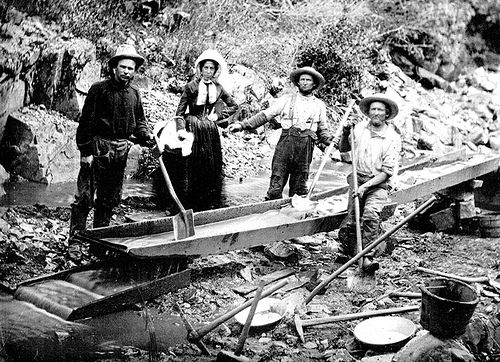
Prospectors panning for gold in California during the gold rush in 1850
Note
Significance of the California Gold Rush
- California was able to demand concessions because of its value.
- Population in California increased to 300,000 by 1855.
- With population increasing, California was able to secure itself as a state.
- Businesses boomed in California because of increasing demands from prospectors.
- Though some prospectors were not able to find gold, they still settled in the area.
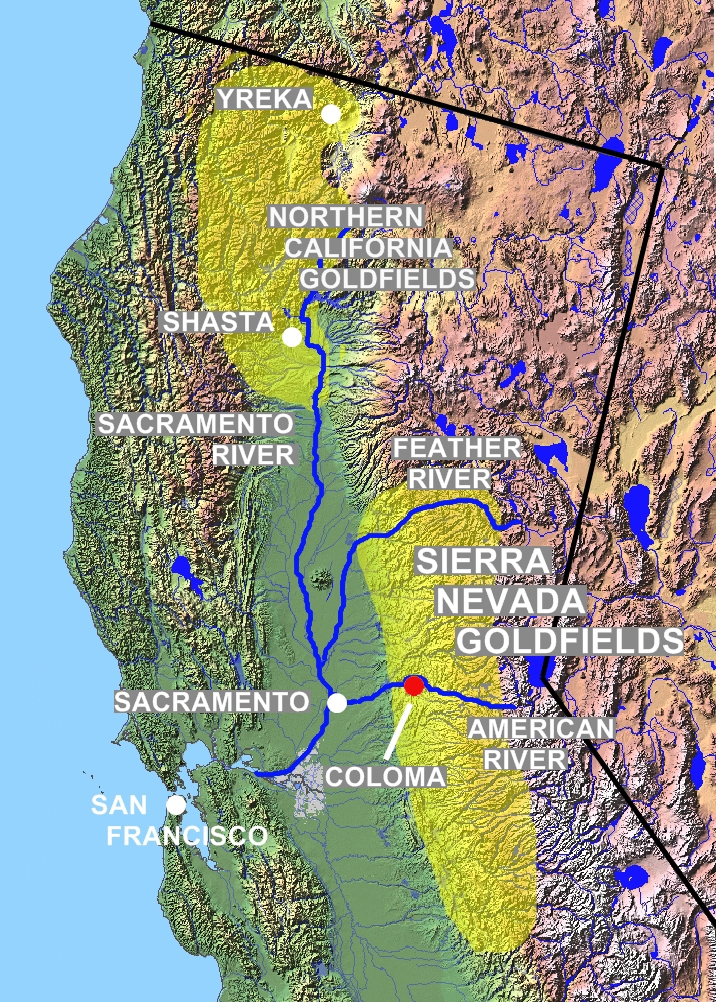
Map outlining California goldfields
Similar to the California Gold Rush, the Pikes Peak Gold Rush, (or Colorado Gold Rush) was the gold peak prospecting and mining in the Pikes Peak Country. It began a decade after the California Gold Rush, from 1858 until 1859. Participants of the gold rush were known as "Forty-Niners".
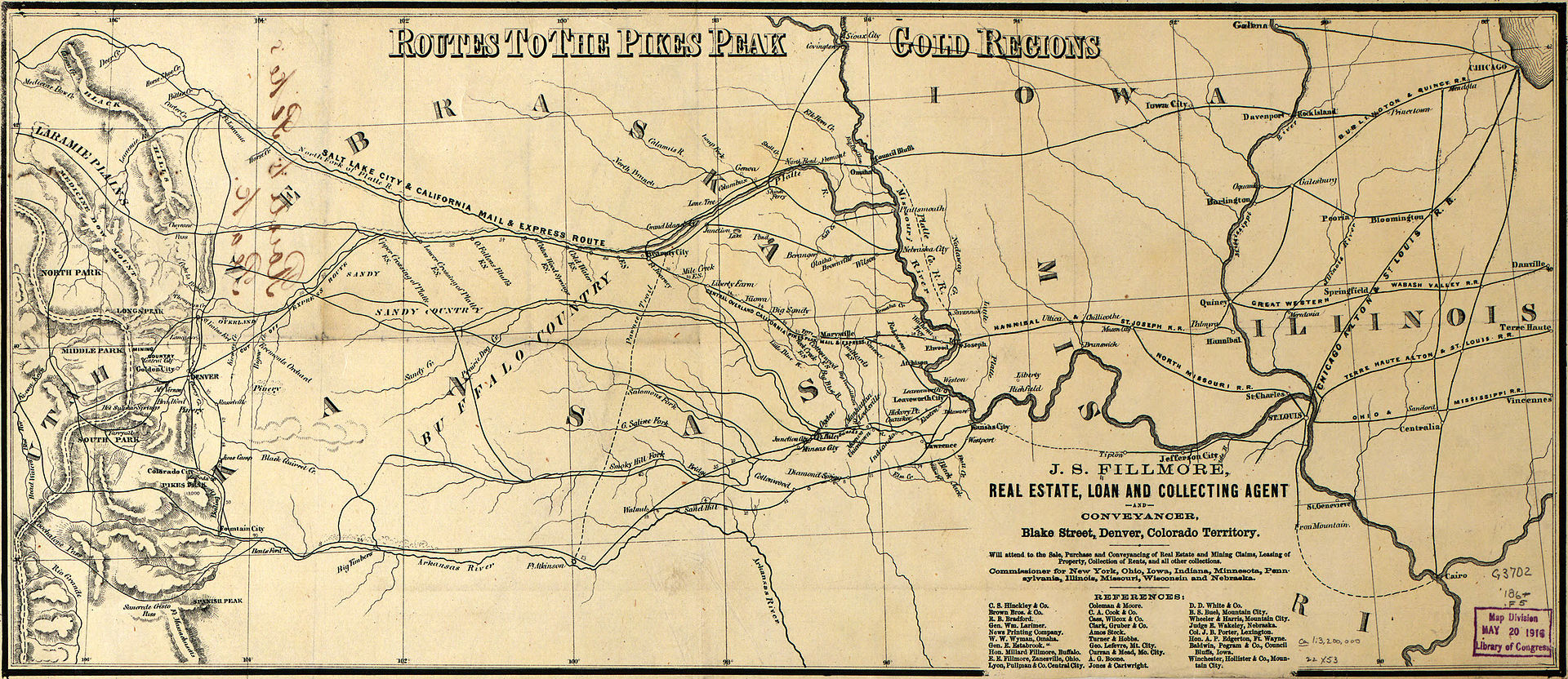
A map from the late 1850s showing prominent routes to the gold regions
The Pikes Peak Gold Rush had numerous significance in Colorado. Some of which are the following:
Significance of the Pikes Peak Gold Rush:
It drew thousands of people to Colorado.
It prompted the political organisation of a U.S. territory in Colorado which would later become a state.
Many current cities and towns in present-day Colorado were founded through the gold rush.
Aroused a sustained interest in the mineral resources of the Rocky Mountains.
Despite these significances, however, it also had its negative consequences, mainly the following:
- Due to the difficulties and costs of finding gold, individual prospectors were replaced by capitalists.
- It led to the pollution and large-scale manipulation of the Colorado environment.
- It led to the displacement of the Native Americans.
- It produced tremendous social and environmental changes.

Glossary of Terms
Plains Indians
Refers to the members of the Native American people who inhabit the vast grasslands of the Great Plains of the United States and Canada
Oregon Fever
The 1840 rush of migrants of the east coast to the Oregon territory
Lakota Sioux
A Sioux division noted for its warrior culture and being great opponents during the Great Sioux Wars
Oregon Trail
The difficult route through the Rocky Mountains for migrants heading westward
Donner Party
The group of 300 migrants riding 60 waggons as they travelled west in 1846
Tipi
A conical-shaped dwelling made of buffalo skins and wooden rods that Indians in the Great Plains lived in
Mormons:
Believers in the Church of Jesus Christ of Latter- Day Saints, which was founded by Joseph Smith
Gold Rush:
The sudden movement of people seeking fortune to a newly discovered goldfield
Exam Practise

Task 1: Essay Writing
Note
Study both sources and then write an essay describing how attitudes about the Great Plains changed, particularly with the arrival of the Mormons.
Source D:
In regard to this extensive section of country. I do not hesitate in giving the opinion that it is almost wholly unfit for cultivation, and of course uninhabitable by a people depending upon agriculture for their subsistence. Large areas of fertile land are occasionally to be found, but the scarcity of wood and water will prove an impossible obstacle in the way of settling the country.
- Major Stephen Long of the Corps of Engineers describing the Great Plains in his expedition)
Source E:
A city has been laid out upon a magnificent scale. Through the city itself flows an unfailing stream of pure, sweet water, which, by an ingenious mode of irrigation, is made to travel along each side of every street whence it is led into every garden-spot, spreading life, and beauty, over what was a barren waste.
- A description of Salt Lake City by a U.S. government surveyor in 1850)
Task 2: Analysing
Note
Carefully read the source. Based on your knowledge of the topic, what were the experiences of the Oregon Trail pioneers during their journey to the West? What evidence from these quotations tells you that they experienced hunger on the Plains?
Two Oregon Trail pioneers describing life on the trail:
"Counted 150 dead oxen. It is difficult to find a camping ground without carcasses." (J.G. Bruff, 1849)
"Looked starvation in the face. I have seen men passing an animal that has starved to death on the plains, stop and cut out a steak, roast and eat it and call it delicious." (Clark Thompson, 1850)