Punishing offenders (OCR GCSE History A (Explaining the Modern World)): Revision Notes
📚Revision Notes
Punishing offenders
Capital punishment, fines, whipping, public humiliation and imprisonment
Note
The final method used by the Saxons to prevent crime was punishment. In Saxon England, petty theft was the most common crime. Such crime was punished by fines, public humiliation and oaths on the Bible.
Note
Major crimes such as murder and treason were punishable by death. Harsh punishments included mutilation and execution through hanging or beheading.
Corporal punishment
Many punishments involved some kind of physical injury, ranging from time spent in the stocks or pillory, to beatings and mutilation.
Capital punishment
Persistent offenders or those found guilty of very serious crimes would be sentenced to death.
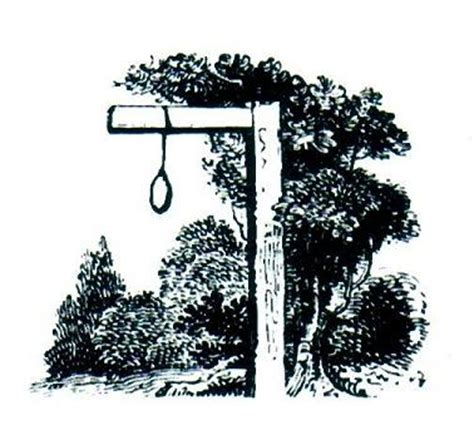
The most common form of death penalty during this period was by hanging. In some instances, the offender was dragged to the place of execution, hanged and quartered afterwards.
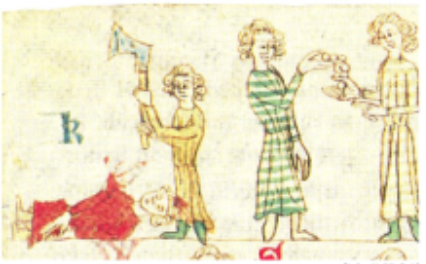
For members of the higher social class such as monarchs and royal officials, decapitation by axe or sword was the most common method.
Other forms of harsh punishments included:
- Impalement wherein the offender's body was dropped onto a spike (metal or wood) repeatedly until the person died.
- In some cases of murder, offenders were buried alive.
- The most common punishment used for heretics was burning at the stake. Victim's hands and legs were tied in a pole surrounded with fire.
- The ducking stool was typically used on women charged of being a witch.
Anglo-Saxon crimes and punishments
| CRIME | PUNISHMENT | |
|---|---|---|
| Against person | Murder, assault, public disorder | Wergild Stocks or pillory |
| Against property | Theft, counterfeiting, arson | Fines Mutilation of a hand hanging |
| Against authority | Treason Betrayal of lord | hanging |
Note
Corporal punishments were used to deter people from committing same crimes. Punishments such as eye gouging or mutilation of body parts like hand or foot were sentenced to lesser crimes. Whipping in public was a common form of deterrence, while prisons were only used to hold criminals before the actual punishments.

Illustration of whipping as a form of punishment in the Mediaeval Period
Note
The Wergild
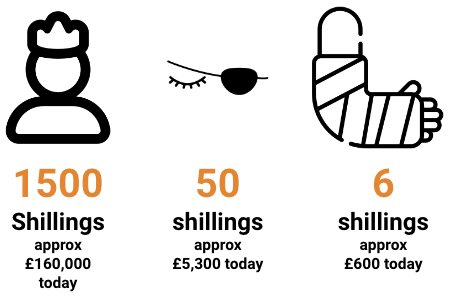
This was compensation paid to the victims of crime or to their families. The laws of the king set the levels of payment to be made. You would have to pay 1500 for murdering a prince, 300 shillings for killing a nobleman, 100 for killing a freeman and 40 shillings for a serf. You paid less for the death of a Welshman than you did an Englishman.
Physical injury was also settled through the wergild. The loss of an eye cost 50 shillings, while a broken arm cost 6 shillings.
Note
Blood Feuds
When a person committed a crime, the victim's family was allowed to take revenge on the criminal's family. The primary concern with this method, retaliation of the victim's family should not be harsher than the original crime, otherwise, the criminal's family would retaliate further to balance the crime.
Medieval Wergild
Change and Continuity: Anglo-Saxons to Norman approach to combating crime
After the Battle of Hasting, William the Conqueror, Duke of Normandy, ruled England and brought changes to the kingdom.
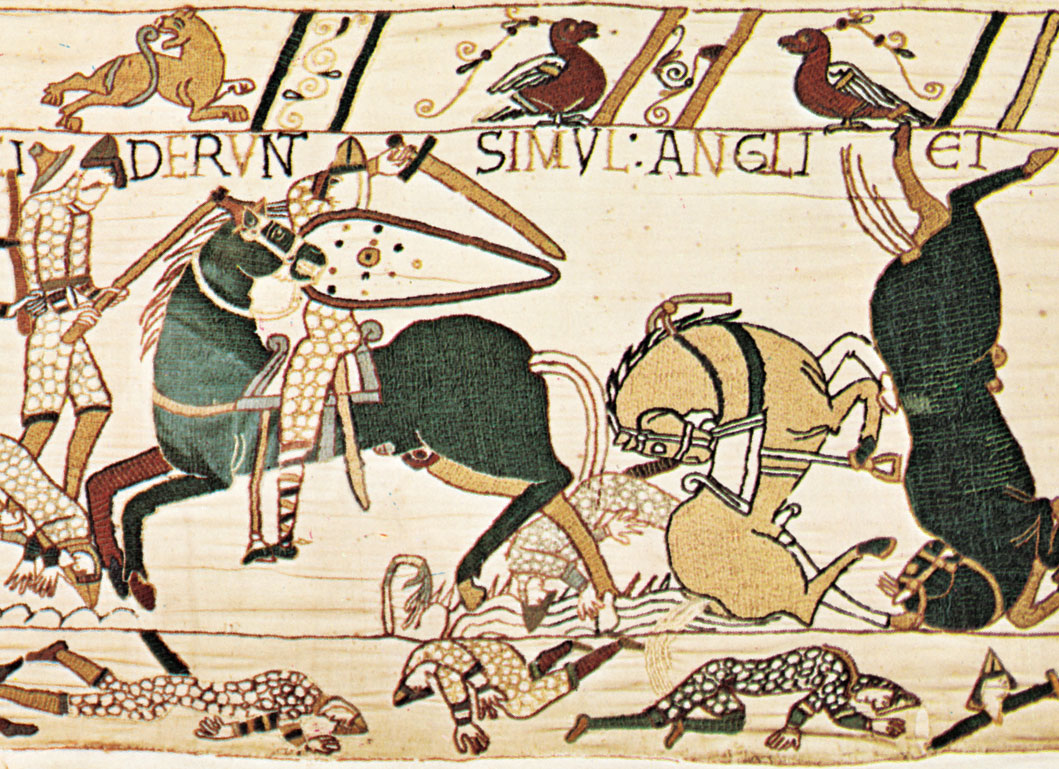
11th century Bayeux Tapestry of the Battle of Hastings
One of the lasting and prominent influence brought by the Normans to Anglo-Saxon England was the building of enormous castles. William I, the new King of England, ordered the erection of massive castles to control lands under manors. Many Anglo-Saxon homes were displaced, which angered the people and resulted in violence between the Normans and Saxons. In response to growing hostility, William I made murder of Normans a serious crime. A Murdrum fine was levied to offenders and the whole village.
Note
Glossary of Terms:
MEDIEVAL PERIOD
Also known as the Middle Ages, this period in European history lasted from the 5th to the 15th century.
TITHING
A group of 10 householders who took responsibility for each other's actions. A communal responsibility in combating crime in the mediaeval period.
CAPITAL PUNISHMENT
A form of fatal punishment for serious crimes.
TREASON
Disloyalty to the crown and the state resulted in being hung, drawn and quartered.
HUE AND CRY
A loud cry of calling the members of the community to capture an offender.
TRIAL BY ORDEAL
A judicial practice of knowing the guilt or innocence of offenders by subjecting to painful tests.
Note
Example Assessment Question: ANALYSIS SOURCE A:
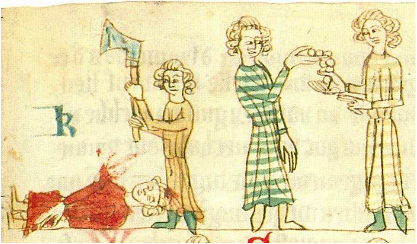
SOURCE B:
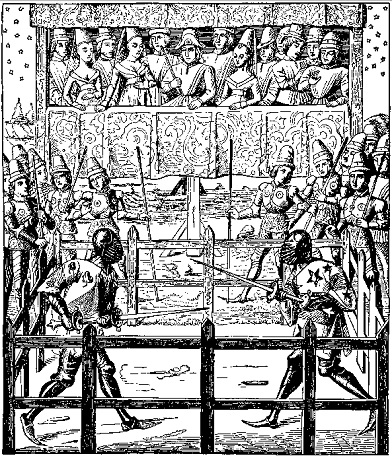
Explain the extent to which the legal system changed between the Anglo-Saxon and Norman eras.
Think about what changed and what stayed the same, before you conclude with your overall opinion about the extent of change.
Note
Example Assessment Question: INFERENCE SOURCE C:
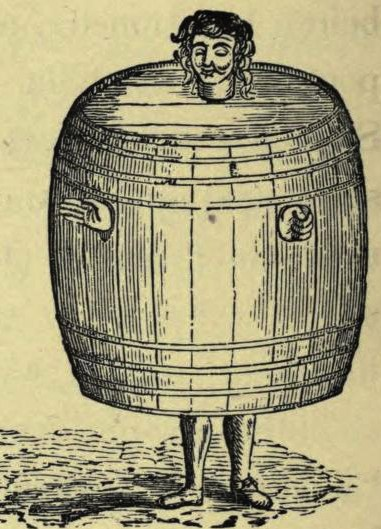
Using your understanding of crime and punishment in Mediaeval Britain and examination of the source, answer the questions provided.
- What is the crime committed?
- Describe the form of punishment depicted.
- What could be the purpose of such punishment?
- Given the historical context, how effective was this form of punishment?
Note
Example Assessment Question: DISCUSSION Given your knowledge of the historical context, substantially answer the questions provided.
- What were the nature and causes of crime in Mediaeval Britain?
- Describe the idea of communal responsibility in combating crime.
- What was the purpose of capital punishment and public humiliation?