The nature, structure and diversity of late Anglo-Saxon society (OCR GCSE History A (Explaining the Modern World)): Revision Notes
📚Revision Notes
The nature, structure and diversity of late Anglo-Saxon society
Nature of late Anglo-Saxon society
Note
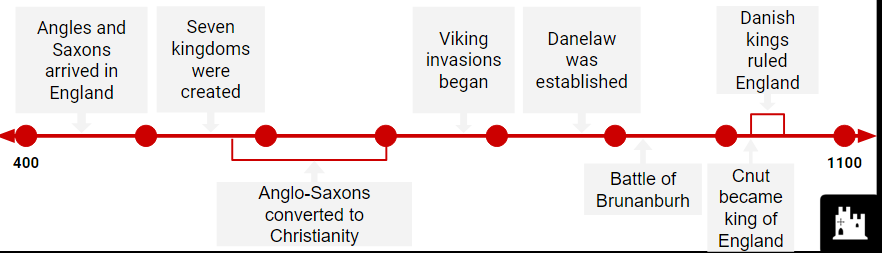
The Saxons, Angles, Jutes and other Germanic tribes who invaded and forced the native Celtic Britons out of lowland England in the 5th century, came to be known as the Anglo-Saxons. Anglo-Saxon invasions began whilst the Romans were still in control. England was Anglo-Saxon for six centuries, until the Norman conquest began.
Note
The seven kingdoms established in Anglo-Saxon England during the Heptarchy were destroyed by the Danes by the second half of the 9th century.
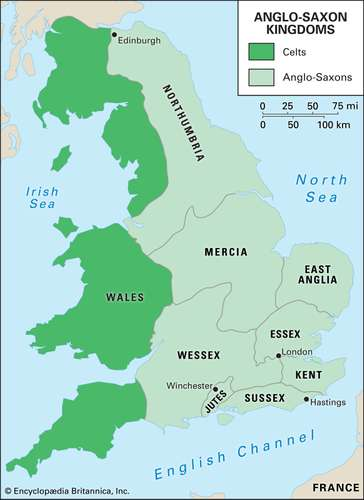
Map of Anglo-Saxon kingdoms
By 927, the remaining kingdoms were united into the Kingdom of England by King Æthelstan. As Anglo-Saxon England became a part of the short-lived North Sea Empire, it saw changes in its rulers and government as the years went by.
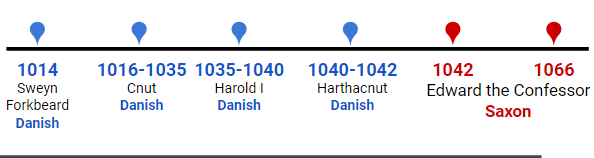
England's kings from 1014 to 1066
Note
Edward the Confessor became king when Harthacnut, the last Danish king to rule England, died suddenly in 1042.
Note
England, Wales, Scotland and Ireland were separate states in 1065. At that time, the kingdom of England had only existed for over a century.
Scotland was an independent country. The border region between Scotland and England was unsettled hence raids were frequent in this region.
Ireland had its own kings and saw the decline of Viking power. It continued to be populated by native Celtic people.
Wales was independent from England and had its own kings and kingdoms. Its people were descended from southern Britain before the Anglo-Saxons arrived.
Population in the north and east of England was a mix of Anglo-Saxons and Vikings. The Vikings, who came from modern-day Norway, Denmark and Sweden, had a strong presence since England became a part of the Viking Empire of King Cnut.

Structure and diversity of late Anglo-Saxon society
Note
England was an agricultural, feudal society. The vast majority of people lived in the countryside and were bound to their feudal lord. Society was organised into a strict hierarchy, with political and economic power in the hands of those at the top of the pyramid. Any member of society who had obligations to another was known as a vassal.
King
The King governed the country and had considerable powers and duties.
Earls
Earls were the most important men in the country after the king and were appointed as the chief advisers of the king.
Thegns
Thegns were servants or attendants and their job was to serve the noblemen or king.
Ceorls
Majority of Anglo-Saxons were ceorls.
Slaves
Slaves made up 10% of the population.
What were the roles of each group?
The King
- The king owned large estates, could grant land to his followers or take away lands from his enemies.
- He ensured the creation and the enforcement of new laws throughout the country.
- He could raise a national army and fleet and decided on the national taxation system.
Note
The people of England had to follow these laws and obey the king whose principal role was to protect them.
The Earls
- Earls had limited authority to aid the king. They acted as the king's agents in the vast areas of land they owned.
- Whilst they had no private armies, they gathered and led the king's 'fyrd' (armed forces) in times of war.
- Earls had the following responsibilities:
- Collect taxes in their earldom whilst earning a revenue
- Oversee justice and legal punishments in their earldom
- Offer their service as generals and military leaders when needed
Note
Earls were given economic, legal, and military control of their earldoms.
Thegns
- The status of thegns came from land ownership.
- There were roughly five thousand thegns below the earls.
- Thegns carried out the king's work on their lands.
- They ran the local courts, collected taxes and were expected to fight for the king if necessary.
Ceorls
- Ceorls were free men, who were no one else's property.
- They worked for the thegn and had to serve in the king's 'fyrd' in times of war.
- They owned some land and a house, grew crops and kept animals.
- They were expected to share in the work of keeping roads and bridges in good order, and were trusted to take part in local decision-making and trials in local courts.
Slaves
- Slaves were the property of a master hence they were not free to seek work elsewhere.
- They could be branded or castrated like animals.
- Anyone born to slavery would remain a slave.
The Witan
Whilst the king was the most powerful in Anglo-Saxon England, he would summon a council when creating new laws and making important decisions. This council was known as the Witan.
Who made up the Witan?
Aristocrats such as earls and archbishops
What was their role to the king?
Advise the king on issues of government
What was the value of each person's life?
Note
The social group in which people belonged dictated the cash value of each person under the Anglo-Saxon law. Wergild had to be paid by a murderer's family in compensation to the family of the murder victim.
Cash value of each person
King
30,000 thrymsa
Prince
15,000 thrymsa
Earl
8,000 thrymsa
Thegn
2,000 thrymsa
Ceorl
200-2,000 thrymsa
Slave
No value
Thrymsa was a gold coin minted in 7th-century Anglo-Saxon England.
Earldoms, shires and burhs
Note
Several earldoms were held by the Godwinson family, making them the richest and the most powerful family in the kingdom.
X 10
Tithing
Tithings were responsible for law and order.
X 10
Hundred
Each Hundred elected a constable.
Earldoms were divided into shires. Shires had their own courts and fortified towns called buhrs.
A collection of Hundreds
Shire or county
A shire-reeve (sheriff) was the head of the shire.