Northern resistance and William’s ‘Harrying of the North’ (OCR GCSE History A (Explaining the Modern World)): Revision Notes
📚Revision Notes
Northern resistance and William's 'Harrying of the North'
Northern resistance
Note
Earls Edwin and Morcar, who initially swore their loyalty to William after the Anglo-Saxons' defeat at the Battle of Hastings, rebelled in 1068 upon realising that they would never regain the amount of influence and authority they once had.
- The earls withdrew from court and announced their opposition to William, encouraging many others to follow suit.
- William marched north and ordered a castle to be built at Warwick. Intimidated, Edwin and Morcar, once again, submitted. William went on to build other castles in the Midlands, putting loyal Normans in charge.
- William appointed Copsig, who had worked for Tostig, as Earl of Northumbria.
- Gospatric was made earl in 1068, after offering money to William.
- Gospatric joined the short-lived rebellion of Edwin and Morcar.
- William took away Gospatric's land and title.
- Robert de Comines, a Norman, was appointed as earl.
- Copsig was ambushed and killed.
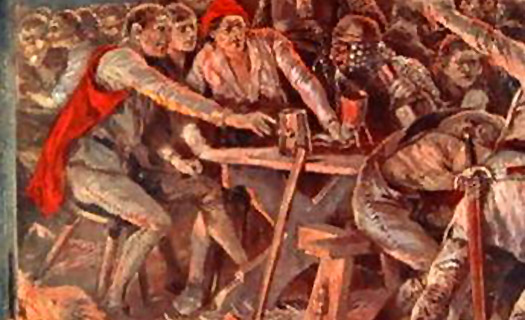
Edgar the Aethling and the rebellions in the North, 1069
- Robert de Comines, the newly appointed Earl of Northumbria, travelled north with his army, allowing his men to attack villages they passed through.
- The people of Northumbria fought back, mobilising themselves into an army.
- On 28 January, the rebels went to Durham, killed many of Robert's men and burned down the house where Robert was staying, killing him.
- The rebels then marched to York, killing the guardian of the castle as well as a large proportion of the Norman force guarding the city. The actions of the northern rebels inspired rebellions to ignite in other parts of the country. The Danes raided English towns as they headed to York.
William gathered his army and began to march north.
William's troops were in control of the city but the Danes and the rebels were able to take York once again.
When the rebels heard William was on his way, their force dispersed. Edgar returned to Scotland and the Danes decided to withdraw.
William offered to pay the Danes if they returned home, an agreement they were happy to make.
Note
Edgar Aethling, who had sought refuge in Scotland, also became involved. He asked for assistance from the Danish king, King Sweyn, who sent a fleet of ships.
William's 'Harrying of the North'
The 'Harrying of the North' came to be known as William's most notorious response to the rebellions in the whole of his reign. Norman troops killed the entire population. Villages and houses were burnt to the ground, and food supplies, crops and animals were deliberately destroyed.
Some sources report 100,000 people were killed in the harrying, although this is disputed by many historians. In the Domesday Book, many areas of the north were simply referred to as 'waste' which may refer to the consequences of the harrying.
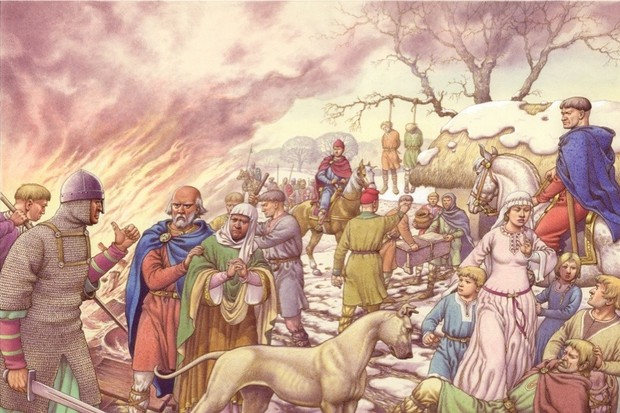
An impression of 'The Harrying of the North', showing villagers killed and houses burnt to the ground
What were the reasons for and the impact of the Harrying of the North?
Why depopulate the north?
- William tried peaceful negotiations with the people of the north right after his conquest but hostility towards the Normans grew strong when he left England.
- The rebels of the north were supported by the Scots and the Danes, who both wanted to take some or all of England.
- With threats of foreign invasions and various rebellions all over the country, William came to the decision that depopulating the north was the best solution to control the people.
Impact
Reduced the threat of invasion
The threat of future Danish invasions was reduced.
Removed the threat of the north
Northumbria was no longer a threat to William's rule.
Refugees
Many people fled and settled in other parts of the country.
Resistance
Some of the refugees joined up with resistance struggles in other areas.
Ruins
Over half the wealth and population in northern England was lost.