Decimals (OCR GCSE Maths): Revision Notes
📚Revision Notes
Decimals
Decimals are numbers that are expressed in a system based on powers of . They are a way of representing fractions in a format that is easy to use in calculations.
Types of Decimals
There are three main types of decimals that you need to know:
- Exact or Terminating Decimals: These are decimals that come to an end (they do not go on forever).
Note
- Examples:
- Explanation: When you convert a fraction like to a decimal, it equals . This is a terminating decimal because it stops after one digit.
- Recurring Decimals: These are decimals where a digit or a group of digits repeats forever.
Note
- Examples: (which means ), (which means )
- Explanation: When you convert a fraction like to a decimal, it equals This is a recurring decimal because the digit repeats indefinitely.
- Irrational Decimals: These are decimals that go on forever without repeating. They cannot be written as a simple fraction.
Note
- Examples:
- Explanation: The value of is an example of an irrational decimal because it continues infinitely without any repeating pattern.
Converting Recurring Decimals to Fractions
To convert a recurring decimal into a fraction, follow these steps:
Note
Example 1: Convert into a fraction.
- Let , so …
- Multiply both sides by
- Subtract the original equation from this: , which simplifies to .
- Solve for
So,
Note
Example 2: Convert into a fraction. 5. Let 6. Multiply by to shift the decimal: . 7. Multiply by again to cover the repeating part: 8. Subtract the first multiplied equation from the second: giving .
- Solve for So,
Understanding Decimals
Decimals are a way of representing fractions, especially when the fractions are in a base-10 system. Understanding how to work with decimals is crucial for various mathematical operations, including addition, subtraction, multiplication, and division.
(a) Adding and Subtracting Decimals
When adding or subtracting decimals, it is important to align the decimal points of the numbers involved. This ensures that the digits are correctly placed according to their place values.
Note
Example 1: Adding Decimals
Note
Example 2: Subtracting Decimals
- Problem: Subtract
- Steps:
- Align the decimals: Write the numbers in a column, ensuring that the decimal points are aligned.
- Perform the subtraction:
- Result: The difference is
(b) Multiplying Decimals
When multiplying decimals, the number of decimal places in the product must equal the total number of decimal places in the numbers being multiplied.
Note
Example 1: Simple Multiplication
Note
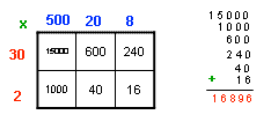
Example 2: Multiplying Larger Decimals
- Problem: Multiply
- Steps:
- Multiply ignoring the decimals:
- Count total decimal places: There are decimal places ( from and from ).
- Place the decimal:
- Result: The product is
(c) Dividing Decimals
Dividing decimals involves converting the divisor into a whole number by multiplying both the divisor and the dividend by the same power of .
Note
Example:
- Problem: Divide
- Steps:
- Multiply both numbers by to eliminate the decimal in the divisor:
- Divide as whole numbers:
- Result: The quotient is .
Fractions, Decimals, and Percentages
Fractions, decimals, and percentages are closely related, and being able to convert between them is an essential skill
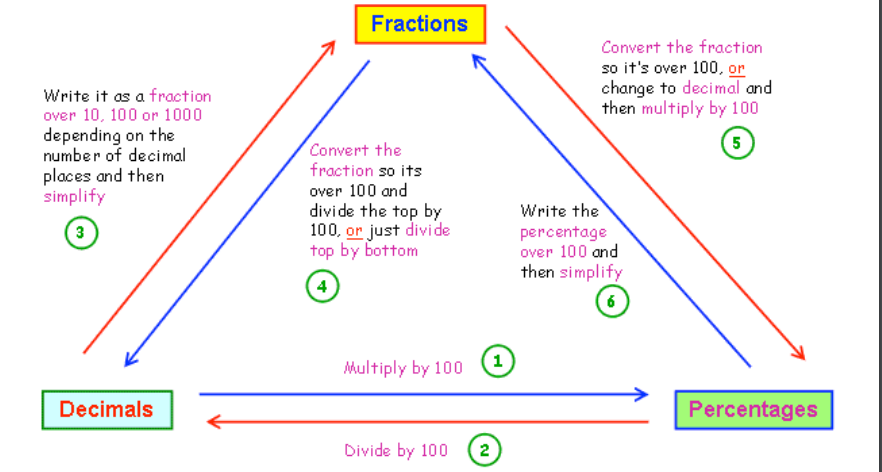
Converting Between Fractions, Decimals, and Percentages
1. Converting a Decimal to a Percentage
Note
- Example: Convert to a percentage.
- Steps:
- Multiply the decimal by :
- Result: as a percentage is %
2. Converting a Percentage to a Decimal
Note
- Example: Convert % to a decimal.
- Steps:
- Divide the percentage by :
- Result: % as a decimal is .
3. Converting a Decimal to a Fraction
Note
- Example: Convert to a fraction.
- Steps:
- Write the decimal as a fraction with the denominator as (since there are two decimal places):
- Simplify the fraction by dividing both the numerator and the denominator by their greatest common divisor (GCD), which is in this case:
- Result: as a fraction is
4. Converting a Fraction to a Decimal
Note
- Example: Convert to a decimal.
- Steps:
- Adjust the fraction so that the denominator is (multiply both the numerator and the denominator by ):
- Convert the fraction to a decimal by dividing the numerator by the denominator:
- Result: as a decimal is .
5. Converting a Fraction to a Percentage
Note
- Example: Convert to a percentage.
- Steps:
- First, convert the fraction to a decimal by dividing the numerator by the denominator:
- Then, convert the decimal to a percentage by multiplying by :
- Result: as a percentage is .
6. Converting a Percentage to a Fraction
Note
- Example: Convert % to a fraction.
- Steps:
- Start by writing the percentage as a fraction over :
- To remove the decimal, multiply both the numerator and the denominator by :
- Simplify the fraction by dividing both the numerator and the denominator by their GCD, which is :
- Result: % as a fraction is .
Converting Recurring Decimals to Fractions
Converting recurring decimals to fractions can seem challenging, but with a systematic approach, you can master this technique. Below is a step-by-step guide to help you convert a recurring decimal into a fraction.
Step-by-Step Guide: Converting a Recurring Decimal to a Fraction
Note
Example: Convert (which means ) into a fraction.
Step 1: Set up the Equation
- Let
Step 2: Eliminate the Recurrence
- To remove the repeating decimal part, multiply by a power of that matches the length of the repeating block. In this case, the block "" has three digits, so multiply by :
- Now, you have two equations:
Step 3: Subtract the Equations
- Subtract equation (i) from equation (ii) to eliminate the recurring part:
- Simplifying the subtraction:
Step 4: Solve for
- Divide both sides by to isolate :
- Simplify the fraction by dividing both the numerator and the denominator by their greatest common divisor (GCD), which is :
Step 5: Verify the Result
- You can check your result by converting back into a decimal using long division or a calculator. You should get confirming that the conversion is correct.
Challenge
When converting fractions to decimals, you might notice that some fractions, like , result in terminating decimals, while others, like , result in recurring decimals.
🔑 Key Rule:
- Terminating Decimal: A fraction will have a terminating decimal if its denominator (after simplifying) has only or as its prime factors.
Note
Example: (since ).
- Recurring Decimal: A fraction will have a recurring decimal if its denominator has any prime factors other than or .
Note
Example: = (since is a prime factor that is neither nor ).