Fractions (OCR GCSE Maths): Revision Notes
📚Revision Notes
Fractions
Things You Should Know About Fractions:
- Numerator: The top part of a fraction, representing how many parts of the whole you have.
- Denominator: The bottom part of a fraction, representing how many equal parts the whole is divided into.
Note
Example: In the fraction :
- is the numerator.
- is the denominator.
Fraction of a Quantity
- To find a fraction of a quantity, follow these simple steps:
- Divide by the Denominator: This gives the value of one part.
- Multiply by the Numerator: This gives the value of the required parts. Worked Examples
Note
Example 1: Finding a Fraction of a Quantity
- Problem: What is of ?
- Steps:
- Divide by the denominator:
- Multiply by the numerator:
- Result: of is 18.
Note
Example 2: Fraction of a Quantity with Units
- Problem: Find of grammes.
- Steps:
- Divide by the denominator:
- Multiply by the numerator:
- Result: of grammes is 1740 grammes
Equivalent Fractions
Equivalent fractions are fractions that represent the same value, even though they may look different. Understanding how to identify and work with equivalent fractions is essential for simplifying answers and performing operations like addition and subtraction of fractions.
What Are Equivalent Fractions?
Equivalent fractions are fractions that have the same value. For instance, is equivalent to because both represent the same proportion of the whole.
🔑 Key Rule:
To create an equivalent fraction, whatever you multiply or divide the top (numerator) by, do the exact same to the bottom (denominator)!
Worked Examples
Note
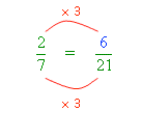
Example 1: Creating an Equivalent Fraction
- Problem: Find an equivalent fraction for with a denominator of .
- Steps:
- Ask yourself: "What has been done to the to make it ?"
- Answer:
- Do the same to the numerator:
- Multiply by :
- Result: The equivalent fraction is .
Visual Representation:
Note
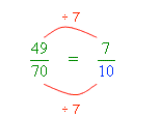
Example 2: Identifying an Equivalent Fraction
- Problem: Identify what is equivalent to when the numerator is reduced to .
- Steps:
- Ask yourself: "What has been done to the to make it ?"
- Answer: .
- Do the same to the denominator:
- Divide by :
- Result: The equivalent fraction is .
Visual Representation:
Note
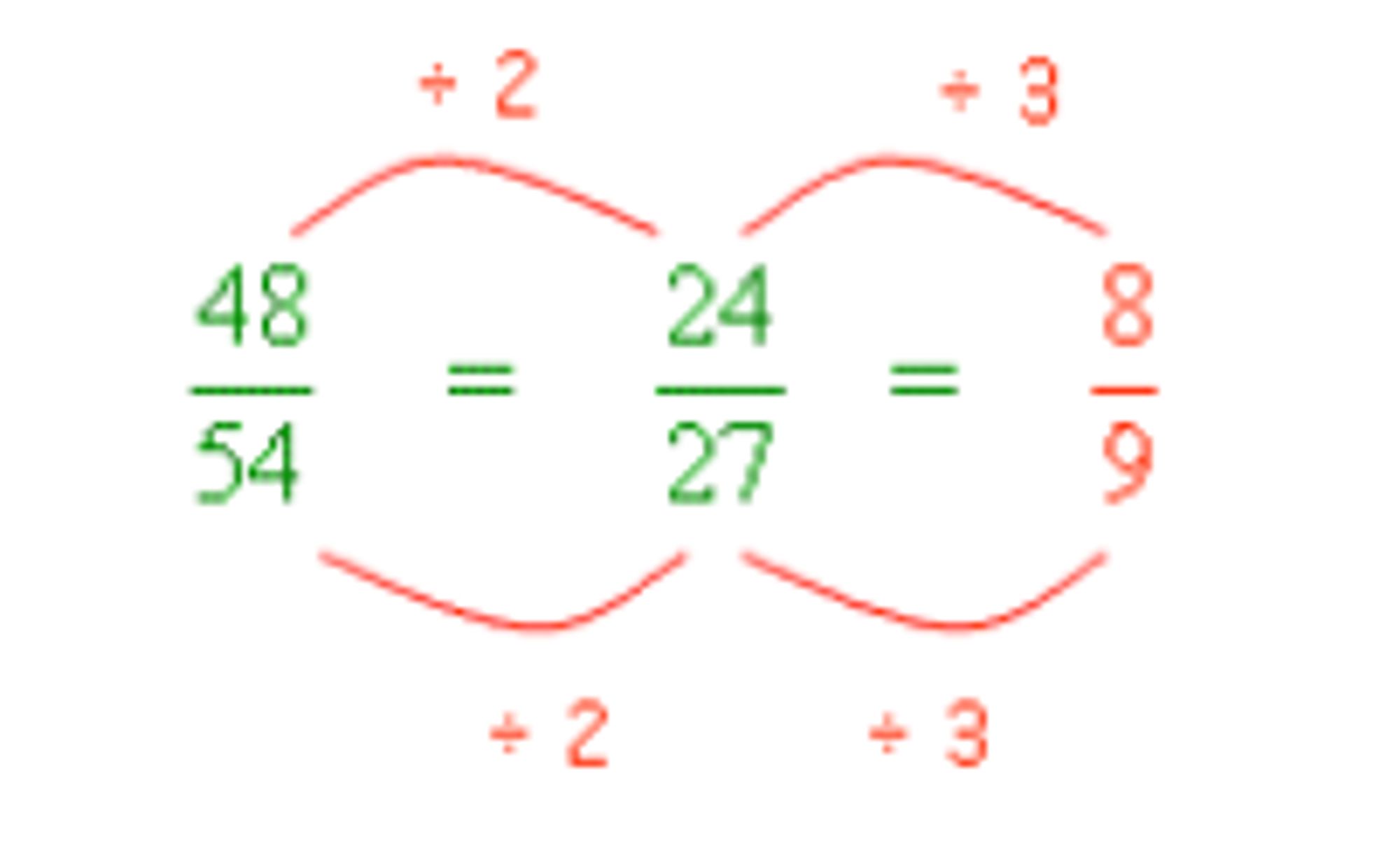
Example 3: Simplifying a Fraction
- Problem: Simplify the fraction .
- Steps:
- Find a common factor that divides both the numerator and the denominator. Start by dividing by :
- Now, divide both by :
- Result: The simplified fraction is .
Visual Representation:
Proper and Improper Fractions
Definitions:
- Proper Fraction: A fraction where the numerator (top number) is smaller than the denominator (bottom number). This type of fraction represents a part of a whole that is less than one.
- Example:
- Improper Fraction: A fraction where the numerator is equal to or greater than the denominator. This type of fraction represents a value that is equal to or greater than one whole.
- Example:
- Mixed Number: A combination of a whole number and a proper fraction, used to express an improper fraction.
- Example:
Converting Improper Fractions to Mixed Numbers:
Note
Example 1: Convert to a Mixed Number
-
Step 1: Divide the numerator by the denominator: with a remainder of
-
The quotient () represents the whole number.
-
The remainder () becomes the numerator of the proper fraction.
-
Step 2: Write the remainder over the original denominator:
- Result: The improper fraction is equivalent to the mixed number .
Converting Mixed Numbers to Improper Fractions:
Note
Example 2: Convert to an Improper Fraction
- Step 1: Multiply the whole number by the denominator:
- Step 2: Add the result to the numerator:
- The sum becomes the numerator of the improper fraction.
- Step 3: Write the result over the original denominator:
- Result: The mixed number is equivalent to the improper fraction .
Adding, Subtracting, Multiplying, and Dividing Fractions
(a) Adding and Subtracting Fractions
Important Reminder:
- Never add or subtract fractions by adding or subtracting the numerators and denominators directly. This approach is incorrect and will not give you the correct answer.
Correct Steps for Adding and Subtracting Fractions:
- Convert Mixed Numbers: If your fractions are in mixed number form, first convert them into improper fractions (top-heavy).
- Common Denominator: Ensure both fractions have the same denominator. To do this:
- Choose the lowest common multiple (LCM) of both denominators.
- Convert both fractions so that they share this common denominator.
- Add or Subtract the Numerators: Once the denominators are the same, add or subtract the numerators, keeping the denominator the same.
- Simplify: If possible, simplify the resulting fraction to its lowest terms.
Note
Example 1: Adding Fractions
Note
Example 2: Subtracting Fractions
- Problem:
- Steps:
- Find a common denominator:
- The LCM of and is .
- Convert to .
- Subtract the numerators:
- Result: The difference is .
(b) Multiplying and Dividing Fractions
Multiplying Fractions:
- Convert Mixed Numbers: Convert any mixed numbers to improper fractions.
- Multiply the Numerators Together: Multiply the top numbers (numerators) together.
- Multiply the Denominators Together: Multiply the bottom numbers (denominators) together.
- Simplify: Simplify the resulting fraction to its lowest terms.
Note
Example 1: Multiplying Fractions
- Problem:
- Steps:
- Multiply the numerators:
- Multiply the denominators:
- Result: The product is .
(c) Dividing Fractions:
- Convert Mixed Numbers: Convert any mixed numbers to improper fractions.
- Flip the Second Fraction: Invert (flip) the second fraction.
- Multiply: Multiply the first fraction by the flipped second fraction.
- Simplify: Simplify the resulting fraction.
Note
Example 2: Dividing Fractions
- Problem:
- Steps:
- Flip the second fraction:
- Change to multiplication:
- Multiply the numerators:
- Multiply the denominators:
- Result: The quotient is .
Fractions, Decimals, and Percentages
Fractions, decimals, and percentages are closely related, and being able to convert between them is an essential skill
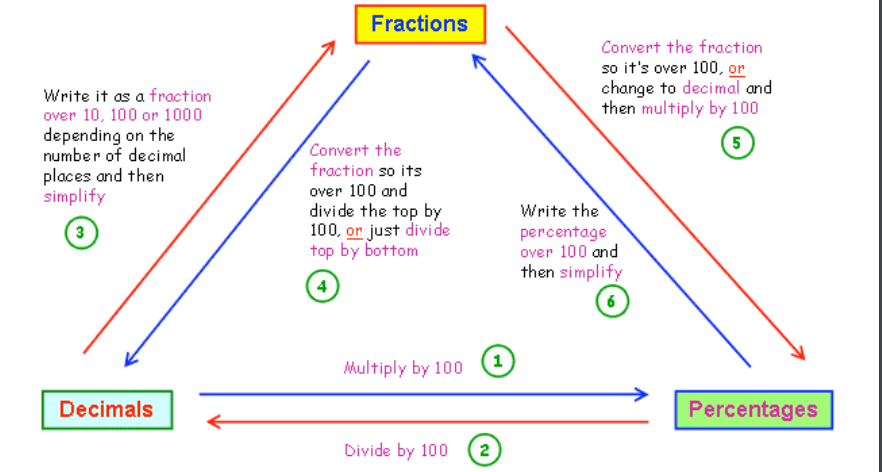
Converting Between Fractions, Decimals, and Percentages:
1. Converting a Decimal to a Percentage
Note
- Example: Convert to a percentage.
- Steps:
- Multiply the decimal by :
- Result: as a percentage is 36.4%.
2. Converting a Percentage to a Decimal
Note
- Example: Convert to a decimal.
- Steps:
- Divide the percentage by :
- Result: as a decimal is 0.083.
3. Converting a Decimal to a Fraction
Note
- Example: Convert to a fraction.
- Steps:
- Write the decimal as a fraction with the denominator as (since there are two decimal places):
- Simplify the fraction by dividing both the numerator and the denominator by their greatest common divisor (GCD), which is in this case:
- Result: as a fraction is .
4. Converting a Fraction to a Decimal
Note
- Example: Convert to a decimal.
- Steps:
- Adjust the fraction so that the denominator is (multiply both the numerator and the denominator by ):
- Convert the fraction to a decimal by dividing the numerator by the denominator:
- Result: as a decimal is 0.65.
5. Converting a Fraction to a Percentage
Note
- Example: Convert to a percentage.
- Steps:
- First, convert the fraction to a decimal by dividing the numerator by the denominator:
- Then, convert the decimal to a percentage by multiplying by :
- Result: as a percentage is 62.5%.
6. Converting a Percentage to a Fraction
Note
- Example: Convert to a fraction.
- Steps:
- Start by writing the percentage as a fraction over :
- To remove the decimal, multiply both the numerator and the denominator by :
- Simplify the fraction by dividing both the numerator and the denominator by their GCD, which is :
- Result: as a fraction is .