Negative Numbers (OCR GCSE Maths): Revision Notes
📚Revision Notes
Negative Numbers
Understanding the Number Line:
The key to understanding negative numbers is the number line. Imagine a number line where positive numbers are to the right of zero, and negative numbers are to the left.
- Positive Numbers: Increase as you move to the right.
- Negative Numbers: Decrease as you move to the left.
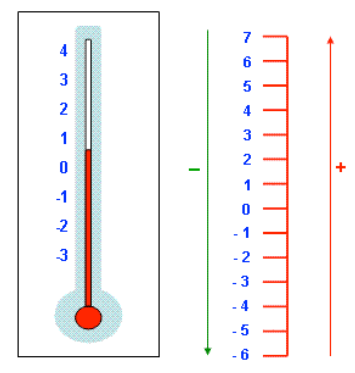
Think of the number line like a thermometer:
- Going up the number line (to the right) increases the value.
- Going down the number line (to the left) decreases the value.
Adding and Subtracting when Signs are NOT Touching
When you add or subtract numbers with different signs and they are not directly next to each other (i.e., no two negative signs touching), the key is to visualise the process using a number line or to think about it in terms of money.
Number Line Approach
Imagine a number line where positive numbers increase as you move to the right and negative numbers decrease as you move to the left.
Worked Examples:
Note
Example 1:
- Start at on the number line.
- Move left spaces because you are subtracting .
- Final position is at .
Note
Example 2: 4. Start at on the number line. 5. Move right spaces because you are adding . 6. Final position is at .
Note
Example 3: 7. Start at on the number line. 8. Move left spaces because you are subtracting . 9. Final position is at .

Note
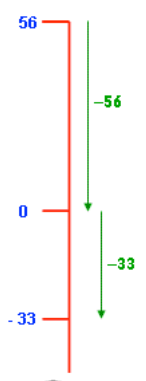
Example 4: 10. Visualize Starting at :
- Imagine your finger is at on the number line.
- Move Left to Zero:
- To reach zero, you must move spaces to the left.
- Move Further Left:
- You still need to subtract more, so continue more spaces left to complete the subtraction (since ).
- Final Position:
- Your final position on the number line is at .
Money Analogy:
- Imagine you have and someone takes away . You lose all , and you're now in debt.
Note
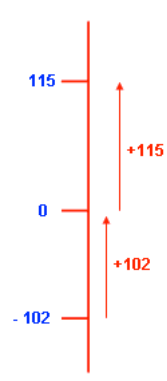
Example 5: 14. Visualize Starting at :
- Imagine your finger is at on the number line.
- Move Right to Zero:
- To reach zero, you must move spaces to the right.
- Move Further Right:
- You still need to add more, so continue more spaces right to complete the addition (since ).
- Final Position:
- Your final position on the number line is at .
Money Analogy:
- Imagine you are in debt, and someone gives you . You first pay off your debt and are left with .
Adding and Subtracting When Signs ARE Touching
The Rule for Touching Signs
Rule: If two signs are touching (meaning a or is directly next to another or ), you can replace them with a single sign using the following rules:
This rule simplifies calculations and helps avoid common mistakes when working with negative numbers.
Worked Examples:
Note
Example 1: Identify the Touching Signs:
-
Here, and are touching. Apply the Rule:
• Replace :highlight[$+ -$ with $-$].
Simplify the Expression:
-
The sum now becomes . Calculate the Result:
-
Using a number line or mentally, move spaces left from .
Final Answer:
Note
Example 2: Identify the Touching Signs:
-
Here, and are touching. Apply the Rule:
-
Replace with . Simplify the Expression:
-
The sum now becomes . Calculate the Result:
-
Add to .
Final Answer:
Note
Example 3: Identify the Touching Signs:
-
Here, and are touching. Apply the Rule:
-
Replace with . Simplify the Expression:
-
The sum now becomes . Calculate the Result:
-
Add to by moving spaces right from .
Final Answer:
Check the Signs:
Note
Example 4:
-
Here, the signs are not touching, so we don't apply the rule. Proceed with Calculation:
-
The sum remains . Calculate the Result:
-
Move spaces left from .
Final Answer:
Multiplying and Dividing
Note
Key Rule:
- Perform the multiplication or division as you normally would, ignoring the plus and minus signs.
- Count the number of minus signs in the problem:
- If there is one minus sign, the result is negative.
- If there are two minus signs, the result is positive.
- If there are three minus signs, the result is negative.
- If there are four minus signs, the result is positive.
- And so on...
Worked Examples:
Note
Example 1: 18. Perform the Division:
- Count the Minus Signs:
- There is one minus sign in the problem.
- Determine the Sign:
- One minus makes the answer negative. Final Answer:
Note
Example 2: 21. Perform the Multiplication:
- Count the Minus Signs:
- There are two minus signs in the problem.
- Determine the Sign:
- Two minuses make the answer positive. Final Answer:
Note
Example 3: 24. Perform the Multiplication:
- Count the Minus Signs:
- There are three minus signs in the problem.
- Determine the Sign:
- Three minuses make the answer negative. Final Answer:
Note
Example 4: 27. Perform the Division:
- Count the Minus Signs:
- There are two minus signs in the problem.
- Determine the Sign:
- Two minuses make the answer positive. Final Answer:
Tricky Questions Involving Negative Numbers
Worked Examples:
Note
📑Example 1: 3. Apply BIDMAS/BODMAS:
- Brackets first: Solve the expression inside the brackets.
- Now, the expression becomes
- Multiply:
- Perform the multiplication:
Final Answer:
Note
📑Example 2: 5. Apply BIDMAS/BODMAS:
- Division first:
- Substituting back into the expression gives:
- Simplify the Fraction:
- The fraction (because a negative divided by a negative is positive).
- Combine with the Original Expression:
Final Answer:
Note
📑Example 3: 8. Apply BIDMAS/BODMAS:
- Multiplication first on the numerator:
- Simplify the denominator by handling the negative signs:
- Now, the expression becomes:
- Simplify the Fraction:
Final Answer:
Worked Example: Exam-Style Question
Note
📝Question: Simplify the expression
Step-by-Step Solution:
- Solve the Brackets:
- Now the expression becomes:
- Multiply:
- Add:
Final Answer: