Proportion (OCR GCSE Maths): Revision Notes
📚Revision Notes
Proportion
Proportion refers to the relationship between two variables where one variable changes in a specific way as the other variable changes. This relationship can be either direct or inverse.
- Direct Proportion: As one variable increases, the other also increases, or as one decreases, the other decreases.
- Inverse Proportion: As one variable increases, the other decreases, and vice versa. The symbol is used to denote "is proportional to."
Types of Direct Proportion
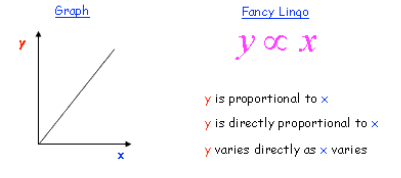
1. Linear Proportion
Fancy Notation:
Explanation: This means that increases directly as increases.
Note
Example:
- If is the number of KitKat Chunkys you buy, and is the total cost, then is directly proportional to
- Graph: A straight line through the origin shows a direct linear relationship.
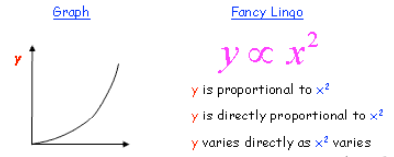
2. Quadratic Proportion
Fancy Notation:
Explanation: This means that increases as the square of increases.
Note
Example:
- If is the amount of money spent advertising a gig, and is the number of people who attend, then is directly proportional to .
- Graph: A curve that gets steeper as increases.
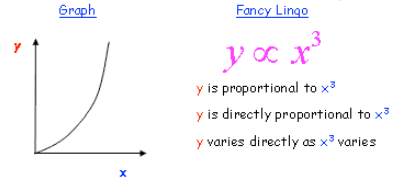
3. Cubic Proportion
Fancy Notation:
Explanation: This means that increases as the cube of increases.
Note
Example:
- If is the time you spend revising, and is your exam mark, then is directly proportional to .
- Graph: A curve that becomes very steep very quickly as increases.
Worked Examples:
Note
Example 1: Direct Linear Proportion Problem: The cost of buying KitKat Chunkys is directly proportional to the number of bars you buy. If bars cost , how much will bars cost?
Solution:
- Set Up the Proportion:
- means , where is the constant of proportionality.
- Find the Constant :
- Calculate the Cost for Bars:
- Final Answer: bars will cost .
Note
Example 2: Quadratic Proportion Problem: The number of people who hear about a concert is directly proportional to the square of the amount of money spent on advertising. If spending results in people hearing about the concert, how many people will hear about it if is spent?
Solution:
Step 1: Set Up the Proportion
The number of people, , is directly proportional to the square of the amount spent, . This can be written as:
[$$ y=kx²
where :highlight[$k$] is the constant of proportionality. --- **Step 2: Find the Constant** :highlight[$k$] Given:y = 1600 \ \text{people when } x = 4000 \ \text{pounds}.
1600=k×4000²
4000²=16,000,000
k=\frac {1600}{16,000,000}
k=\frac {1600}{16×10^6}= \frac{1}{10,000}
So, :highlight[$k=0.0001$] --- **Step 3: Calculate for** :highlight[$£9,000$] Now use this constant k_k_ to find $y$ when $x=9000$ Substitute $k=0.0001$ and $x=9000$ into the equation:y=0.0001×9000^2
Calculate $9000^2$:9000^2=81,000,000
Now calculate $y$:y=0.0001×81,000,000=8100
**Final Answer:** If :highlight[£$9,000$] is spent on advertising, approximately :success[$8,100$ people] will hear about the concert.What is Inverse Proportion?
Inverse proportion describes a relationship between two variables where:
- As one variable increases, the other decreases.
- As one variable decreases, the other increases. The mathematical symbol for inverse proportion is also ∝∝, but it's used differently compared to direct proportion.
General Form of Inverse Proportion:
- Simple Inverse Proportion:
- Quadratic Inverse Proportion:
Types of Inverse Proportion
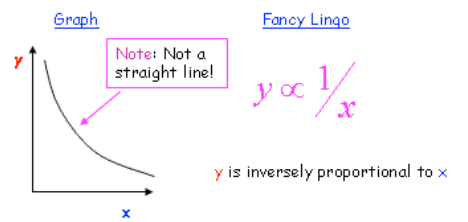
1. Simple Inverse Proportion
Fancy Notation:
Explanation: As increases, decreases in such a way that their product remains constant.
Note
Example:
- could be the number of people sharing a car ride, and could be the amount each person has to pay for petrol. As more people join the ride, the amount each person pays decreases.
- Graph: The graph of against is a hyperbola, which approaches both axes but never touches them.
Note
Worked Example 1: Simple Inverse Proportion Problem: The time taken to complete a journey is inversely proportional to the speed. If it takes hours to complete a journey at mph, how long will it take at mph?
Step-by-Step Solution:
- Set Up the Proportion:
- Since , we have
- Find the Constant kk:
- Given: hours, mph.
- Use to Find the New Time:
- At mph: hours.
Final Answer: It will take hours to complete the journey at mph.
2. Quadratic Inverse Proportion
- Fancy Notation:
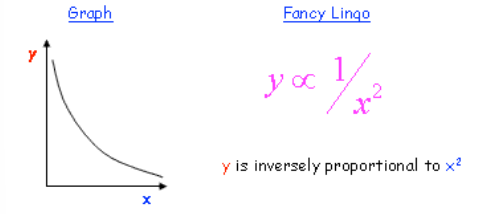
- Explanation: As x increases, decreases at a faster rate because is inversely proportional to the square of .
Note
- Example:
- could be the number of hours spent watching TV, and could be the number of brain cells remaining. As the number of hours increases, the number of brain cells decreases at an accelerating rate.
- Graph: The graph of against is a steeper curve than in simple inverse proportion, showing a faster rate of decrease.
Visual Representation:
Note
Worked Example 2: Quadratic Inverse Proportion Problem: The intensity of light is inversely proportional to the square of the distance from the light source. If the intensity is units at a distance of metres, what is the intensity at metres?
Step-by-Step Solution:
- Set Up the Proportion:
- Since , we have
- Find the Constant :
- Given: units, metres.
- Use to Find the New Intensity:
- At metres: units.
Final Answer: The intensity at metres is units.
3. Method for Tackling Proportion Questions
- Decide on the Type of Proportion:
- Direct or Indirect: Determine if the problem involves direct or inverse proportion.
- Linear, Quadratic, or Cubic: Identify if the relationship is linear quadratic , or cubic .
- Write the Expression with the Proportionality Symbol ():
Note
- Example: or .
- Make the Expression into an Equation:
- Replace the proportionality symbol with an equation using , the constant of proportionality.
Note
- Example: or .
- Use the Given Numbers to Find :
- Substitute the values provided in the question to solve for .
- Write Down the Formula:
- After finding , write down the complete formula.
- Answer the Questions:
- Use the formula to find the required values by substituting the given numbers.
Worked Examples:
Note
📑Example 1: Problem: is directly proportional to . Given that when , calculate the value of:
- (a) when
- (b) when
Step-by-Step Solution:
- Identify the Proportion Type:
- The problem states that is directly proportional to , so we write:
- Convert to an Equation:
- Replace the proportionality sign with an equation using :
- Find the Constant :
- Use the given values and to find :
- Write the Complete Formula:
- Now that , the relationship between and is:
- Solve Part (a): Find y when .
- Substitute into the formula:
Answer: when .
- Solve Part (b): Find when
- Substitute into the formula and solve for :
Answer: when .
Note
📑Example 2:
Note
📑Example 3: Problem:
is inversely proportional to . Given that when , the value of , find the value of when .
Step-by-Step Solution:
- Identify the Proportionality:
- The problem states that is inversely proportional to . We express this relationship as:
- Write the Equation:
- Replace the proportionality sign () with an equals sign and introduce a constant :
- Substitute Known Values:
- We know that when , . Substitute these values into the equation to find :
- Solve for :
- Rearrange the equation to solve for :
- Write the Full Equation:
- Now that we have , the full equation becomes:
- Substitute the New Value of :
- To find when , substitute into the equation:
- Calculate :
- Perform the division:
Final Answer:
When , .
Note
Example 4: Problem:
(a) Describe the variation using the proportionality symbol ().
(b) Find the equation connecting the two variables.
Given:
Step-by-Step Solution:
- Identify the Type of Proportion:
- The problem states that as increases from to , also increases from to .
- To determine the type of direct proportion, observe the changes:
- increases by a factor of (since ).
- increases by a factor of (since ).
- Since is , this suggests a quadratic proportion.
- Express the Proportion:
- The relationship between and is expressed as:
- This means that is directly proportional to the square of .
- Write the Equation:
- Replace the proportionality sign () with an equals sign and introduce a constant :
- Determine the Constant k:
- Use the given values to find . Substitute and into the equation:
- Simplify the equation to solve for :
- Write the Final Equation:
- Substitute the value of back into the equation:
- Verify the Equation:
- Check the equation with the other set of values () to ensure it works correctly:
- The equation works with both sets of values, confirming its accuracy.
Final Answer:
The equation connecting and is