Ratio (OCR GCSE Maths): Revision Notes
📚Revision Notes
Ratio
What is a Ratio?
A ratio is a way of showing the relative sizes of two or more values. It's commonly used to compare quantities, such as money, lengths, or time. Ratios can be written in different ways, but the most common format uses a colon .
Note
Example: If you have red squares and green squares, the ratio of red to green is
Why Do We Need Ratios?
Ratios allow us to understand the relationship between different quantities. For example, in a recipe, if the ratio of flour to sugar is , this tells us that for every parts of flour, we use part of sugar. Ratios are used in everyday life, science, engineering, and many other fields.
Writing Ratios
Ratios are written using a colon to separate the quantities being compared.
Note
Example: Consider the following grid of squares:
- Red Squares:
- Green Squares:
- Blue Squares:
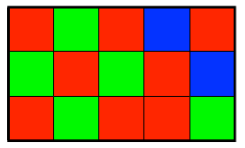
Note: Ratios can often be simplified in the same way as fractions. For example, the ratio can be simplified to .
From this grid, we can express the following ratios:
-
Ratio of Red to Green Squares: This means there are red squares for every green squares.
-
Ratio of Green to Red Squares: This means there are green squares for every red squares.
-
Ratio of Blue to Red Squares: This means there are blue squares for every red squares.
Simplifying Ratios
A ratio is simplified when the two (or more) numbers in the ratio are expressed in their lowest terms, meaning they have no common factors other than . Simplifying ratios is similar to simplifying fractions.
Note
Example: If the ratio of frogs to penguins is , it can be simplified by dividing both numbers by their greatest common factor (GCF).
Method for Simplifying Ratios
To simplify a ratio:
- Identify Common Factors: Find the greatest common factor (GCF) of the numbers in the ratio.
- Divide Both Sides by the GCF: Divide each number in the ratio by the GCF.
- Check: Ensure there are no further common factors. The ratio is now in its simplest form.
Worked Examples:
Note
Example 1: Simplifying Problem: Simplify the ratio
Step-by-Step Solution:
- Identify Common Factors:
- The numbers and share a common factor of .
- Divide Both Sides by the GCF:
- Write the Simplified Ratio:
- Check for Other Common Factors:
- and have no other common factors, so the ratio is fully simplified. Final Answer: The simplified ratio is .
Note
Example 2: Simplifying Problem: Simplify the ratio .
Step-by-Step Solution:
- Identify Common Factors:
- The numbers and share a common factor of .
- Divide Both Sides by the GCF:
- Write the Simplified Ratio:
- Check for Other Common Factors:
- and have no other common factors, so the ratio is fully simplified. Final Answer: The simplified ratio is
Understanding Through Visual Representation
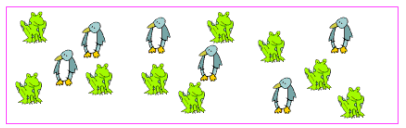
Consider a box with a mix of frogs and penguins:
- Original Ratio: The ratio of frogs to penguins is .
- Simplified Ratio: For every frogs, there are penguins, so the simplified ratio is .
and
Understanding the form and
- The first number is , and you express the second number as a multiple of the first.
- : The second number is , and you express the first number as a multiple of the second. Note: These forms are useful because they allow you to see the ratio as a comparison to a single unit.
Worked Examples:
Note
Example 1: Converting to Form Problem: Express the ratio in the form .
Step-by-Step Solution:
- Set the First Number to :
- To turn into , divide both sides of the ratio by .
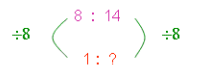
- Result:
Final Answer: The ratio expressed in the form is .
Note
Example 2: Converting to Form Problem: Express the ratio in the form
Step-by-Step Solution:
- Set the Second Number to :
- To turn into , divide both sides of the ratio by .
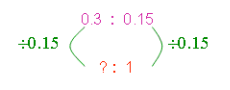
- Result:
Final Answer: The ratio expressed in the form is
Classic Ratio Questions
Note
In ratio problems, you're often given a ratio and some information about one part of it. Your task is to use this information to find out about the other parts. The key principle is whatever you multiply or divide one part by, you must do the same to the other parts.
Note
Problem: Oisin is making a cake, and the ingredients must be mixed in the following ratios:
- Flour : Butter = :
- Eggs : Sugar =
(a) If Oisin has of flour, how much butter does he need? (b) If he has eggs, how much sugar does he need?
Worked Example
Note
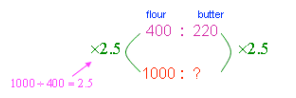
Example a): Finding Butter from Flour
- Write the Ratio:
-
Given ratio: Flour
-
Known amount of flour =
- Set Up the Ratio:
- You need to find out how much butter corresponds to of flour.
- Set up a ratio equation:
- Solve the Ratio:
- Determine how many times goes into :
- Multiply the butter quantity by the same factor:
Final Answer: He needs of butter.
Worked Example
Note
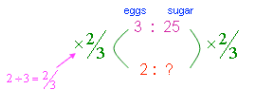
Example (b): Finding Sugar from Eggs 12. Write the Ratio:
-
Given ratio: Eggs
-
Known amount of eggs
- Set Up the Ratio:
- You need to find out how much sugar corresponds to eggs.
- Set up a ratio equation:
- Solve the Ratio:
- Multiply the sugar quantity by the same factor:
Final Answer: He needs approximately of sugar.
Sharing in a Given Ratio
Method for Sharing in a Given Ratio
- Add Up the Parts: Add together all parts of the ratio to find the total number of parts.
- Calculate the Value of One Part: Divide the total amount by the total number of parts to find the value of one part.
- Distribute the Amount: Multiply the value of one part by the number of parts each individual gets according to the ratio.
Worked Examples:
Note
Example 1: Sharing Chocolate Problem: You have a bar of chocolate to share with your mum in the ratio . How many pieces do each of you get if there are pieces of chocolate in total?
Step-by-Step Solution:
- Add Up the Parts:
- The ratio is , so the total number of parts is .
- Calculate the Value of One Part:
- Total chocolate pieces .
- Value of one part:
- Distribute the Chocolate:
- For yourself: pieces.
- For your mum: pieces.
Final Answer: You get pieces of chocolate, and your mum gets pieces.
Worked Example
Note
Example 2: Sharing Money Problem: Share £ in the ratio How much does each person get?
Step-by-Step Solution:
- Add Up the Parts:
- The ratio is , so the total number of parts is .
- Calculate the Value of One Part:
- Total money = £.
- Value of one part:
- Distribute the Money:
- First person ( parts):
- Second person ( parts):
- Third person ( parts):
Final Answer: The first person gets £, the second gets £, and the third gets £.