Standard Form (OCR GCSE Maths): Revision Notes
📚Revision Notes
Standard Form
Standard form is a way of writing numbers that are too big or too small to be conveniently written in decimal form. A number in standard form is written as:
Where:
- is a number between 1 and 10.
- is an integer (positive, negative, or zero).
Why Do We Need Standard Form?
When dealing with extremely large numbers (like the mass of the sun) or extremely small numbers (like the size of an atom), writing out all the zeros is impractical. Standard form simplifies these numbers by expressing them as a product of a number between 1 and 10, and a power of 10.
Note
📑Example of a Large Number:
- The mass of the sun:
- In standard form:
Note
📑Example of a Small Number:
- A tiny fraction of a second:
- In standard form:
The Structure of Standard Form
When a number is written in standard form, it looks like this:
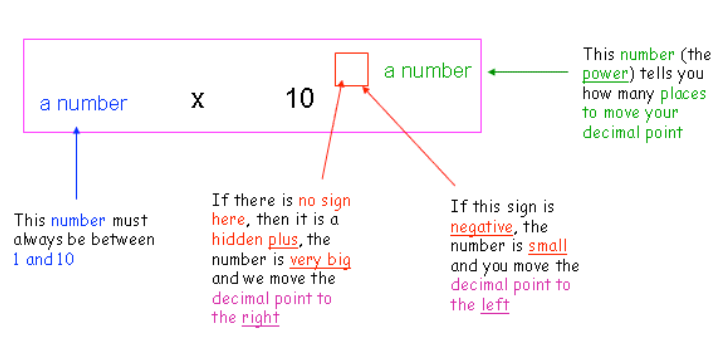
- The first number () must always be between 1 and 10.
- The power of 10 tells you how many places to move the decimal point:
- Positive Power: Move the decimal point to the right (the number is large).
- Negative Power: Move the decimal point to the left (the number is small).
Worked Examples:
Note
📑Example 1: Converting a Large Number to Standard Form Convert into standard form.
Step-by-Step Solution:
- Write the number as a decimal between 1 and 10:
- Count how many places the decimal point has moved to the left:
- The decimal point has moved 8 places.
- Express the number in standard form:
Final Answer: in standard form is
Note
📑Example 2: Converting a Small Number to Standard Form Convert into standard form.
Step-by-Step Solution:
- Write the number as a decimal between 1 and 10:
- Count how many places the decimal point has moved to the right:
- The decimal point has moved 4 places.
- Express the number in standard form:
Final Answer: in standard form is
1. Writing Numbers in Standard Form
Method:
- Identify the Decimal Point: Place your finger where the decimal point is (it might be hidden if the number is a whole number).
- Count the Places: Count backwards or forwards the number of places you have to move the decimal point to create a number between 1 and 10.
- Write in Standard Form: Express the number as , where a is the number between 1 and 10, and is the number of places you moved the decimal point.
Worked Example 1: Large Number
Note
📑Example: Convert into standard form. Step-by-Step Solution:
- Start with the original number:
- Move the decimal point: Place it between and to create a number between 1 and 10: .
- Count the places: The decimal point moved 9 places to the left.
- Write in standard form:
Final Answer: in standard form is .
Worked Example 2: Small Number
Note
📑Example: Convert into standard form. Step-by-Step Solution:
- Start with the original number:
- Move the decimal point: Place it between and to create a number between 1 and 10: .
- Count the places: The decimal point moved 5 places to the right.
- Write in standard form:
Final Answer: in standard form is .
2. Changing Numbers from Standard Form
Method:
- Identify the Power of 10: The exponent tells you how many places to move the decimal point.
- Move the Decimal Point: If the exponent is positive, move the decimal point to the right; if negative, move it to the left.
- Fill in the Gaps: Add zeros as needed to complete the number.
Worked Example 1: Positive Exponent
Note
📑Example: Convert to a decimal number. Step-by-Step Solution:
- Identify the power: means you move the decimal point 6 places to the right.
- Move the decimal point:
- Start with .
- Move the decimal point 6 places: .
- Fill in the gaps with zeros: The number becomes
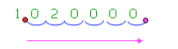
Final Answer: is 1,020,000 in decimal form.
Worked Example 2: Negative Exponent
Note
📑Example: Convert to a decimal number. Step-by-Step Solution:
- Identify the power: means you move the decimal point 5 places to the left.
- Move the decimal point:
- Start with .
- Move the decimal point 5 places: .
- Fill in the gaps with zeros: The number becomes
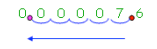
Final Answer: is 0.000076 in decimal form.
3. Multiplying and Dividing with Standard Form
When multiplying or dividing numbers in standard form, you need to:
- Multiply/Divide the Coefficients: Handle the numbers (coefficients) in front of the powers of 10.
- Add/Subtract the Powers: For multiplication, add the exponents; for division, subtract the exponents.
Worked Example 1: Multiplying Numbers in Standard Form
Note
📑Problem: Multiply by Step-by-Step Solution:
- Multiply the Coefficients:
- Add the Powers:
- Combine the Results:
- Check the Result: The answer is not yet in standard form because 40 is not between 1 and 10.
- Adjust to Standard Form:
Final Answer: .
Worked Example 2: Dividing Numbers in Standard Form
Note
📝Problem: Divide by Step-by-Step Solution:
- Divide the Coefficients:
- Subtract the Powers:
- Combine the Results:
- Check the Result: The answer is not yet in standard form because 0.6 is not between 1 and 10.
- Adjust to Standard Form:
Final Answer: .
4. Adding and Subtracting in Standard Form
- Ensure Same Powers of 10: Before you add or subtract, make sure both numbers are expressed with the same power of 10.
- Convert to Standard Form: If necessary, convert your final answer back into standard form.
Worked Example 1: Adding Numbers in Standard Form
Note
📝Problem: Add and . Step-by-Step Solution:
- Rewrite in Standard Form:
- Convert and into their full forms:
- Align the Numbers:
- Align the digits by their decimal places and add:
- Convert Back to Standard Form:
- The result 454,000 needs to be converted back into standard form:
Final Answer: .
Worked Example 2: Subtracting Numbers in Standard Form
Note
📝Problem: Subtract from Step-by-Step Solution:
- Rewrite in Standard Form:
- Convert and into their full forms:
- Align the Numbers:
- Align the digits by their decimal places and subtract:
- Convert Back to Standard Form:
- The result 0.00794 needs to be converted back into standard form:
Final Answer: .