Angle Facts (OCR GCSE Maths): Revision Notes
📚Revision Notes
Angle Facts
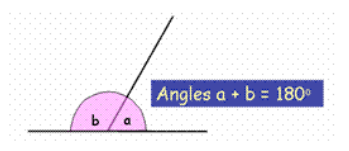
Fact 1: Angles on a Straight Line
Key Fact:
Angles on a straight line add up to 180°.
How to Spot It:
If you see any continuous straight line with another straight line joining it or cutting across it, then the angles formed by this intersection will always sum to 180°.
Note
Example Question: Given that one angle on a straight line is 120°, find the other angle.
Step-by-Step Solution:
- Let the unknown angle be
- Since angles on a straight line add up to 180°, you can set up the equation:
- Subtract 120° from both sides:
- Calculate :
So, the other angle is 60°.
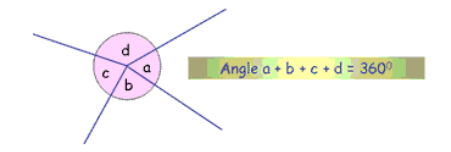
Fact 2: Angles Around a Point
Key Fact:
Angles around a point add up to 360°.
How to Spot It:
Whenever you have multiple lines that meet at a single point, the sum of all the angles formed around that point is 360°.
Note
Example Question: Given four angles around a point: 90°, 85°, 100°, and . Find .
Step-by-Step Solution:
- Set up the equation using the fact that the sum of angles around a point is 360°:
- Add the known angles:
- Subtract 275° from both sides:
- Calculate :
So, the missing angle is 85°.
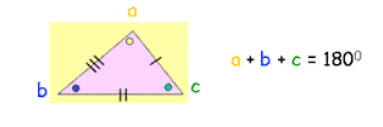
Fact 3: Angles in a Triangle
Key Fact:
The interior (inside) angles of any triangle add up to 180°.
How to Spot It:
Look for any type of triangle—equilateral, isosceles, right-angled, or scalene—and remember that the sum of its interior angles will always be 180°.
Note
Example Question: In a triangle, two angles are 65° and 75°. Find the third angle.
Step-by-Step Solution:
- Let the unknown angle be .
- Set up the equation using the fact that the sum of angles in a triangle is 180°:
- Add the known angles:
- Subtract 140° from both sides:
- Calculate :
So, the third angle is 40°.
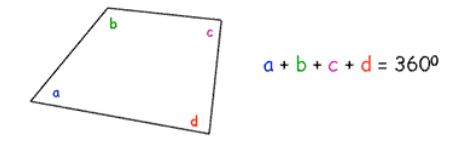
Fact 4: Angles in a Quadrilateral
Key Fact:
The interior (inside) angles of a quadrilateral add up to 360°.
How to Spot It:
Identify any four-sided shape (such as a square, rectangle, trapezium, or kite). Regardless of the type of quadrilateral, the sum of all its interior angles will always be 360°.
Note
Example Question: A quadrilateral has three angles measuring 85°, 95°, and 100°. Find the measure of the fourth angle.
Step-by-Step Solution:
- Let the unknown angle be .
- Set up the equation using the fact that the sum of angles in a quadrilateral is 360°:
- Add the known angles:
- Subtract 280° from both sides:
- Calculate :
So, the fourth angle is 80°.
Fact 5: Opposite Angles
Key Fact:
Opposite angles are equal.
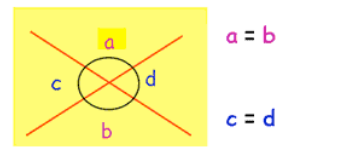
How to Spot It:
When two straight lines intersect, they form two pairs of opposite (also called vertical) angles. These angles are always equal to each other.
Note
Example Question: Two intersecting lines form an angle of 110°. Find the measures of the three remaining angles.
Step-by-Step Solution:
- Identify the angle that is opposite the given angle of 110°. By the property of opposite angles, this angle is also 110°.
- The other two angles are opposite to each other and must both add up with 110° to equal 180° (since they are on a straight line).
- Set up the equation:
- Subtract 110° from both sides:
- The other two angles are 70° each.
So, the remaining angles are 110°, 70°, and 70°.
A Quick Note on Parallel Lines
Definition:
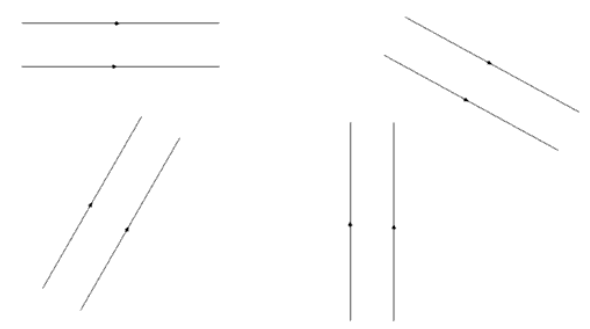
Parallel lines are lines that never meet and always maintain a consistent distance from each other. In diagrams, parallel lines are often marked with little arrows to indicate that they are indeed parallel.
Fact 6: Corresponding Angles
Key Fact:
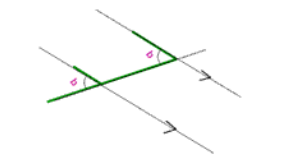
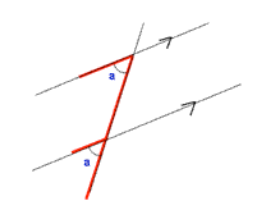
Corresponding angles are equal.
How to Spot It:
Look for the F shape formed when a transversal (a line that crosses two other lines) cuts across two parallel lines. The angles in the corresponding positions (underneath the arms of the F) are equal.
Note
Example Question: In the diagram below, if one of the corresponding angles is 75°, what are the measures of the other corresponding angles?
Step-by-Step Solution:
- Identify the corresponding angles using the F shape.
- Since corresponding angles are equal, all corresponding angles will be 75°. So, all corresponding angles in the diagram are 75°.
Fact 7: Alternate Angles
Key Fact:
Alternate angles are equal.
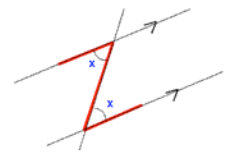
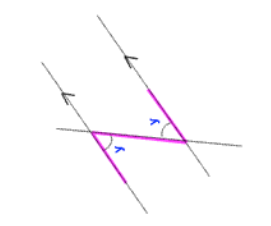
How to Spot It:
Look for the Z shape (or backwards Z) that forms when a transversal cuts through two parallel lines. The angles inside the Z shape are alternate angles and are equal.
Note
Example Question: In the diagram, if one of the alternate angles is 60°, what are the measures of the other alternate angles?
Step-by-Step Solution:
- Identify the alternate angles using the Z shape.
- Since alternate angles are equal, the other alternate angle will also be 60°. So, all alternate angles in the diagram are 60°.
Fact 8: Interior Angles
Key Fact:
Interior angles (also known as co-interior or consecutive angles) add up to 180° when formed between two parallel lines by a transversal.
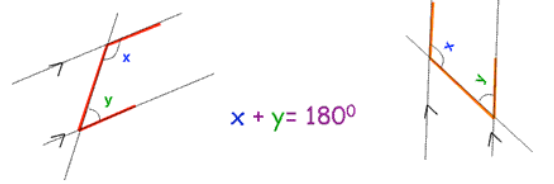
How to Spot It:
Look for the C shape. The angles inside the C shape, underneath the top and bottom of the C, are interior angles.
Important Note:
The lines forming the top and bottom of the C must be parallel.
Note
Example Problem: If you have a diagram where and are interior angles, and you know that 70°, find the value of .
Step-by-Step Solution:
- Identify the interior angles using the C shape.
- Use the key fact:
- Substitute the given value:
- Solve for :
- 110°
So, the value of is 110°.
Note
Tips for Answering Angle Questions
- Always Write Down the Name of Each Angle Fact You Use:
- Clearly state which angle fact (like corresponding, alternate, or interior angles) you've used to arrive at your answer. This shows your understanding and makes your working clear.
- Check for Parallel Lines:
- Remember, lines are only parallel if they have the little arrows to indicate it. Never assume lines are parallel unless marked.
- Use Alphabetical Order:
- If you are given multiple angles to find and aren't sure where to start, it's often a good idea to work in alphabetical order. This can help keep your working organised.
- Multiple Methods:
- There are often various ways to solve angle problems. If you get stuck, consider if there's another angle fact or method that could help you find the solution.
Note
Example 1: Using Angles on a Straight Line and Opposite Angles
Problem: Given that angle is 56°, find the values of , , and .
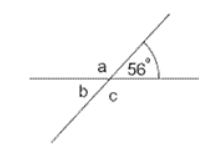
Solution:
- Finding :
- 124°
- Fact 1: Angles on a straight line add up to 180°.
- Finding :
- 56° (opposite angle to )
- Fact 5: Opposite angles are equal.
- Finding :
- 124°
- Fact 2: Angles around a point add up to 360°.
Note
Example 2: Using Opposite Angles and Corresponding Angles
Problem: Given that angle is 118°, find the values of , , and .
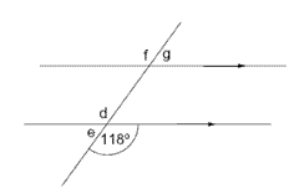
Solution:
- Finding :
- 118° (opposite angle to )
- Fact 5: Opposite angles are equal.
- Finding :
- 118° (corresponding angle to )
- Fact 6: Corresponding angles are equal.
- Finding :
- 62°
- Fact 1: Angles on a straight line add up to 180°.
Note
Example 3: Using Angles in a Triangle and Quadrilateral
Problem: Given that angle is 51°, find the values of , , and .
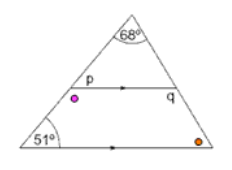
Solution:
- Finding :
- 68°
- Fact 3: Angles in a triangle add up to 180°.
- Finding :
- 180°
- Fact 4: Angles in a quadrilateral add up to 360°.
- Finding :
- 112°
- Fact 1: Angles on a straight line add up to 180°.
Note
Example 4: Using Interior Angles and Angles in a Triangle
Problem: Given that angle is 30°, find the values of and .
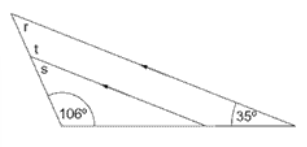
Solution:
- Finding :
- 150°
- Fact 3: Angles in a triangle add up to 180°.
- Finding :
- 39°
- Fact 8: Interior angles add up to 180°.