Circle theorems (OCR GCSE Maths): Revision Notes
📚Revision Notes
Circle theorems
Understanding Parts of a Circle
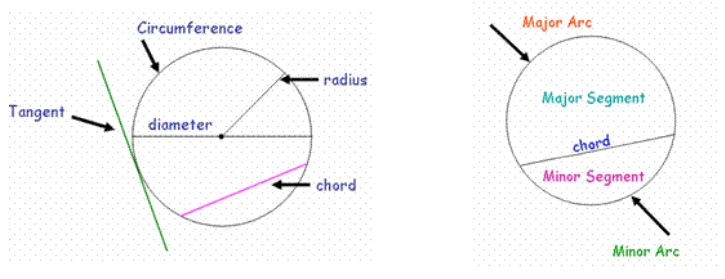
Before diving into circle theorems, it's essential to familiarise yourself with the different parts of a circle:
- Circumference: The complete distance around the circle.
- Radius: The distance from the centre of the circle to any point on its circumference.
- Diameter: A straight line passing through the centre of the circle, connecting two points on the circumference. The diameter is twice the radius.
- Chord: A line segment connecting two points on the circle's circumference.
- Tangent: A line that touches the circle at exactly one point.
- Arc: A part of the circumference of the circle.
- Major Arc: The larger part of the circumference.
- Minor Arc: The smaller part of the circumference.
- Segment: The area between a chord and the circumference.
- Major Segment: The larger segment.
- Minor Segment: The smaller segment.
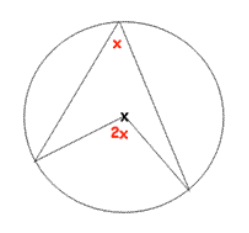
Theorem 1: Angle at the Centre
Fact: The angle at the centre of a circle is twice as large as the angle at the circumference made by the same arc or chord.
How to Spot It:
- Start with two points on the circumference (these could be the ends of a chord).
- Draw lines from these points to the centre of the circle.
- The angle formed at the centre is twice as large as the angle formed at the circumference by the same arc or chord.
Note
Example: If the angle at the circumference is , then the angle at the centre is Diagram Explanation: Imagine an arc of a circle with two endpoints. Draw two lines from these endpoints to the centre of the circle, creating an angle at the centre, . Now draw lines from the same two endpoints to any point on the circumference, creating an angle . The angle at the centre () is twice the angle at the circumference ().
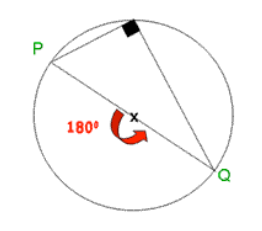
Theorem 2: Angles in a Semi-Circle
Fact: The angle made at the circumference of a semi-circle is always a right angle ().
How to Spot It:
- Look for a triangle where the base is the diameter of the circle.
- The angle at the circumference in this triangle will always be a right angle.
Note
Example:
- If you have a triangle inscribed in a circle where one side is the diameter of the circle, the angle opposite the diameter will always be .
Diagram Explanation: Consider a semi-circle where the diameter is the base of a triangle. The two ends of the diameter are connected to any point on the circumference, forming a triangle. The angle opposite the diameter, at the circumference, will always be .
Note: This theorem is actually a special case of Theorem . When the angle at the centre is (as the diameter passes through the centre), the angle at the circumference must be half of this, hence
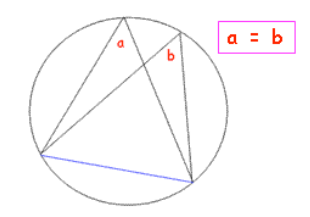
Theorem 3: Angles in the Same Segment
Fact: Angles in the same segment of a circle are equal to each other.
How to Spot It:
- Start with two points on the circle (these could be the ends of a chord).
- If you draw lines from these points to any point on the circumference within the same segment, the angles formed will be equal.
Note
Example:
- In a circle, if two different angles are subtended by the same chord and lie in the same segment, then these angles are equal, i.e.,
Diagram Explanation: Consider two points on the circumference of a circle, and , connected by a chord. Now draw two lines from points and to any point on the same segment of the circle, forming two angles. According to this theorem, these two angles are equal.
Theorem 4: Cyclic Quadrilateral
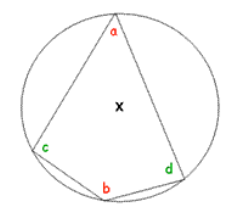
Fact: The opposite angles in a cyclic quadrilateral add up to .
How to Spot It:
- Look for a four-sided shape (quadrilateral) where all vertices lie on the circumference of a circle.
- In such a quadrilateral, the sum of opposite angles is always .
Note
Example:
- If you have a cyclic quadrilateral .
Diagram Explanation: Consider a quadrilateral inscribed in a circle, where all the vertices () lie on the circumference. According to this theorem, the sum of opposite angles will each add up to .
Note:
- Like any other quadrilateral, the sum of all interior angles in a cyclic quadrilateral is still .
Theorem 5: Tangent
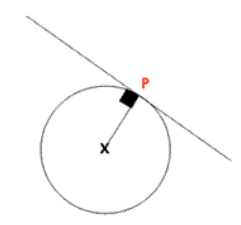
Fact: The angle made by a tangent and the radius at the point of contact is always a right angle ().
How to Spot It:
- A tangent is a straight line that only touches the circle at one point.
- If you draw a line from that point of contact to the centre of the circle, the angle formed between the tangent and the radius is always .
Note
Example:
- Given a circle with centre and a tangent touching the circle at point , the angle between OP (radius) and (tangent) is .
Diagram Explanation:
- Consider a circle with a tangent touching it at point . Draw the radius from the centre to the point of contact. The angle formed between the radius and the tangent is .
Theorem 6: Alternate Segment Theorem
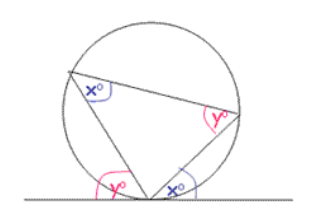
Fact: The angle between a tangent and a chord at the point of contact is equal to the angle made by the chord in the alternate segment of the circle.
How to Spot It:
- Look for a tangent and a chord meeting at the same point on the circle.
- The angle between the tangent and the chord at the point of contact will be equal to the angle subtended by the chord in the opposite segment of the circle.
Note
Example:
- If is a tangent to the circle at point and is a chord, then the angle between the tangent and the chord is equal to the angle subtended by the chord at the circumference in the opposite segment.
Diagram Explanation:
- Consider a circle with a tangent touching the circle at and a chord drawn inside the circle. The angle formed between the tangent and the chord is equal to the angle subtended by on the opposite side of the circle.
Theorem 7: Two Tangents
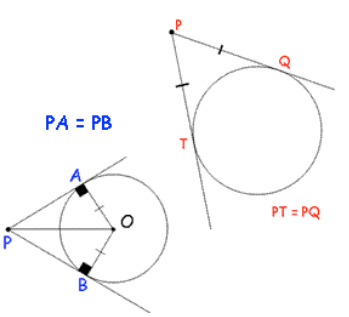
Fact: From any point outside a circle, you can draw exactly two tangents to the circle, and these tangents will be equal in length.
How to Spot It:
-
Look for the point where the two tangents meet outside the circle.
-
The lengths from the point where the tangents touch the circle to the external point will always be the same. Important Note:
-
This theorem often results in the formation of isosceles triangles. Keep an eye out for these triangles in problems involving two tangents.
Note
Example:
- Consider a point outside the circle. Two tangents and touch the circle at points and respectively. According to Theorem , the lengths and are equal, i.e.,
Diagram Explanation:
- Imagine a point outside the circle. Draw two tangents and from to touch the circle at points and . The lengths of these tangents will be equal, so .
Theorem 1: Angle at the Centre
- Fact: The angle at the centre of a circle is twice the angle at the circumference subtended by the same arc or chord.
- How to Spot It: Look for two points on the circumference that are connected to the centre of the circle. The angle formed at the centre will be twice that of the angle at the circumference.
Note
Example 1:
- Given: and .
- Find and .
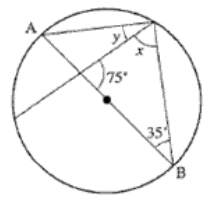
Solution:
- Use the angle sum of a triangle:
- For , since subtends the same arc as :
Theorem 2: Angles in a Semi-Circle
- Fact: The angle made at the circumference by a diameter is a right angle ().
- How to Spot It: Look for a triangle where one side is the diameter of the circle.
Note
Example 2:
- Given: . Find and .
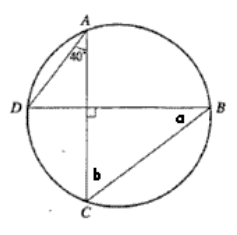
Solution:
- Since is opposite the diameter, it is a right angle:
- Using the angle sum of a triangle:
📑Example 3:
-
Given: . Find .
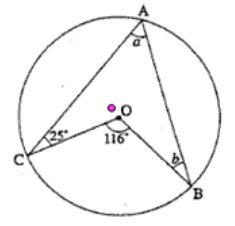
-
Solution:
-
Since and are in the same segment:
📑Example 4:
- Given: A quadrilateral inside a circle with one angle . Find the opposite angle .
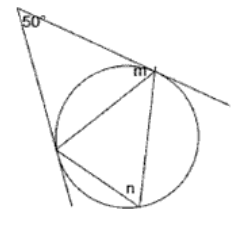
- Solution:
- The sum of the opposite angles in a cyclic quadrilateral is :
📑Example 5:
- Given: , , and a cyclic quadrilateral is formed with one exterior angle.
- Find: The values of , , and .
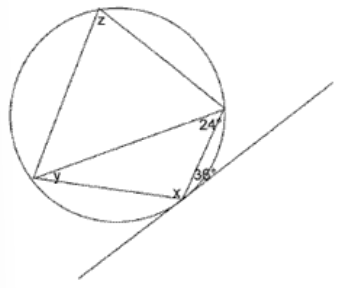
Solution:
- Determine :
- is found using the Alternate Segment Theorem:
- Determine :
- is found using the angle sum in a triangle:
- Determine =
- is found using the Cyclic Quadrilateral Theorem:
Thus, the solutions are: