Polygons (OCR GCSE Maths): Revision Notes
📚Revision Notes
Polygons
What Are Polygons?
A polygon is any closed shape which has three or more sides. Polygons can be classified into two main types: Regular Polygons and Irregular Polygons.
- Regular Polygons: These polygons have all sides of the same length and all their angles are the same size. Examples include squares, equilateral triangles, and regular octagons.
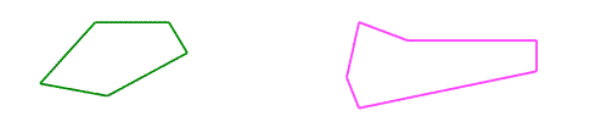
- Irregular Polygons: These polygons do not have equal-length sides or angles. Examples include rectangles, kites, and trapeziums. Irregular shapes can also include polygons with sides and angles of varying lengths and sizes, as shown in the examples below.
1. Triangles
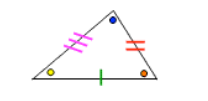
Triangles are polygons with three sides. There are four main types of triangles that you need to be familiar with, each with unique properties:
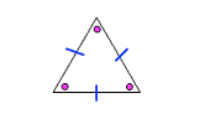
- Equilateral Triangle:
- Sides: All three sides are equal.
- Angles: All three angles are 60°.
- Properties: Three lines of symmetry.
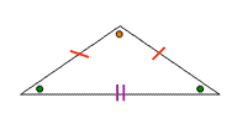
- Isosceles Triangle:
- Sides: Two sides are equal.
- Angles: Two angles are equal.
- Properties: One line of symmetry.
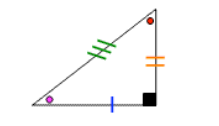
- Right-Angled Triangle:
- Sides: Can be scalene or isosceles.
- Angles: Has one right angle (90°).
- Properties: May have 0 or 1 line of symmetry.
- Scalene Triangle:
- Sides: All three sides are of different lengths.
- Angles: All three angles are of different sizes.
- Properties: No lines of symmetry.
2. Quadrilaterals
Quadrilaterals are polygons with four sides. There are several types of quadrilaterals, each with its own properties:
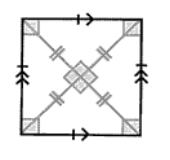
- Square:
- Sides: All four sides are equal.
- Angles: All four angles are right angles (90°).
- Properties: Opposite sides are parallel, and diagonals bisect each other at right angles. It has four lines of symmetry.
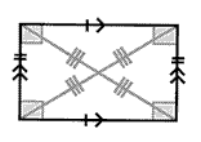
- Rectangle:
- Sides: Opposite sides are equal.
- Angles: All four angles are right angles (90°).
- Properties: Opposite sides are parallel, and diagonals are equal in length. It has two lines of symmetry.
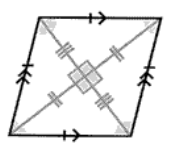
- Rhombus:
- Sides: All four sides are equal.
- Angles: Opposite angles are equal.
- Properties: Opposite sides are parallel, and diagonals bisect each other at right angles but are not equal in length. It has two lines of symmetry.
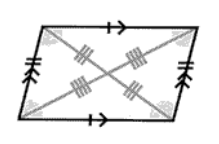
- Parallelogram:
- Sides: Opposite sides are equal and parallel.
- Angles: Opposite angles are equal.
- Properties: Diagonals bisect each other but are not equal in length. It has no lines of symmetry.
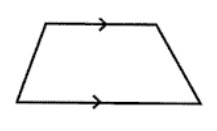
- Trapezium:
- Sides: Only one pair of opposite sides are parallel.
- Angles: The angles on the same side of a leg add up to 180°.
- Properties: May have no lines of symmetry.
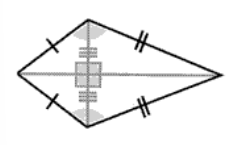
- Kite:
- Sides: Two pairs of adjacent sides are equal.
- Angles: One pair of opposite angles are equal.
- Properties: Diagonals intersect at right angles, but one diagonal bisects the other. It has one line of symmetry.
3. Other Polygons
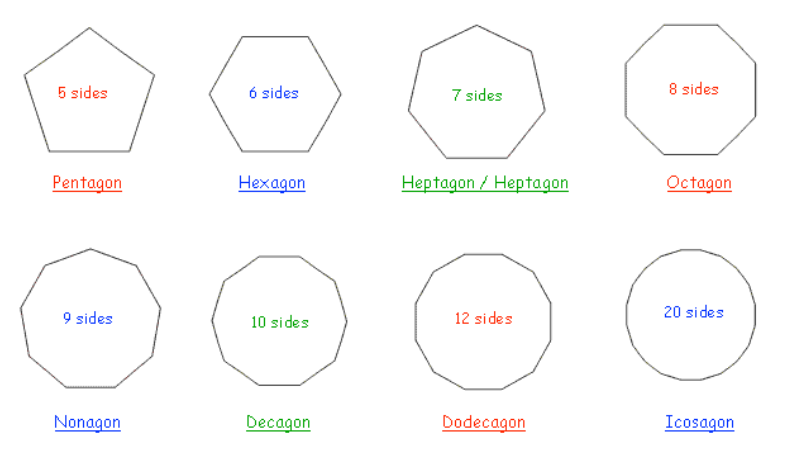
As soon as you get above 4 sides, the names of the polygons start to get more specific. Here are some of the main ones you should learn. Notice that each of the shapes below are regular polygons, meaning all sides and angles are equal. However, any polygon with the same number of sides can be irregular.
- Pentagon: 5 sides
- Hexagon: 6 sides
- Heptagon: 7 sides
- Octagon: 8 sides
- Nonagon: 9 sides
- Decagon: 10 sides
- Dodecagon: 12 sides
- Icosagon: 20 sides
4. Interior Angles of Polygons
The interior angle is any angle inside the polygon. If you know the number of sides a polygon has, you can work out the total sum of all the interior angles using this formula:
Why does this work?
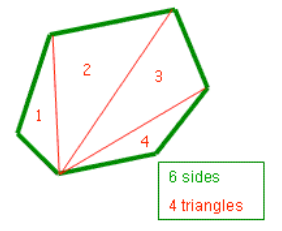
- The reasoning behind this formula involves splitting the polygon into triangles. For example, a hexagon can be split into four triangles.
- The sum of the interior angles of any triangle is 180°. So, for any polygon, the sum of the interior angles is 180° multiplied by the number of triangles you can split the polygon into.
For Regular Polygons
If all sides and angles of a polygon are equal (like in a regular polygon), you can work out the size of each interior angle by dividing the total sum of the interior angles by the number of sides:
5. Exterior Angles of Polygons
An exterior angle is an angle outside the polygon formed by extending one of the sides. A key fact about exterior angles is:
[$$ \text{Sum of all exterior angles}=360\degree
<img src="https://simplestudy-assets-prod.s3.eu-west-1.amazonaws.com/assets/backend/uploads/manually-styled-note-images/f3a56186-2b64-4dda-a406-e62793122f72.png" width="293" height="212" alt="image" /> ### **Why does this happen?** - If you keep moving around the polygon, extending the sides and measuring each exterior angle, by the time you get back to where you started, you've made a full circle! A full circle contains :highlight[360°]. ### **For Regular Polygons** - If all interior angles are equal (as in regular polygons), then all exterior angles are equal too. To find the size of each exterior angle in a regular polygon, use the formula: :highlight[$$ \text{Size of each exterior angle}=\frac{360\degree}{Number of sides} $$] ### **Finding Interior Angles Using Exterior Angles** - If you know the sizes of the exterior angles of a regular polygon, you can also calculate the sizes of the interior angles by remembering that **angles on a straight line add up to** :highlight[180°]. Therefore: :highlight[$\text{Size of each interior angle}=180\degree−\text{Size of each exterior angle}$] --- ## <u>**6. Massive Table of Polygon Facts**</u> Using the formulas discussed above, you can calculate various angle facts for different polygons, as summarised in the table below: | Name of Polygon | Number of Sides | Total Sum of Interior Angles | Size of Each Interior Angle (if Regular) | Total Sum of Exterior Angles | Size of Each Exterior Angle (if Regular) | |---|---|---|---|---|---| | Triangle | :highlight[3] | :highlight[180°] | :highlight[60°] | :highlight[360°] | :highlight[120°] | | Quadrilateral | :highlight[4] | :highlight[360°] | :highlight[90°] | :highlight[360°] | :highlight[90°] | | Pentagon | :highlight[5] | :highlight[540°] | :highlight[108°] | :highlight[360°] | :highlight[72°] | | Hexagon | :highlight[6] | :highlight[720°] | :highlight[120°] | :highlight[360°] | :highlight[60°] | | Heptagon | :highlight[7] | :highlight[900°] | :highlight[128.6°] (1dp) | :highlight[360°] | :highlight[51.4°] (1dp) | | Octagon | :highlight[8] | :highlight[1080°] | :highlight[135°] | :highlight[360°] | :highlight[45°] | ::question{#139962}