Similarity and congruency (OCR GCSE Maths): Revision Notes
📚Revision Notes
Similarity and Congruency
1. What Does It Mean If Two Shapes Are Congruent?
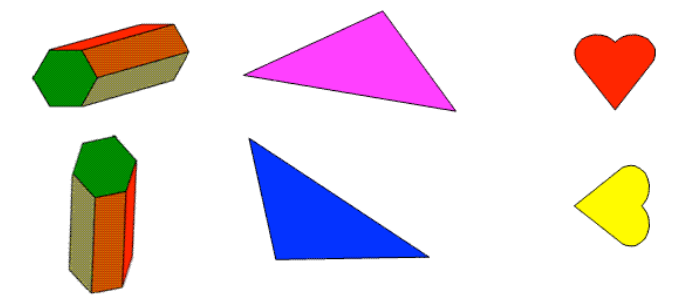
When mathematicians say that two shapes are congruent, they mean that the shapes are identical in every way.
Congruent shapes are the same size and shape.
They can be rotated, flipped, or moved, but they still remain congruent as long as their size and shape are preserved.
Note
Examples:
- Two triangles are congruent if they have the same angles and side lengths.
- Two rectangles are congruent if their lengths and widths are the same.
Congruent Triangles
Triangles are unique because they have three sides and three angles, and the sum of the interior angles is always . This means we don't need all the information about the sides and angles to prove that two triangles are congruent (identical in shape and size).
There are four sets of criteria you can use to determine if two triangles are congruent. If any of these criteria are met, the triangles are congruent.
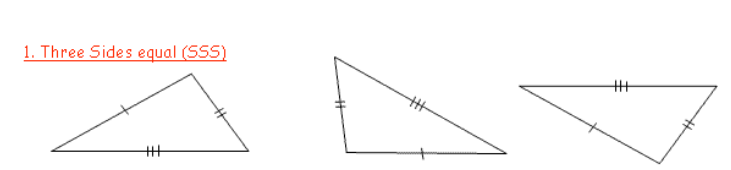
1. Three Sides Equal (SSS)
- Description: If all three sides of one triangle are equal to all three sides of another triangle, then the triangles are congruent.
Note
Example:
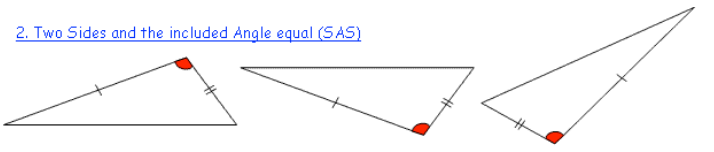
2. Two Sides and the Included Angle Equal (SAS)
- Description: If two sides and the angle between them (included angle) in one triangle are equal to two sides and the included angle in another triangle, then the triangles are congruent.
Note
Example:
3. Two Angles and a Corresponding Side Equal (AAS or ASA)
- Description: If two angles and the corresponding side in one triangle are equal to two angles and the corresponding side in another triangle, the triangles are congruent.

Note
Example:
4. Right Angle, Hypotenuse, and Side Equal (RHS)
- Description: If two triangles have a right angle, and the lengths of the hypotenuse and one other side are equal, the triangles are congruent.

Note
Example:
5. Examples of Congruent Triangles
When answering questions on congruent triangles, it's crucial to identify and apply one of the four conditions that prove triangles are congruent. Here are some examples:
Note
Example 1: Angle-Angle-Side (AAS)
- Triangles: Given triangles where two angles and a non-included side are equal.
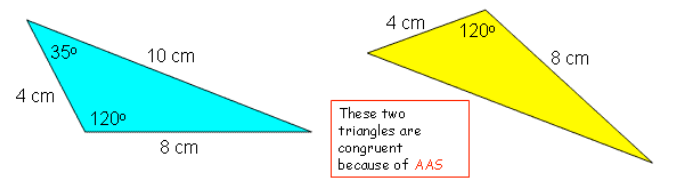
- Details:
- with , , and .
- with , , and .
- Congruency: These triangles are congruent because they satisfy the AAS condition (two angles and a corresponding side are equal).
Note
Example 2: Right Angle-Hypotenuse-Side (RHS)
-
Triangles: Given right-angled triangles where the hypotenuse and one other side are equal.
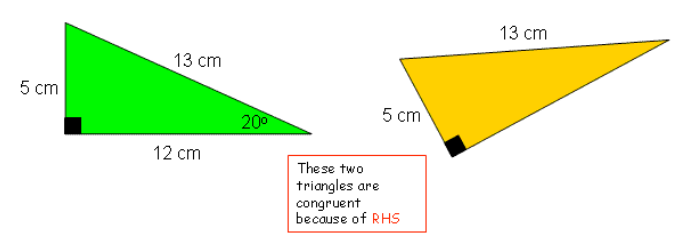
-
Details:
-
with , , and .
-
with , , and .
-
Congruency: These triangles are congruent because they satisfy the RHS condition (right angle, hypotenuse, and another side are equal).
2. If Two Shapes Are Similar, What Does That Mean?
Similarity in geometry means that two shapes are the same in form but different in size. One shape is an enlargement of the other, meaning that all corresponding sides are proportional.
- Scale Factor: The number by which you multiply (or divide) all the lengths of one shape to get the corresponding lengths in the other shape.
Note
Example of Similar Shapes:
- Shapes: Suppose you have two shapes where one is an enlargement of the other.
- The smaller shape is enlarged by a scale factor of to get the larger shape.
- Transformation: Each side of the smaller shape is multiplied by to obtain the corresponding sides of the larger shape.
Using Length Scale Factors
Concept: When two objects are similar, we can use the scale factor between them to find missing lengths, areas, or even volumes. The scale factor tells us how much one shape has been enlarged or reduced to get to the other.
Note
Example Problem:
Given three similar rectangles , , and , with the following dimensions:
- Rectangle : Height = , Length =
- Rectangle : Height = , Length =
- Rectangle : Height = , Length =
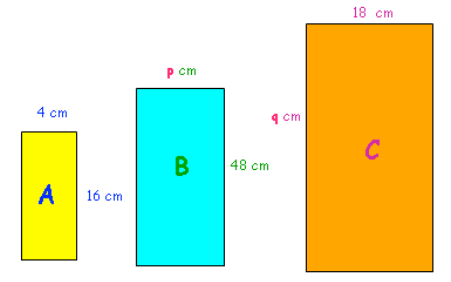
We are asked to find the missing lengths and .
Step-by-Step Solution:
- Determine the Scale Factor Between Rectangles:
- Start by finding the scale factor between Rectangles and .
- Scale Factor for Length:
- This means Rectangle is an enlargement of Rectangle by a factor of .
- Find the Missing Length :
- To find , we use the scale factor from Rectangle to Rectangle .
- Since the heights are scaled by the same factor:
- So, .
- Determine the Scale Factor Between Rectangles and :
- Now, calculate the scale factor between Rectangles and using their lengths.
- This indicates that Rectangle is an enlargement of Rectangle by a factor of .
- Find the Missing Length :
- Using the scale factor from to :
- So, .
Similar Triangles
Definition: For two triangles to be similar, all corresponding angles must be the same and all corresponding sides must be in proportion. This means that one triangle is an enlargement (or reduction) of the other.
Key Points:
- All angles are equal in similar triangles.
- Corresponding sides are proportional.
Note
Example: You are given two triangles, one yellow and one green, as shown in the diagram. The task is to:
5. Determine if the triangles are similar.
6. Find the missing lengths and in the triangles.
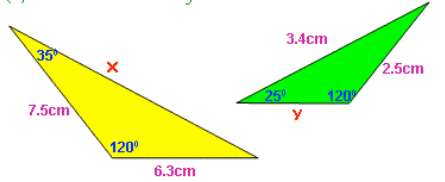
Part (a): How do you know these two triangles are similar?
To determine if the two triangles are similar:
- Check if all their corresponding angles are equal.
- In the yellow triangle:
- The angles are , , and (we calculate the third angle because the angles in a triangle must add up to ).
- In the green triangle:
- The angles are , and (already given). Since all corresponding angles in the two triangles are the same, the triangles are similar.
Part (b): Finding the missing lengths
- To find :
-
Use the scale factor between the matching sides. The matching sides are:
-
Yellow triangle: (corresponds to green triangle's )
-
Calculate the scale factor:
$Scale \ Factor=\frac{Matching\ Side\ in\ Yellow\ Triangle}{Matching\ Side\ in\ Green\ Triangle}=\frac{6.3}{3.4}≈1.85$ -
Use the scale factor to find (which is the corresponding side to the side in the yellow triangle):
- To find :
-
Similarly, use the scale factor:
$Y=\frac{Side\ in\ Yellow\ Triangle}{Scale\ Factor}=\frac{6.3 \ cm}3≈2.1 \ cm$
Thus, the missing sides and are approximately and , respectively.
Area and Volume Factors
Key Concept: It is also possible for 3D shapes to be similar. When 3D shapes are similar, the relationship between their corresponding dimensions (length, area, and volume) can be determined using scale factors.
Formulas:
- Area Factor =
- Volume Factor =
Note
Example: Two cylindrical containers are given. The larger container has a height of and holds litres of water. The smaller container has a height of . We need to find the volume of water the smaller container can hold.
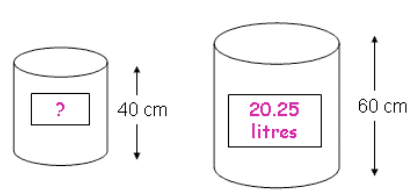
Step-by-Step Solution:
- Determine the Length Scale Factor:
- Determine the Volume Scale Factor:
- Calculate the Volume of the Smaller Container:
Thus, the smaller container can hold litres of water.