Volume (OCR GCSE Maths): Revision Notes
📚Revision Notes
Volume
What is a Prism?
Definition:
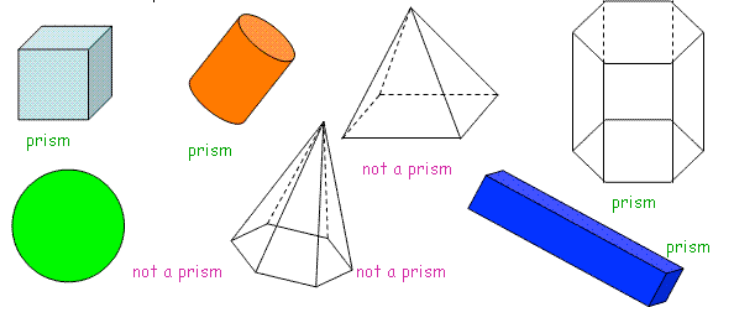
A prism is a 3D object where the cross-section (the shape you see if you cut straight through it) remains the same along the entire length of the object.
In simpler terms, if you were to slice the prism perpendicular to its length, every slice would look exactly the same.
Note
Examples of Prisms:
-
A cuboid (a box shape) is a prism because every cross-section parallel to its base is a rectangle of the same size.
-
A cylinder is also a prism because every cross-section parallel to its circular base is a circle of the same size. Non-Examples:
-
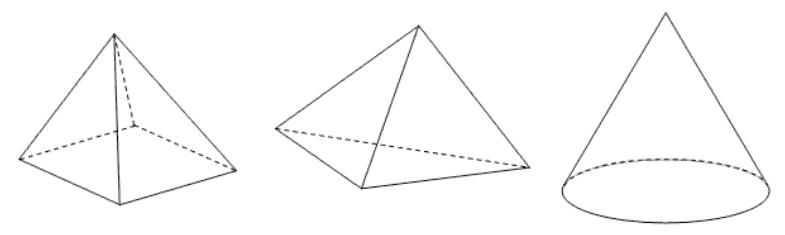
A pyramid is not a prism because as you move from the base to the apex, the cross-section changes size.
-
A cone is also not a prism for the same reason.
Working Out the Volume of a Prism
Formula:
- The repeating face is the shape that, when extended or extruded along the length, creates the prism.
- The length (or height, depending on the orientation of the prism) is how far the shape extends in the third dimension.
Note
Example 1: Volume of a Cuboid
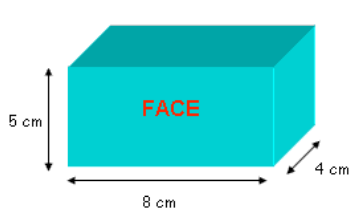
Problem: Calculate the volume of a cuboid with a base measuring 8 cm by 5 cm and a height of 4 cm.
Solution:
- Step 1: Calculate the Area of the Repeating Face
- The repeating face of this cuboid is a rectangle.
- Dimensions of the rectangle: Base , Height Formula for the Area of a Rectangle:
Substitute the values:
The area of the repeating face is 40 cm².
- Step 2: Multiply by the Length (or Height) of the Prism
- The length of the cuboid is 4 cm. Formula for the Volume of the Prism:
Substitute the values:
The volume of the cuboid is 160 cm³.
Volume of a Triangular Prism
Key Formula:
- The repeating face or cross-section of a triangular prism is a triangle.
- The length (or height) of the prism is the distance the triangular face is extruded along.
Note
Example 2: Triangular Prism
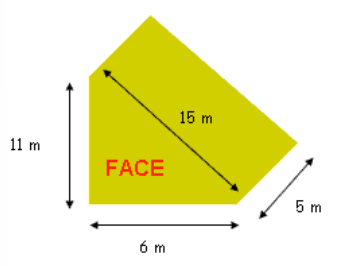
Problem: Calculate the volume of a triangular prism where the base of the triangular face is 6m, the height of the triangular face is 11m, and the length of the prism is 5m. Note that an additional measurement of 15m is given, but this is not needed for the volume calculation.
Solution:
- Step 1: Calculate the Area of the Repeating Face (Triangle)
- Dimensions of the triangle:
- Base
- Height
Formula for the Area of a Triangle:
Substitute the values:
The area of the triangular face is 33 m².
- Step 2: Multiply by the Length of the Prism
- The length of the prism is 5 m. Formula for the Volume of the Prism:
Substitute the values:
The volume of the triangular prism is 165 m³.
Note
Example 3: Volume of a Cylinder
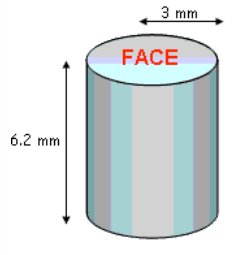
Problem: Calculate the volume of a cylinder with a radius of 3mm and a height of 6.2mm.
Solution:
- Step 1: Calculate the Area of the Repeating Face (Circle)
- Given:
- Radius Formula for the Area of a Circle:
Substitute the values:
The area of the circular face is approximately 28.274 mm².
Note: Keep this value in your calculator to maintain accuracy for the next calculation.
- Step 2: Multiply by the Height of the Cylinder
- Given:
- Height Formula for the Volume of the Cylinder:
Substitute the values:
The volume of the cylinder is approximately 175.3 mm³ (rounded to 1 decimal place).
Note
Example 4: Complicated Prism
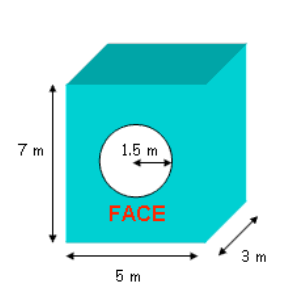
Problem: Calculate the volume of a prism where the cross-sectional face is a rectangle with a circular hole in it. The rectangle has a base of 5m, a height of 7m, and the circular hole has a radius of 1.5m. The length of the prism is 3m.
Solution:
- Step 1: Calculate the Area of the Complete Rectangle (Ignoring the Hole)
- Dimensions of the rectangle:
- Base
- Height Formula for the Area of a Rectangle:
Substitute the values:
- Step 2: Calculate the Area of the Circular Hole
- Radius of the circle: Formula for the Area of a Circle:
Substitute the values:
- Step 3: Subtract the Area of the Circular Hole from the Area of the Rectangle
- Area of Repeating Face:
Substitute the values:
- Step 4: Multiply by the Length of the Prism
- Length of the prism: 3 m Formula for the Volume of the Prism:
Substitute the values:
Round to one decimal place:
Volume of Pointed Shapes
Key Formula:
- The area of the base is the area of the flat face (usually a circle for cones or a polygon for pyramids).
- The height is the perpendicular distance from the base to the point (the apex) of the shape.
Note
Example 4: Volume of a Cone
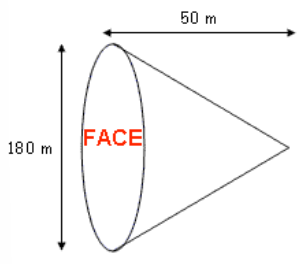
Problem: Calculate the volume of a cone with a base radius of 90 m and a height of 50m.
Solution:
- Step 1: Calculate the Area of the Base (Circle)
- Given:
- Radius
Formula for the Area of a Circle:
Substitute the values:
The area of the circular base is approximately 25,446.9 m².
- Step 2: Use the Volume Formula for a Cone
- Height of the cone: 50 m Formula for the Volume of a Cone:
Substitute the values:
$Volume=\frac{25,446.9\ m^2×50 \ m}3=\frac{1,272,345 \ m^3}3≈424,115 \ m^3$
Round to the nearest whole number:
Volume of a Sphere
Key Formula:
Volume of a Sphere=
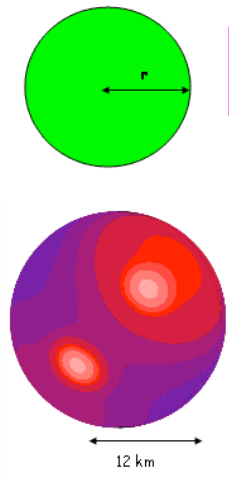
- is the radius of the sphere.
- (pi) is approximately 3.14159.
Note
Example 5: Volume of a Sphere
Problem: Calculate the volume of a sphere with a radius of 12 km.
Solution:
- Step 1: Write Down the Formula
- Step 2: Substitute the Radius into the Formula
- Given:
- Substitute the value of into the formula:
- Step 3: Calculate the Cube of the Radius
- Calculate :
- Step 4: Multiply by ππ and Then by
- Multiply by :
- Now, multiply by :
- Step 5: Final Answer
- The volume of the sphere is approximately 7,238.29 km³.