Basic Information Processing Model (OCR GCSE Physical Education): Revision Notes
📚Revision Notes
Basic Information Processing Model
Information Processing
Note
Information processing is where you make decisions based on gathering information (stimuli) from your senses, such as what you see and hear. You prioritise the important stimuli to make a suitable decision.
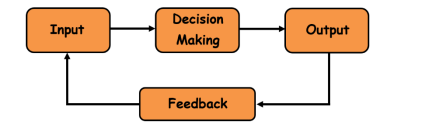
| Input | The information received from your senses (display) via selective attention: Selective attention: This is when you focus on the important information (stimuli). When performing a skill there can be a lot of information around you. You have little time to select the relevant information such as the speed and direction of the ball and ignore the irrelevant such as the noise from the crowd |
|---|---|
| Decision making | The selection of an appropriate response using the information (input) and what is stored in the long-term memory Long-term memory: This is information that has been rehearsed and stored for future reference. The more you practice, the more information about a skill or technique is stored in your memory and can be recalled in the future Short-term memory: This only lasts for a few seconds. It is a working memory you use while completing a skill. E.g. attention to your opponent's position when passing a ball in rugby |
| Output | The information you send to your muscles to carry out the response |
| Feedback | A review of your response this can be intrinsic or extrinsic Intrinsic feedback: This is within the performer, they understand how the movement feels from feedback from the muscles. A footballer may understand why a skill was performed badly. Extrinsic feedback: This is feedback from outside the performer, it is important as someone watching the skill can observe and explain what needs to be done to correct it. A coach could give you feedback about a skill |
Sporting Examples
A miss-kick in Football Input: The player uses selective attention and sees the ball coming towards him, he looks at the ball and the players around him
Decision Making: From past experience in long-term memory, he decides what position to get into and when to move the body
Output: He moves into position and swings his foot at the ball
Feedback: He misses the ball. He received intrinsic feedback as his nonkicking foot was too close leaving him unbalanced so missed the ball

Football Player
Sporting Examples
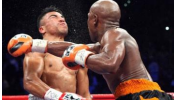
Boxers
KO Punch in Boxing Input: A boxer sees that his opponent has his guard down the boxer throws a right hand at his opponent
Decision Making: From past experience in the long-term memory he decideswhat position to get into and when and how to throw the punch
Output: He moves into position ready to throw a right-hand punch
Feedback: He successfully knocked out his opponent. He received intrinsic feedback on how the movement felt and the position of himself and his opponent
Sporting Examples
Conversion Kick (Rugby) Input: A rugby player uses selective attention to block out the crowd he focuses on the angle of the kick and the wind speed
Decision Making: From past experience he decides to kick the ball slightly left of the near post. The action has been rehearsed many times
Output: He positions himself to kick the ball
Feedback: He kicked the ball straight through the posts he received intrinsic feedback on how the movement felt and the flight of the ball
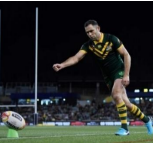
A Rugby player