Investigating Resistance in Thermistors & LDRs (OCR GCSE Physics A, Combined (Gateway Science Suite)): Revision Notes
📚Revision Notes
2.1.7 Resistors: Thermistors and LDRs
Note
Certain types of resistors are designed to respond differently to changes in current and potential difference.
Note
A thermistor is designed so that its resistance decreases as the temperature increases.
An LDR (light-dependent resistor) is designed so that its resistance decreases as the light intensity on the LDR increases.
These components can be used in sensing circuits. In such circuits, a thermistor or LDR is used to vary the resistance across another component, allowing the current through the component to increase under specific conditions. For instance, a thermistor might be used in a sensing circuit to switch on a heater only when it is cold or to activate a fan when it gets hot.
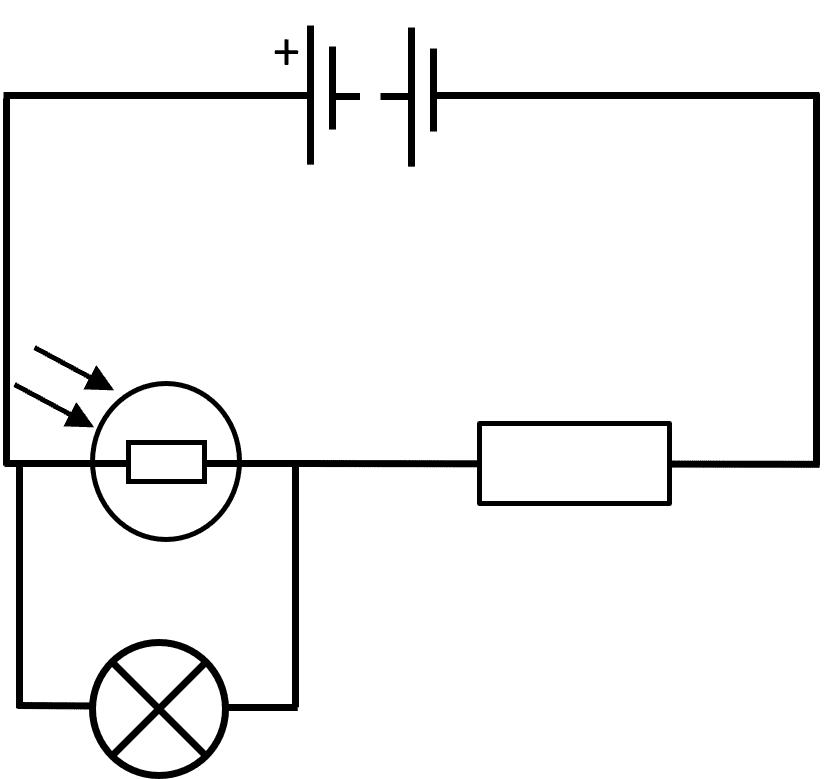
A different example of a sensing circuit is shown on the left. This circuit is designed so that when the room gets dark, the bulb switches on.
Note
When the room is dark, the resistance of the LDR is high. As a result, both the LDR and the bulb will have a high potential difference. This means the bulb receives more energy and thus shines brighter in darker conditions. When there is a bright light in the room, the LDR has a very low resistance. The bulb will also experience a low potential difference and will therefore be dimmer due to the lower potential difference.