Forces as Vectors (OCR GCSE Physics A, Combined (Gateway Science Suite)): Revision Notes
📚Revision Notes
5.1.3 Forces as Vectors
Note
Vector Representation of Forces
- Forces are vector quantities. This means they have both magnitude and direction.
- A force can be represented as an arrow.
- Length: Represents the magnitude (strength) of the force.
- Direction: Shows the direction in which the force acts.
Combining Forces
When more than one force acts on an object, the resultant force (or net force) is the combined effect of all individual forces. Forces can be combined in the following ways:
- Same direction: Add the magnitudes of the forces.
- Example: Two forces of 10 N and 5 N acting in the same direction give a resultant force of 15 N.
- Opposite direction: Subtract the smaller force from the larger force.
- Example: A 10 N force and a 5 N force acting in opposite directions result in a 5 N resultant force, in the direction of the larger force.
Free-Body Diagrams
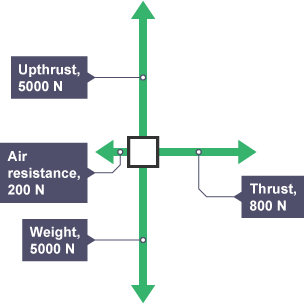
- A free-body diagram is a simple diagram used to show all the forces acting on an object. Each force is represented by an arrow pointing in the direction of the force. The length of each arrow corresponds to the force's magnitude.
Resolving Forces
- Resolving a force means splitting a force into two components that are perpendicular to each other (usually horizontal and vertical).
- Example: A force of 100 N acts at 45°. It can be resolved into two components: one in the horizontal direction (100 cos 45°) and one in the vertical direction (100 sin 45°).
Equilibrium
An object is in equilibrium when:
- All the forces acting on it are balanced, and
- The resultant force is zero.
- Example: If a book rests on a table, the force of gravity pulling the book down is balanced by the upward normal force from the table.
Parallelogram of Forces
- When two forces act at an angle to each other, their combined effect (the resultant force) can be found using the parallelogram of forces method.
- The two forces are represented as adjacent sides of a parallelogram. The diagonal of the parallelogram gives the resultant force in both magnitude and direction.
Note
Key Points:
- Forces are vectors that have both magnitude and direction.
- Forces can be combined by vector addition, and their combined effect is called the resultant force.
- If the resultant force on an object is zero, the object is in equilibrium and will either remain at rest or move with constant velocity.