Newton's Laws of Motion (OCR GCSE Physics A, Combined (Gateway Science Suite)): Revision Notes
📚Revision Notes
5.7.5 Inertia
What is Inertia?
Note
Inertia is the idea that things like to keep doing what they're already doing. If something is not moving, it will stay still unless you push or pull it. If it's moving, it will keep moving at the same speed and in the same direction unless something makes it stop or change direction.
What is Inertial Mass?
Note
Inertial mass tells us how hard it is to change the way something is moving. If something has a big inertial mass, it's tougher to make it speed up, slow down, or change direction.
Note
The formula to figure this out is:
Note
But don't worry about the formula too much—just remember that bigger things need more force to change their movement.
Note
Key Idea
- If something is really heavy (has a large inertial mass), you need to push it harder to get it moving as fast as something lighter.
Note
Real-Life Example Think about trying to push a car versus pushing a shopping trolley. The car is much harder to push because it has a bigger inertial mass. The trolley is easier to move because it's lighter and has a smaller inertial mass.
Simple Diagram
Here's a picture to show how this works:
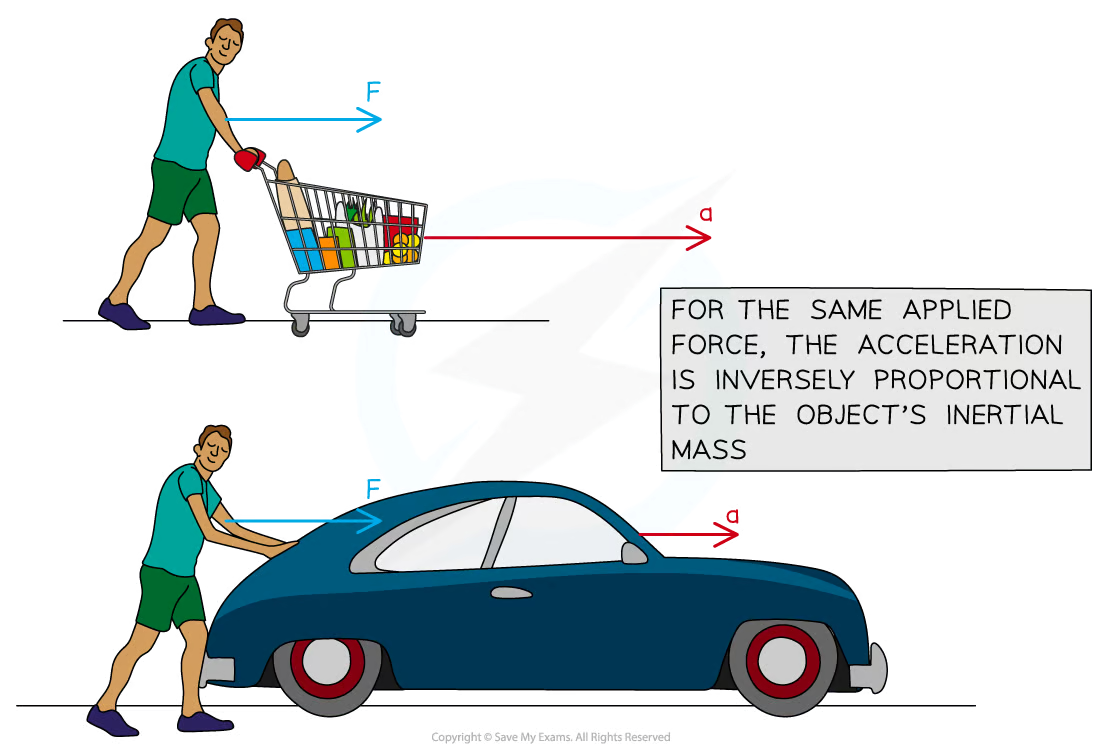
- The lighter object speeds up more when you push it.
- The heavier object doesn't speed up as much with the same push.