Background Radiation (OCR GCSE Physics A (Gateway Science Suite)): Revision Notes
📚Revision Notes
4.3.1 Background Radiation
Background Radiation (Physics Only)
Note
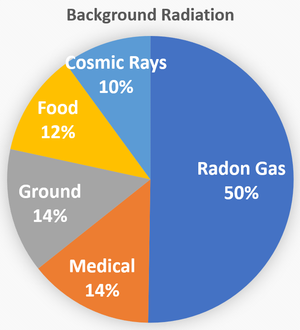
Background Radiation: Low-level radiation that is always present in the environment, originating from both natural and artificial sources.
Sources
-
Cosmic Rays: High-energy particles from outer space that reach the Earth.
-
Radiation from Underground Rocks: Naturally occurring radioactive materials, such as radon gas, emitted from rocks and soil.
-
Nuclear Fallout: Residual radioactive material from nuclear weapons testing or accidents.
-
Medical Rays: Radiation from medical procedures, such as X-rays and radiation therapy.
Factors Affecting Background Radiation
Occupation: Certain jobs, like those in healthcare or nuclear industries, expose workers to higher levels of radiation.
Location: Areas with higher natural radiation levels, such as those with radon gas, or proximity to nuclear facilities, can affect radiation exposure.
Measurement
Radiation Dose: The amount of radiation absorbed by the body, measured in Sieverts (Sv).
Types of Radiation
Alpha Radiation
- Characteristics:
- Strongly Ionising: Alpha particles can easily ionise nearby atoms, causing damage.
- Low Penetration: Alpha particles are stopped by dead skin cells and cannot penetrate the skin, but are hazardous if inhaled or ingested.
Beta Radiation
- Characteristics:
- Moderately Ionising: Beta particles can ionise atoms, but less so than alpha particles.
- Medium Penetration: Beta particles can penetrate the skin and enter the body, posing a risk to internal organs.
Gamma Radiation
- Characteristics:
- Weakly Ionising: Gamma rays have a lower ionising power compared to alpha and beta particles.
- High Penetration: Gamma rays can penetrate deep into the body and materials but are less likely to cause ionisation within the body.
Peer Review
Note
Peer Review: The process where scientific studies are evaluated by other experts in the field before publication. This ensures the accuracy, validity, and reliability of the findings, allowing the scientific community to verify and build upon the research.