Calculating Weight (OCR GCSE Physics A (Gateway Science Suite)): Revision Notes
📚Revision Notes
5.1.5 Calculating Weight
Note
The weight of an object and its mass are directly proportional. For a given gravitational field strength, the greater the mass of the object, the greater its weight.
Note
Weight can be calculated using the equation:
This is when:
- weight () is measured in newtons (N)
- mass () is measured in kilogrammes (kg)
- gravitational field strength () is measured in newtons per kilogramme (N/kg)
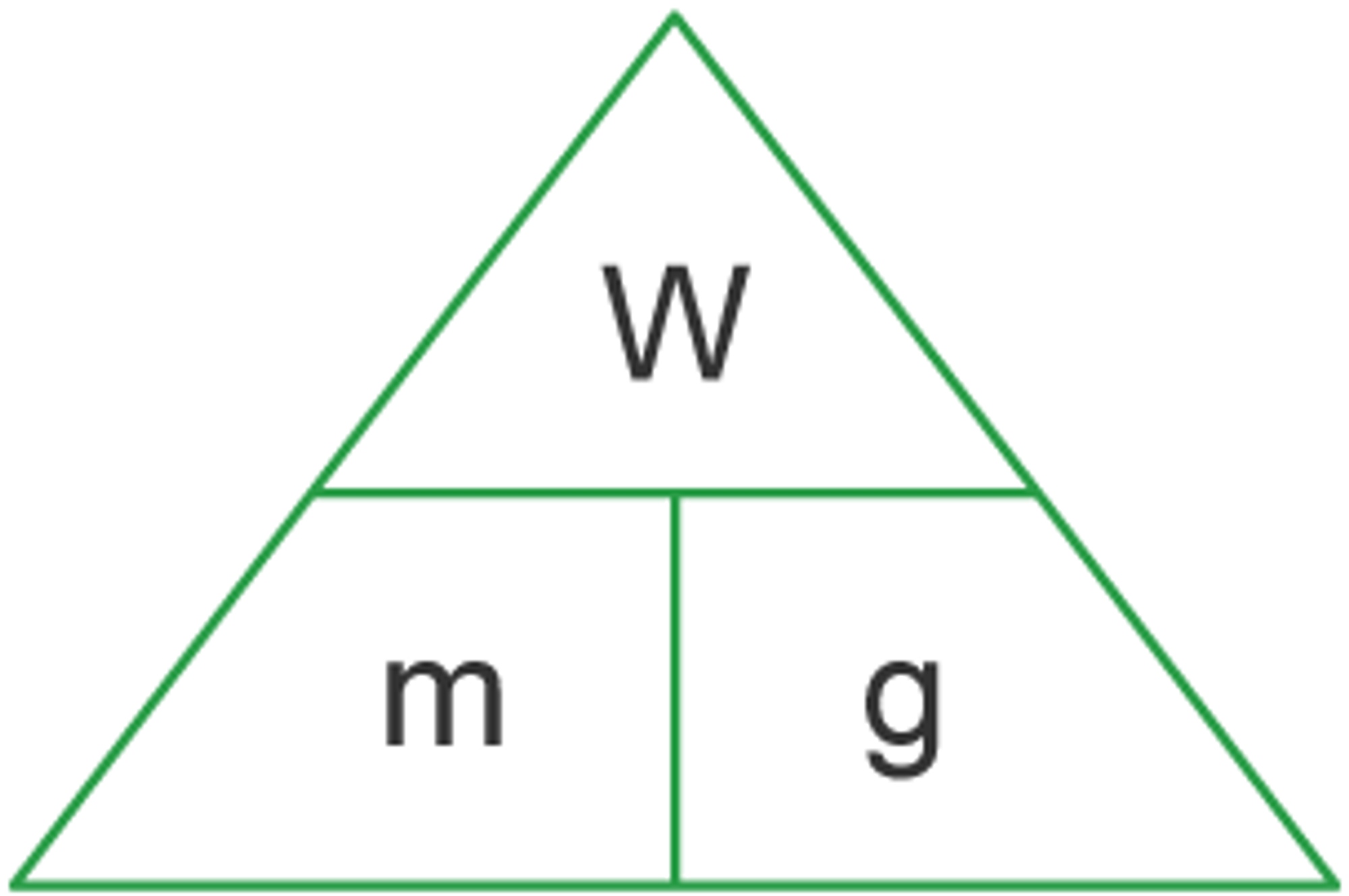
Rearranging:
| W = m x g |
|---|
| m = W ÷ g |
| g = W ÷ m |
Example
Example: What is the weight of a person with a mass of 55 kg?
Weight = mass x gravity
Weight = 55 x 10
Weight = 550 N
Measuring Weight
A Newton Meter
A mass suspended on the lower hook will pull the spring inside and move the indicator along the scale.
Note
The scale is calibrated to newtons. We can use a Newton metre to measure the weight of an object, in Newtons.
Note
Key Points:
- Weight is a force and is measured in newtons.
- It is different from mass, which is a measure of the amount of matter in an object and is measured in kilogrammes.
- Weight changes with the strength of the gravitational field, but mass remains constant.