Newton's First Law (OCR GCSE Physics A (Gateway Science Suite)): Revision Notes
📚Revision Notes
5.7.1 Newton's First Law
Newton's First Law of Motion
Note
Newton's First Law of Motion, also known as the Law of Inertia, explains how objects behave when forces act on them. In simple terms, it states that an object will stay in its current state of motion unless a force causes it to change.
Note
Key Points
- If the resultant force acting on a stationary object is zero, then the object will remain stationary.
- If the resultant force acting on a moving object is zero, the object will continue moving in the same direction at the same speed (with the same velocity).
Note
A stationary object with a 50N force acting to the right and also a 50N force acting to the left will remain stationary as it has a resultant force of zero. If there is no resultant force acting on a moving object, both the speed and the direction of the object (its velocity) will remain the same.
Example
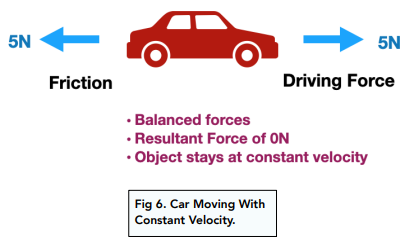
Example: Forces can act on both stationary and moving objects. Sometimes these forces act in opposite directions – for example, a car engine drives the car forwards, whilst friction opposes this and pushes against the car in the opposite direction.
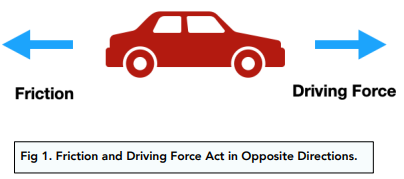
- Sometimes the forces acting on objects can be balanced (they equal each other) or unbalanced. If forces are unbalanced, we can calculate the resultant force in a particular direction.
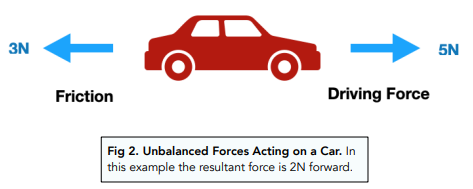
Effects of Resultant Force
- If a resultant force acts on the object, it will accelerate.
- Acceleration is a change in velocity over time.
- So the velocity will change.
- Either the direction or speed of the object will change (or both).
- If no resultant force acts on the object:
- And the object is stationary, it will remain stationary.
- And the object is moving, it will continue to move at the same velocity.
Applying Newton's First Law
Let's take a look at another example:
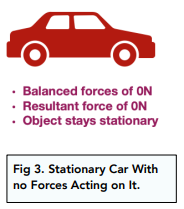
1. Stationary Object – there are no forces acting on this stationary object. The resultant force is zero and the car is stationary:
2. Stationary Object – Tom tries to push his car, but it doesn't move. This is because the force of his push does not exceed the force of friction pushing the other way. The resultant force is still zero and the car remains stationary.
3. Moving, Accelerating Object – Tom starts the engine, and the driving force of the car now exceeds friction. The car starts to accelerate because there is a resultant force. The speed is increasing (starting from 0 km/h at rest).
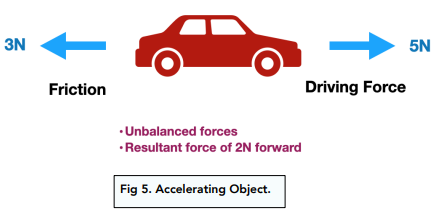
4. Moving, Constant Velocity Object – the force of friction increases and catches up, and now equals the driving force. There is no resultant force, so the object is no longer changing speed (no acceleration). However, it is not stationary either – it is at constant velocity.
Inertia
Note
We can sum up Newton's First Law using one word, 'inertia'. This describes what happens to both moving and stationary objects.
We can use inertia to describe the unchanged motion of objects. In the previous section, we mentioned the motion of vehicles when no resultant force is applied. The concept of inertia is the tendency for these objects to continue in their state of rest or uniform motion.
Resistive Forces
- A force whose direction is opposite to the motion of an object (friction with the air or road).
- A resultant force causes an object's speed or direction to change.