Newton's Second Law (OCR GCSE Physics A (Gateway Science Suite)): Revision Notes
📚Revision Notes
5.7.2 Newton's Second Law
Newton's Second Law of Motion
Note
Resultant force means that an object is accelerating or decelerating. Newton's Second Law helps us understand how we can measure the size of this acceleration or deceleration.
Note
The acceleration of an object is directly proportional to the resultant force acting on the object and inversely proportional to the mass of an object.
Note
Formula
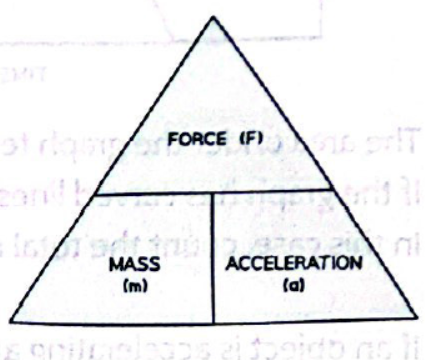
The size of the acceleration (positive or negative) depends on two factors:
- Resultant Force – The larger the resultant force, the larger the acceleration. Remember, if the resultant force is zero, the object is at constant speed and does not accelerate.
- Mass – the heavier an object is, the more force needed to accelerate it, and hence the lower the acceleration for a given resultant force.
Note
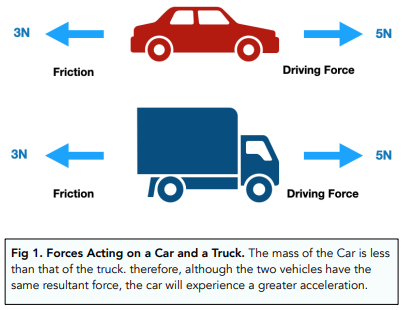
For example, both vehicles below have a resultant force of 2N. The car is much lighter than the truck, so will experience a larger acceleration. Newton's Second Law
Note
Key Points
- If two objects of the same mass experience different resultant forces, the object experiencing the higher resultant force will have a greater acceleration.
- If two objects of different masses experience the same resultant force, the object with the higher mass will have a lower acceleration.
Relationships of Proportionality
In Newton's Second Law, there are relationships of proportionality.
- We know that the acceleration of an object is proportional to the force acting on it (as the force increases, the acceleration increases).
- We also know that the acceleration is inversely proportional to the mass of the object (as the mass increases, the acceleration decreases).
Inertia
Note
We can use Newton's Second Law to help us find a value for inertial mass
Note
This is the measure of how difficult it is to change the velocity of an object.