Required Practical: Investigating Force & Acceleration (OCR GCSE Physics A (Gateway Science Suite)): Revision Notes
📚Revision Notes
5.7.3 Required Practical: Investigating Force & Acceleration
Required Practical: Acceleration
Note
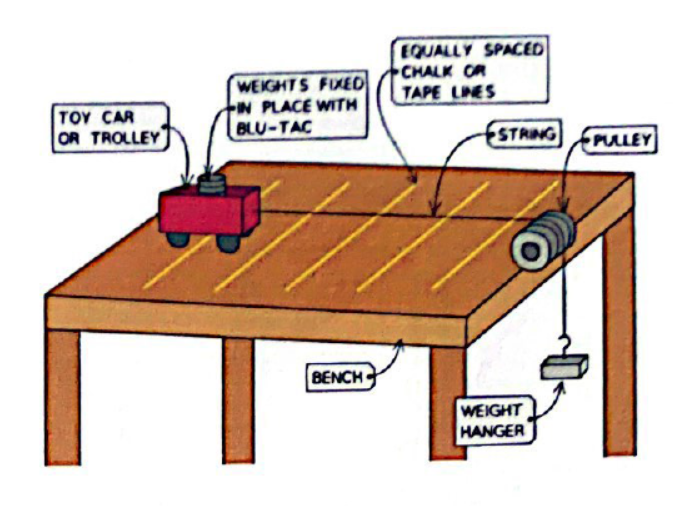
Setup
- Draw several straight lines at equal intervals perpendicular to the edge of a bench using chalk. These will help you measure the car's movement.
- Attach a toy car to a piece of string. Place the string over a pulley at the end of the bench.
- Attach a weight stack to the loose end of the string. Hold the weight stack so it doesn't pull the car but keeps the string fully extended.
- When ready, release the weight stack and start the timer.
- Stop the timer when the car reaches the pulley at the other end of the bench.
Note
Investigations 6. How Varying the Force Affects Acceleration with Constant Mass
- Start by adding a 10g mass to the weight stack. Hold the weights so they don't pull the car yet, but ensure the string remains fully extended.
- Release the weights and time how long it takes for the car to travel across the bench.
- Repeat this experiment, adding 10g weights each time and recording the travel time for each trial.
- How Varying the Mass of the Car Affects Acceleration with a Constant Force
- Attach a 10g mass on top of the toy car using rubber bands or adhesive putty.
- Pull the car back to the starting chalk line and release it.
- Time how long it takes for the car to travel across the bench.
- Repeat the experiment by increasing the mass of the car and recording the time taken.
Note
Calculation
-
To calculate the acceleration, use the formula: where:
-
is the acceleration,
-
is the final velocity,
-
is the initial velocity (which is 0 if starting from rest),
-
is the time taken. This setup helps explore how force and mass affect acceleration, reinforcing Newton's Second Law of Motion.