Stopping Distances (OCR GCSE Physics A (Gateway Science Suite)): Revision Notes
📚Revision Notes
5.8.6 Estimating Breaking Force
Note
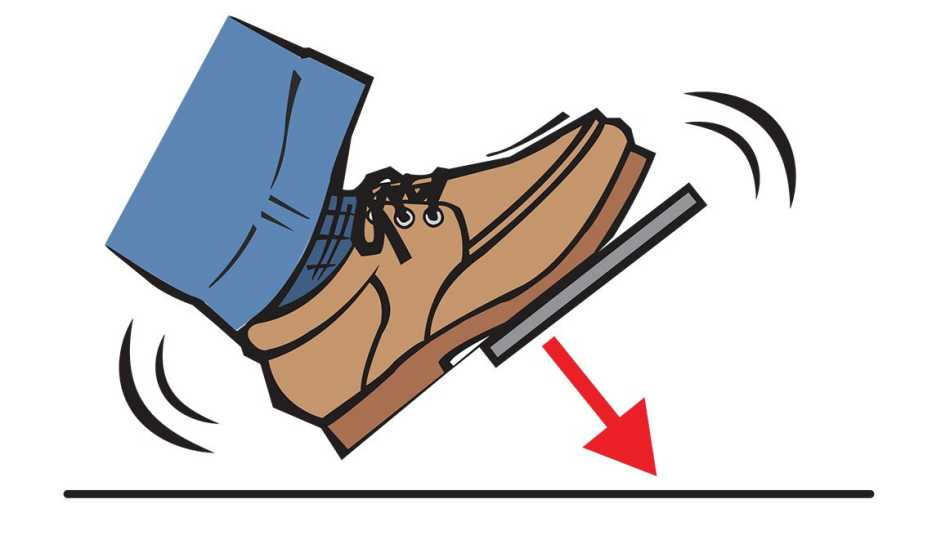
When the driver pushes the brake pedal, they are applying force to the pedal. This force is used to press the brake pads onto the wheels. There is friction between the wheels and the brake pads (in order to slow the wheels down). Work is done here because the friction is causing the kinetic energy of the wheel to be transferred as thermal energy to the brakes. The brakes then increase in temperature as a result.
Note
The faster a vehicle is going, the more energy it has in its kinetic energy store. This means when braking, more work done is required to convert this kinetic energy to thermal energy and stop the vehicle. The greater the braking force of the vehicle, the greater the deceleration. However, large decelerations could be dangerous. This is because they can lead to the vehicle losing control, or the brakes could overheat.
Example
Example: Estimating Braking Force A truck is travelling at 25m/s. The truck brakes to try and avoid an obstacle that is 50m in front of it. Calculate the braking force required to stop the truck before the hazard.
The truck has a mass of 30000 kg. [3 marks]
We can use as long as we assume that acceleration is uniform.
The initial velocity is 25m/s.
The final velocity is 0m/s because the truck needs to stop.
The distance is 50m.
We can find the braking force by using the force equation: