Applications of the Generator Effect (OCR GCSE Physics A (Gateway Science Suite)): Revision Notes
📚Revision Notes
7.3.2 Applications of the Generator Effect
How Electric Generators (dynamos) work (Physics only)
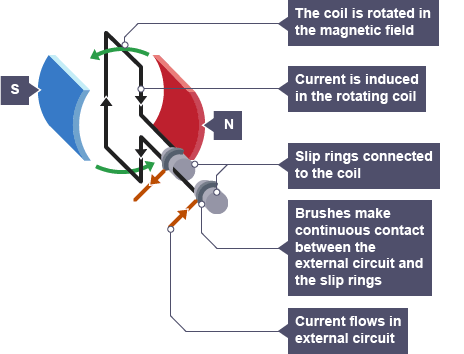
Basic Setup: Similar to a motor, an electric generator (or dynamo) consists of a coil of wire that can rotate between two permanent magnets.
- A turbine, driven by wind spins turning the coil of wire
- Magnetic Interaction: As the coil rotates, it cuts through the magnetic field lines between the magnets, causing a change in the magnetic field around the wire.
- Induced Potential Difference: This movement induces a potential difference (voltage) across the coil.
Alternating Current (AC):
Note
If the coil is connected to a complete circuit, an alternating current (AC) is generated. This happens because the direction of the induced current changes as the coil rotates, which is the principle behind an alternator.
Direct Current (DC):
Note
To produce direct current (DC), the ends of the coil (labelled A and D in the diagram) are connected to a split ring commutator.
Note
The commutator reverses the direction of the current every half-rotation, ensuring that the current always flows in the same direction. This setup is known as a dynamo.