Volcanoes I (Junior Cert Geography): Revision Notes
📚Revision Notes
Volcanoes I
Volcanoes
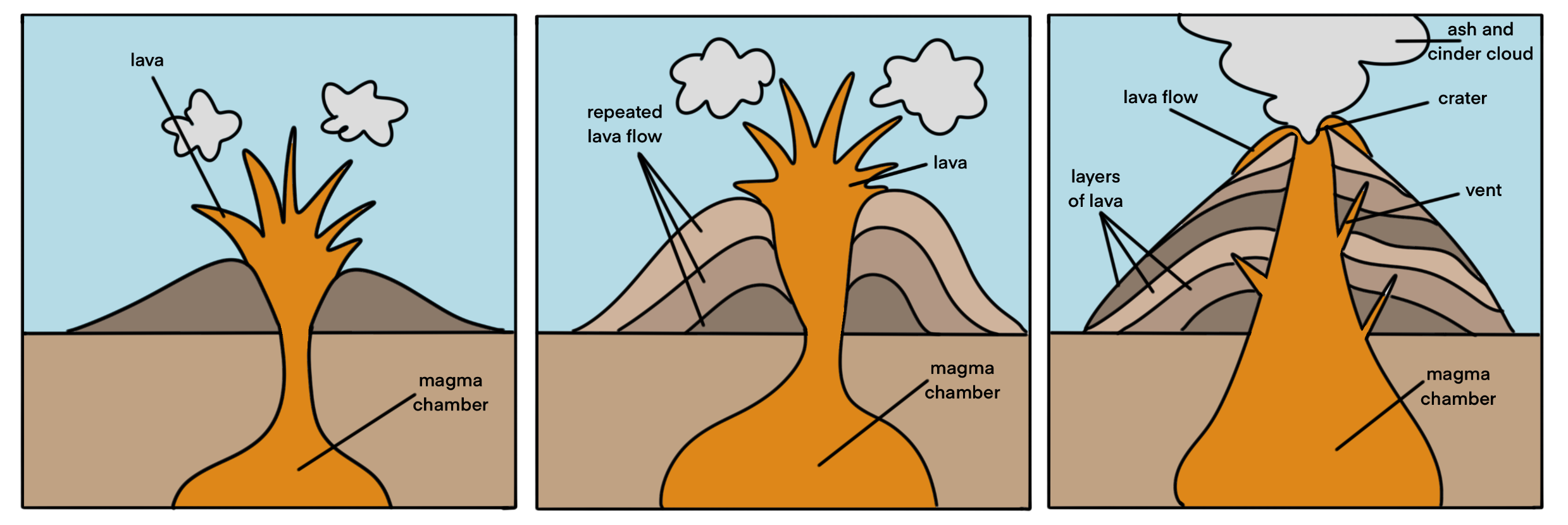
A volcano is a mountain that forms when molten rock (magma) from beneath the Earth's surface erupts through a vent.
Formation of a Volcano:
- Magma is stored underground in a magma chamber.
- Pressure builds up in the magma chamber, forcing the magma to move upwards.
- The magma reaches the surface through a narrow opening called a vent.
- When magma exits the vent, it is called lava.
- The lava cools and hardens around the vent, forming a cone-shaped mountain.
Note
Magma vs Lava
- Magma:
- Molten (melted) rock found beneath the Earth's surface.
- Stored in magma chambers under volcanoes.
- Contains gases and crystals mixed in with the molten rock.
- Lava:
- When magma reaches the surface through a volcanic eruption, it is called lava.
- It flows across the ground and cools to form new igneous rock.
- Gases often escape once it reaches the surface.
In short: Magma is underground. Lava is magma that has erupted onto the surface.
Main Features of a Volcano:
- Magma Chamber: Underground area where magma is stored.
- Vent: The channel through which magma travels to reach the surface.
- Lava: Magma that has erupted onto the Earth's surface.
- Crater: A bowl-shaped opening at the top of a volcano, formed by past eruptions.
- Lava Flow: The spread of lava as it flows out of the vent.
- Ash and Cinder Cloud: A mixture of volcanic ash, dust, and gases ejected during an eruption
Life Cycle of a Volcano
Volcanoes can be classified based on their eruption activity:
- Active: A volcano that erupts regularly.
- Example: Mount Etna, Sicily.
- Dormant: A volcano that hasn't erupted for a long time but could erupt again in the future.
- Example: Mount St. Helens, USA, which erupted after being quiet for 120 years.
- Extinct: A volcano that hasn't erupted in recorded history and is not expected to erupt again.
- Example: Slemish Mountain, County Antrim.
Pacific Ring of Fire
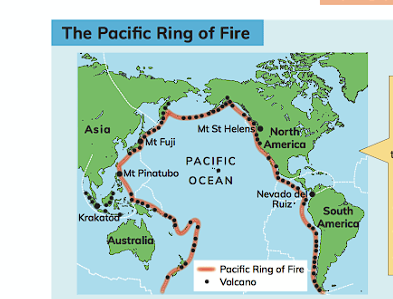
The Pacific Ring of Fire is a horseshoe-shaped zone around the edges of the Pacific Ocean, where many of the world's tectonic plates meet.
- This area is known for its high level of volcanic and earthquake activity.
- The Ring of Fire includes some of the most active volcanoes and frequent earthquakes in the world.
- Examples of Volcanoes in the Ring of Fire: Mount St. Helens (USA), Mount Fuji (Japan), and Mount Pinatubo (Philippines).
Mid-Ocean Ridges
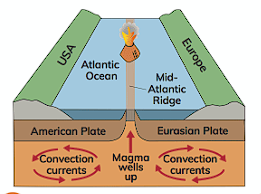
A mid-ocean ridge is an underwater mountain range that forms due to volcanic activity at constructive plate boundaries.
- Formation:
- Two tectonic plates move apart, due to convection currents, which creates a fissure (crack) in the Earth's crust.
- Magma rises up through the fissure and emerges on the ocean floor.
- When the magma contacts seawater, it cools and solidifies, forming new oceanic crust.
- Over time, multiple eruptions cause the ocean floor to rise and form a ridge of volcanic mountains.
- Mid-Atlantic Ridge:
- The Mid-Atlantic Ridge is a major example of a mid-ocean ridge, running through the Atlantic Ocean.
- It formed due to the separation of the North American and Eurasian Plates.
- In some places, like Iceland, the ridge is so high that it reaches above the ocean surface, forming volcanic islands.