Major and Minor Triads (Junior Cert Music): Revision Notes
📚Revision Notes
Major and Minor Triads
What is a Triad?
- A triad is a three-note chord made up of:
- The Root (the starting note)
- The 3rd (the note 3 steps above the root)
- The 5th (the note 5 steps above the root)
- Triads are built by stacking intervals of a third. They can be major or minor, depending on the types of intervals used.
- The root gives the triad its name (e.g. C major, A minor).
Major Triads in a Major Key
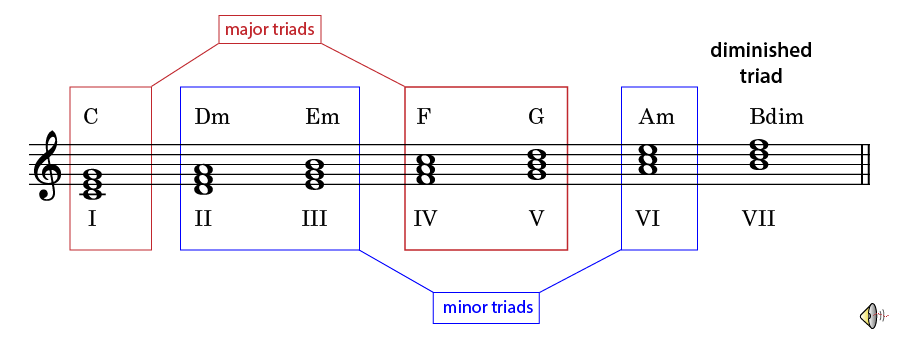
- In every major scale, major triads are found on:
- The 1st note – called the tonic
- The 4th note – called the subdominant
- The 5th note – called the dominant
- These are the three most important chords in any major key.
- Roman numerals are used to label chords:
- Uppercase numerals (I, IV, V) are for major triads
- Lowercase numerals (ii, iii, vi) are for minor triads
Example: C Major
In the key of C major, the major triads are built on:
- C (I) – the tonic triad
- F (IV) – the subdominant triad
- G (V) – the dominant triad | Triad Name | C Major Scale Notes | Triad Notes | |---|---|---| | C major (I) | C – D – E – F – G – A – B – C | C – E – G | | F major (IV) | C – D – E – F – G – A – B – C | F – A – C | | G major (V) | C – D – E – F – G – A – B – C | G – B – D |
Minor Triads in a Major Key
- In every major scale, minor triads occur on the:
- 2nd note (ii)
- 3rd note (iii)
- 6th note (vi)
- In the C major scale (C – D – E – F – G – A – B – C), the minor triads are:
- D minor (ii)
- E minor (iii)
- A minor (vi)
- These triads sound different from major triads because the intervals between the notes are different.
How Are Triads Built?
Major Triad
- From root to third = major third (4 semitones)
- From third to fifth = minor third (3 semitones)
Minor Triad
- From root to third = minor third (3 semitones)
- From third to fifth = major third (4 semitones) This difference in interval structure gives major triads a bright, happy sound and minor triads a sad, darker quality.
Minor vs Major Triad – What's the Difference?
| Feature | Major Triad | Minor Triad |
|---|---|---|
| Root to Third | Major third (4 semitones) | Minor third (3 semitones) |
| Third to Fifth | Minor third (3 semitones) | Major third (4 semitones) |
| Sound | Bright, happy | Sad, dark, emotional |
Example: C Minor Triad
- Root = C
- Minor third = E♭ (3 semitones above C)
- Fifth = G (4 semitones above E♭)
- C minor triad = C – E♭ – G
- This interval structure gives the triad its minor sound.

Note
Triadic movement is where the melody moves between the notes of the triad. Look at the melodic phrase below.