Overview (Junior Cert Music): Revision Notes
📚Revision Notes
Overview
Note
A musical genre is a broad category or type of music that shares certain characteristics, e.g. rock, jazz, rap.
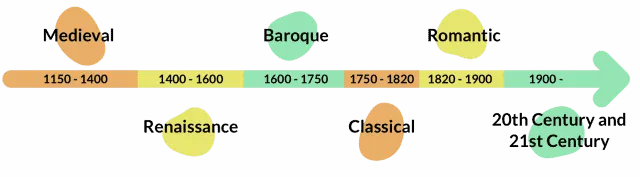
Music has changed and evolved over hundreds of years. The main eras of classical music are:
- Renaissance (c.1400–1600)
- Music was mainly vocal, with choirs singing in polyphonic style.
- Instruments used: lute, recorder, early violins (viols), harpsichord.
- Composers: Josquin des Prez, William Byrd.
- Example: Missa Gaudeamus (Des Prez).
- Baroque (c.1600–1750)
- Highly decorative and expressive music.
- Opera developed, along with orchestras and concertos.
- Instruments used: harpsichord, pipe organ, Baroque violin.
- Contrapuntal textures (multiple independent melodies).
- Composers: J.S. Bach, Vivaldi, Handel.
- Example: Four Seasons (Vivaldi).
- Classical (c.1750–1820)
- Music became more structured and balanced.
- Simple, elegant melodies with homophonic textures (clear melody with chords).
- The piano replaced the harpsichord.
- Composers: Mozart, Haydn, Beethoven (early).
- Example: Eine Kleine Nachtmusik (Mozart).
- Romantic (c.1820–19o0)
- Emotional and expressive music.
- Larger orchestras, with new instruments like trombones and tubas.
- Rubato (free tempo) and dramatic contrasts.
- Composers: Chopin, Tchaikovsky, Wagner.
- Example: Swan Lake (Tchaikovsky).
- Modern (c.1900–present)
- Composers experimented with atonality, jazz influences, and electronic sounds.
- Different styles: Serialism (Schoenberg), Neoclassicism (Stravinsky).
- New technology (recording, film music).
- Example: The Rite of Spring (Stravinsky)