The Baroque Era (1600–1750) (Junior Cert Music): Revision Notes
📚Revision Notes
The Baroque Era (1600–1750)
- The Baroque period was a time of dramatic, expressive, and highly decorated music.
- Composers experimented with new ideas, developing many musical features that shaped future styles.
- This era saw the birth of opera, the orchestra, and the modern major-minor key system.
- Music became more ornate, with rich harmonies, polyphonic textures, and strong contrasts in dynamics and mood.
Historical Context
The Baroque era took place during a time of scientific and artistic advancements. Many important events influenced the development of music:
- The scientific revolution introduced new discoveries, with figures such as Galileo (1623) and Newton (1687) making significant contributions.
- The first opera house opened in Venice in 1637, marking the rise of opera as an important musical form.
- Around 1700, the Italian instrument maker Bartolomeo Cristofori invented the piano, although the harpsichord remained the dominant keyboard instrument of the period.
- Composers were often employed by the Church or wealthy patrons, which influenced the type of music they wrote.
Key Features of Baroque Music
Music from the Baroque era was richly decorated, expressive, and structured. Some of the most important features include:
- Use of harpsichord for accompaniment (continuo).
- Ornamentation (trills, mordents, and other decorative notes).
- Polyphonic texture (multiple independent melodies).
- Walking bass line (continuous, steady bass movement).
- Contrast in dynamics (terraced dynamics – sudden shifts from loud to soft).
- Small orchestra: (the Baroque orchestra was much smaller than modern orchestras, with a focus on string instruments and the harpsichord).
Instruments of the Baroque Period
Baroque music was performed by small orchestras with a mix of string, keyboard, woodwind, and brass instruments.
- Strings: Violin, viola, cello, double bass
- Keyboard: Harpsichord, organ
- Woodwind: Flute, recorder, oboe, bassoon
- Brass: Trumpet, horn (without valves)
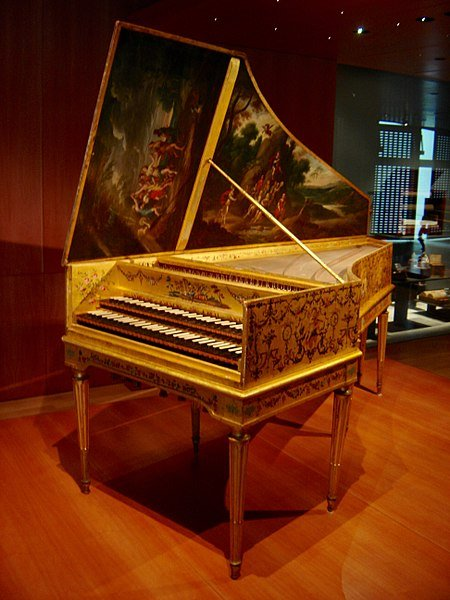
- Percussion: Timpani (used occasionally in larger works) The harpsichord was one of the most important instruments of the Baroque period and was often used to accompany singers and instrumentalists.
Baroque Composers and Their Works
Three of the most famous composers from the Baroque period were Antonio Vivaldi, Johann Sebastian Bach, and George Frideric Handel. Their music is still widely performed today.
Antonio Vivaldi (1678–1741)
- Antonio Vivaldi was an Italian composer and violinist.
- He worked as a music teacher at a school for orphaned girls, where he composed many of his pieces.
- Vivaldi was best known for writing concertos, particularly for the violin.
- His music is lively and energetic, with dramatic contrasts in dynamics and tempo.
- Famous Work: Presto from The Four Seasons: Summer
- This piece is part of The Four Seasons, a set of violin concertos that describe different times of the year through music.
- Features:
- Small orchestra with a harpsichord accompaniment
- Fast and energetic violin solo passages
- Use of ornamentation
- Walking bassline moving steadily throughout the piece
- Contrast between solo violin and orchestra
Johann Sebastian Bach (1685–1750)
- Johann Sebastian Bach was a German composer.
- He wrote sacred choral music, fugues, concertos, and instrumental works.
- His music is highly structured, featuring complex polyphonic textures and rich harmonies.
- Famous Work: Brandenburg Concerto No. 5
- This piece is part of a collection of six concertos Bach wrote for the Margrave of Brandenburg.
- Features:
- A harpsichord solo (one of the first of its kind)
- Contrasting dynamics (terraced dynamics)
- Polyphony with independent melody lines
- Fast-moving sequences and imitation between instruments
George Frideric Handel (1685–1759)
- George Frideric Handel was a German-born composer who spent most of his career in England.
- He was famous for writing operas, oratorios, and orchestral music.
- Unlike Bach, who spent much of his life working for the church, Handel wrote music for royalty and public concerts.
- Famous Work: Hallelujah Chorus from Messiah
- This choral work is one of the most well-known pieces of Baroque music and is often performed at Christmas concerts.
- Features:
- Strong and dramatic choral writing
- Contrasts between loud and soft sections
- Homophonic and polyphonic textures
- Rich harmonies and bold orchestral accompaniment
How to Recognise Baroque Music
Baroque music has several distinctive characteristics that make it easy to identify:
- Polyphonic textures, where multiple melodies overlap.
- Highly ornamented melodies, using trills and grace notes.
- Sudden changes in dynamics (terraced dynamics).
- Harpsichord accompaniment with basso continuo (a steady bassline).
- Concertos featuring solo instruments such as the violin.
- Use of sequences and imitation in melodies.
Why the Baroque Period Is Important
- The Baroque period paved the way for modern classical music.
- Many of the techniques introduced during this time, such as polyphony, ornamentation, and concertos, influenced later styles of music.
- The introduction of major and minor key systems replaced the older modal system and became the foundation of modern Western music.
- The development of orchestras, operas, and dynamic contrasts in Baroque music influenced the composers of the Classical period, such as Mozart and Beethoven.