Inheritance and Variation (Junior Cert Science): Model Answers
📚Model Answers
Genetics and Traits: Understanding Family Trees and Inheritance Patterns
Sample Answer
Question (a)
Answer
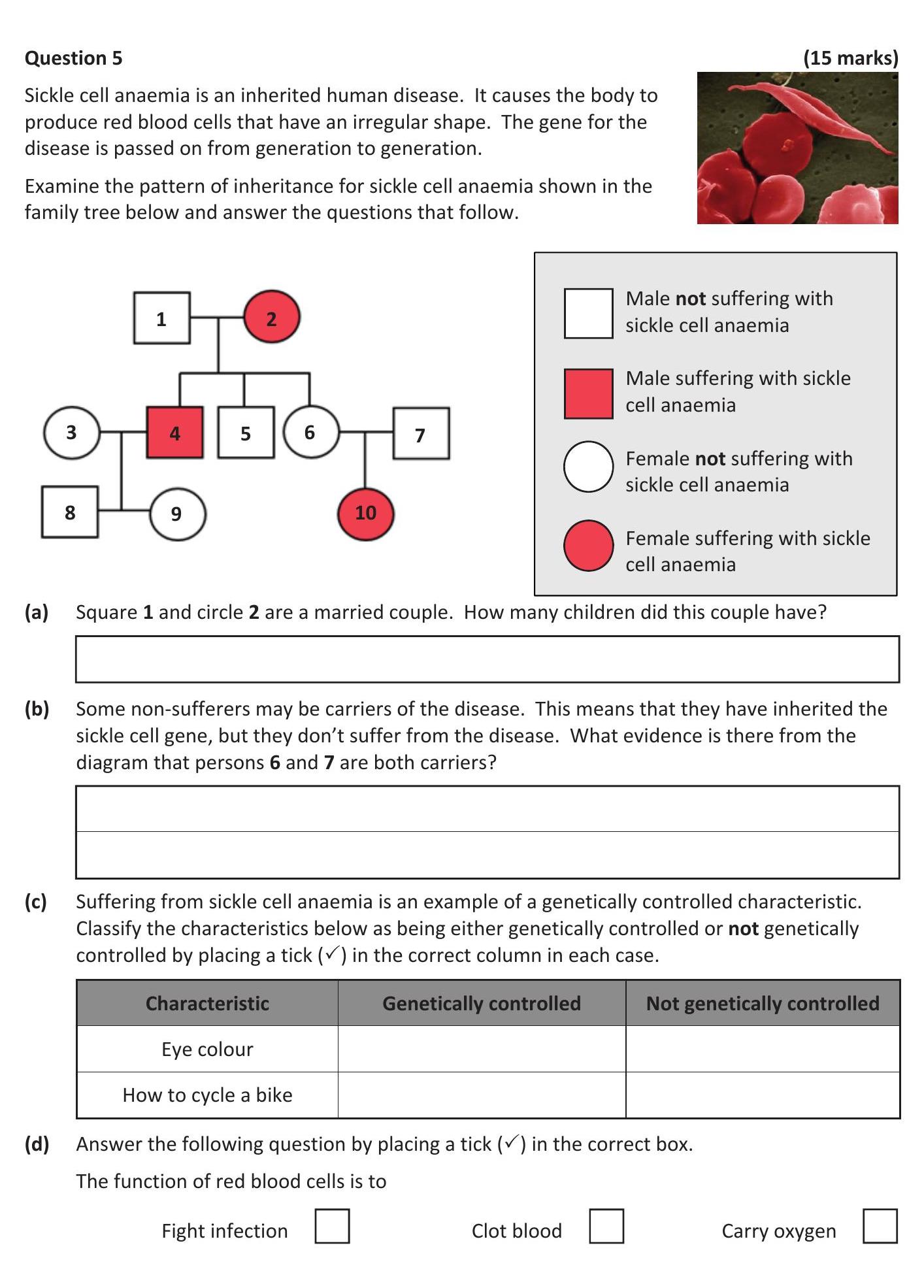
Square 1 and circle 2 have three children: numbers 3, 4, and 5.
Note
[1/1 Marks] This answer correctly identifies the three children shown directly below the parental couple in the family tree.
Question (b)
Answer
Persons 6 and 7 are both non-sufferers (shown as white symbols), but they have a child (10) who suffers from sickle cell anaemia. Since sickle cell anaemia is an autosomal recessive disorder, a child can only develop the condition if they inherit the recessive allele from both parents. This means both parents must be carriers (heterozygous), possessing one normal allele and one sickle cell allele.
Note
[3/3 Marks] This answer correctly identifies the evidence from the family tree and explains the genetic basis - that two non-sufferers producing a child with the condition must both be carriers of the recessive allele.
Question (c)
Answer
| Characteristic | Genetically controlled | Not genetically controlled |
|---|---|---|
| Eye colour | ✓ | |
| How to cycle a bike | ✓ |
Note
[2/2 Marks] Both characteristics are correctly classified. Eye colour is determined by genetics, while cycling a bike is a learned skill that is not genetically controlled.
Question (d)
Answer
The function of red blood cells is to carry oxygen.
Note
[1/1 Marks] The answer correctly identifies the primary function of red blood cells, which is to transport oxygen throughout the body via haemoglobin.
Marking Scheme