Inheritance and Variation (Junior Cert Science): Revision Notes
📚Revision Notes
Inheritance and Variation
Sexual and asexual reproduction
Living organisms can reproduce in two main ways: sexually or asexually. Understanding the difference between these methods is fundamental to genetics.
Sexual reproduction requires two parents. In this process, male and female gametes (sex cells) join together during fertilisation to create a zygote. The offspring produced through sexual reproduction will have characteristics from both parents, but they will not be identical to either parent. This creates variation among offspring.
Asexual reproduction requires only one parent. In this process, DNA is passed from the parent to the offspring, making them genetically identical to each other and to the parent. This means there is no variation among offspring produced through asexual reproduction.
Note
The key difference between sexual and asexual reproduction lies in the number of parents involved and whether variation occurs in the offspring. Sexual reproduction creates diversity, while asexual reproduction creates clones.
Examples of asexual reproduction in organisms
Many single-celled organisms reproduce asexually through simple cell division:
Amoeba reproduction: An amoeba is a single-celled organism found in freshwater streams, lakes and ponds. It reproduces by dividing into two identical offspring. First, the nucleus divides, then the cytoplasm divides, creating two daughter cells that are identical to the parent.
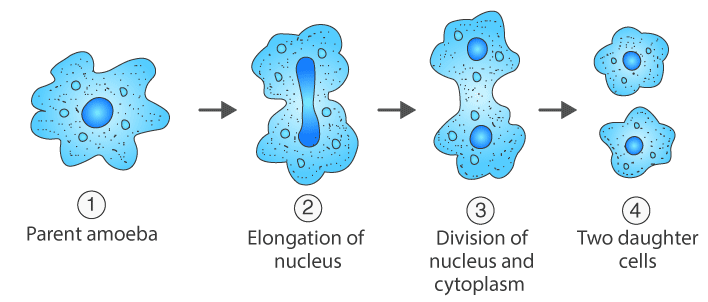
Bacterial reproduction: Bacteria can divide in two every minutes. Their populations grow very rapidly because of this fast reproduction rate. Like amoeba, bacteria divide to produce genetically identical daughter cells.

Important
The offspring produced by asexual reproduction show much greater similarity to their parents than offspring produced by sexual reproduction. This is because they receive DNA from only one parent and are therefore genetically identical.
DNA and the genetic code
DNA (deoxyribonucleic acid) is the molecule that carries genetic information in all living organisms. It controls all the activities that take place in cells. Understanding DNA is essential to understanding how characteristics are passed from parents to offspring.
The structure of DNA
The shape of DNA is called a double helix, which looks somewhat like a spiral staircase. This twisted ladder structure is made up of two strands wound around each other.
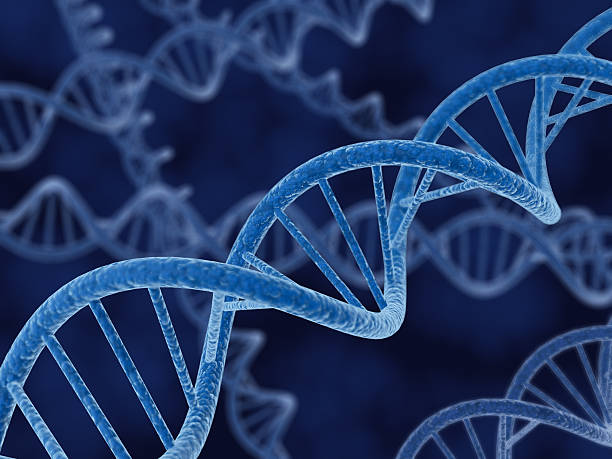
Discovery of the DNA structure
The structure of DNA was discovered through the work of several scientists:
James Watson (an American scientist) and Francis Crick (an English scientist) worked together to explain how DNA can copy itself and pass genetic information from one generation to the next. Their important discovery earned them the Nobel Prize in Physiology or Medicine in .
Rosalind Franklin was an English chemist whose X-ray photographs of DNA were crucial in helping Watson and Crick discover the double helix structure of DNA.
Note
The discovery of DNA's structure was a collaborative effort. While Watson and Crick are often credited, Rosalind Franklin's X-ray crystallography work provided critical evidence for understanding the double helix shape.
The genetic code
The genetic code is a code written in DNA. This code determines what characteristics will be present in the physical appearance of organisms - in other words, what organisms look like.
When the genetic code of an organism changes, this is called a mutation. A mutation is a change in the genetic code of DNA.
Important
Mutations can lead to serious genetic disorders, such as cystic fibrosis and haemophilia. However, it is important to understand that mutations can also be beneficial. Some mutations provide advantages, such as making muscles stronger or creating a colour change in an animal that helps it hide better from predators in its environment.
Variation
When you look at the people around you, you will notice many differences. Some are tall, some are short, some have dark hair, some have light hair, and some have blue eyes. These differences are called variations.
Variation is the way members of the same species differ from each other.
A species is a group of organisms that can breed with each other to produce fertile offspring.

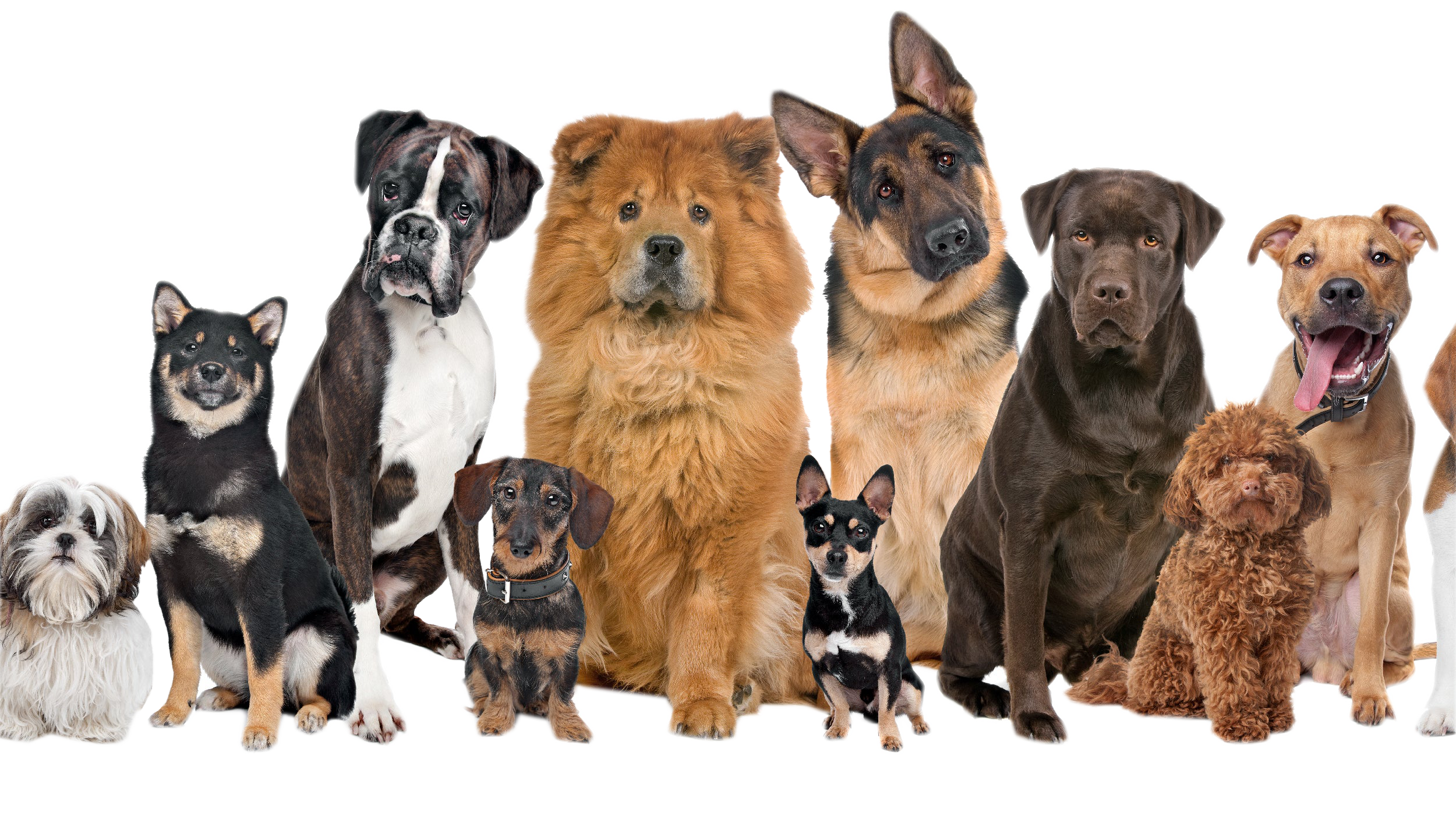
These images show variation - no two people are exactly alike, and different dog breeds show enormous variation in size, colour, and physical features.
Types of variation
Some variations within a species are caused by our DNA, while others are not.
Inherited characteristics are controlled by the DNA from the father's sperm and the mother's egg which join together during fertilisation. Examples include eye colour, hair colour, blood type, and the ability to roll your tongue.
Acquired characteristics are not controlled by our DNA. They are learned during our lifetime. These characteristics are known as acquired characteristics. Examples include the ability to ride a bicycle, the ability to play the piano, and your accent.
Note
Key Distinction: Inherited characteristics come from your genes and are passed down from your parents. Acquired characteristics develop during your lifetime through experience and learning. Only inherited characteristics can be passed to offspring.
Chromosomes and genes
What are chromosomes?
Chromosomes are thread-like structures in the nucleus of a cell. They are made of DNA twisted around protein molecules. Humans have chromosomes in each cell nucleus - these exist as pairs.
It is estimated that each human cell contains approximately metres of DNA in the nucleus! The DNA is supercoiled around protein molecules so that it will fit into the very tiny nucleus.
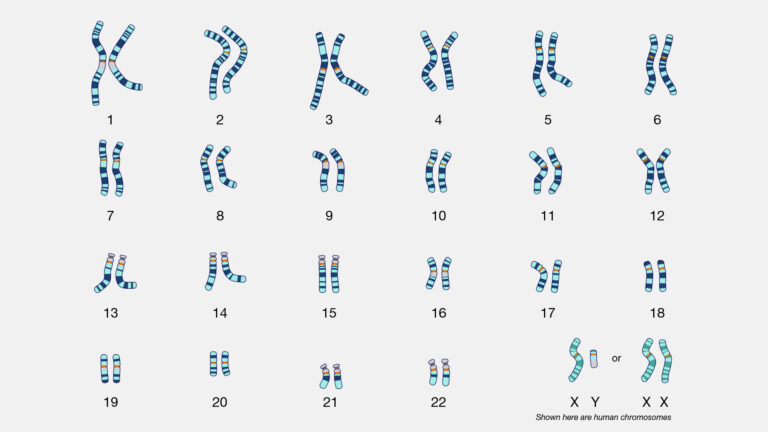
This diagram shows the pairs of human chromosomes. In both males and females, pairs are the same, but females have two X chromosomes while males have one X chromosome and one Y chromosome. The Y chromosome is shorter than the X chromosome.
Note
DNA organisation follows a hierarchical structure: The cell contains a nucleus, which contains chromosomes. Each chromosome is made of DNA wrapped around protein. When unwound, the DNA has the famous double helix structure.
What are genes?
Genes are lengths of DNA along a chromosome. Each gene controls the production of a particular protein in the body.
Humans have chromosomes in each cell. Remember that one set of chromosomes comes from the mother's egg and the other set of chromosomes comes from the father's sperm during fertilisation. This creates the fertilised egg containing chromosomes, from which all body cells develop.
Each chromosome from a person's mother (for example, chromosome number ) has a corresponding chromosome from their father (again, chromosome number ). These two chromosomes are positioned on the same place in pairs.
Important
We have two genes for each trait - one gene comes from our mother through the egg, and the other gene comes from our father through the sperm. Each member of the gene pair is positioned on the same place on their pair of chromosomes.
Mendelian inheritance
Inheritance is the way traits are passed from parents to offspring.
Gregor Mendel discovered several important principles about inheritance:
- Cells of an organism carry two genes for the control of each trait
- Gametes (sex cells) carry only one gene for each trait
- When gametes fuse during fertilisation, the genes are in pairs again in the zygote
- When an individual develops from the zygote, all the cells in the body have two genes controlling each trait
Gregor Mendel (-) was born in what was then the Austrian Empire but is now part of the Czech Republic. He was an Augustinian monk who taught science to secondary school students. He was a brilliant researcher and scientist who explained how traits are passed from parents to offspring. He carried out most of his research and experiments with pea plants. Through his work, he was able to find a pattern in the inheritance of certain traits (characteristics). He is called the 'father of genetics'.

Note
The image shows an example of an inherited trait - attached earlobes versus free earlobes. These are characteristics controlled by genes that follow Mendelian inheritance patterns.
Genetic crosses
A genetic cross shows how certain genes are inherited by offspring from their parents. Understanding genetic crosses helps us predict what characteristics offspring might have.
Important terminology
When studying genetic crosses, you need to understand these key terms:
Genotype: The genes that an organism possesses. For example, two genes for brown eyes would be written as BB or Bb.
Phenotype: The traits that can be seen in the organism. For example, brown eyes that you can actually see.
Dominant gene: A gene that prevents another gene from working (being expressed). Dominant genes are given capital letters. For example, if brown eyes are dominant to blue eyes, then B = brown eyes.
Recessive gene: A gene that is prevented from being expressed (working) by the dominant gene. Recessive genes are given lowercase letters. For example, the gene for blue eyes is recessive, so b = blue eyes.
Important
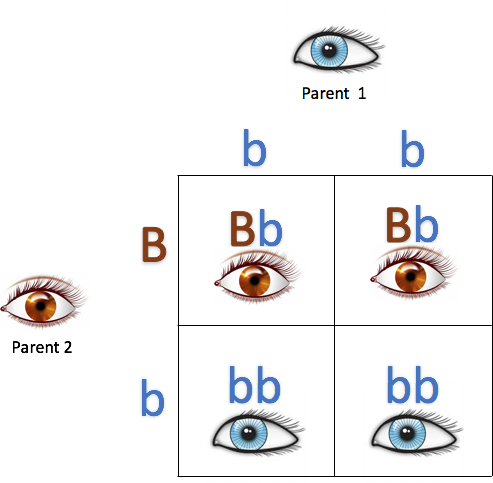
The gene for brown eyes prevents the gene for blue eyes from working. Therefore, the gene for brown eyes is the dominant gene. The gene for blue eyes is the recessive gene. For example, if brown eyes are dominant (B) to blue eyes, then B = brown eyes and b = blue eyes.

This image shows the difference in eye colour - blue eyes versus brown eyes. This is one of the classic examples used to teach genetic inheritance.
Example
Worked Example 1: Eye colour inheritance (pure breeding parents)
Eye colour is controlled by two different genes. The gene for brown eyes (B) is dominant to the gene for blue eyes (b). Let's show the possible eye colour of children if the mother has blue eyes (bb) and the father has brown eyes (BB).
Analysis:
- Mother's genotype: bb (blue eyes)
- Mother's phenotype: Blue eyes
- Father's genotype: BB (brown eyes)
- Father's phenotype: Brown eyes
- Each parent can only produce one type of gamete
- All children will have genotype Bb
- All children will have brown eyes phenotype
Explanation: This happens because each child receives one B gene from their father and one b gene from their mother, giving them Bb. Since B is dominant, they will all have brown eyes.
Example
Worked Example 2: Eye colour inheritance (heterozygous parents)
Eye colour is controlled by two different genes. The gene for brown eyes (B) is dominant to the gene for blue eyes (b). Let's show the possible eye colour of children if both the mother and father have brown eyes (Bb).
Analysis:
- Mother's genotype: Bb (brown eyes)
- Father's genotype: Bb (brown eyes)
- Both parents can produce two types of gametes (B or b)
- Possible offspring genotypes: BB, Bb, Bb, bb
- Possible offspring phenotypes: brown eyes, brown eyes, brown eyes, blue eyes
Result: There is a 75% chance that a child will have brown eyes and a 25% chance that a child will have blue eyes when both parents have the Bb genotype.
Note
Exam tip: To work out genetic crosses, you should use a Punnett square. This helps you see all the possible genotypes of the children by pairing each possible gamete from each parent with each possible gamete from the other parent.
Pedigree charts
Pedigree charts are also known as family trees. These charts show how genetic disorders are inherited through families across multiple generations.
Understanding pedigree symbols
When reading pedigree charts, different symbols represent different family members:
- Squares represent males
- Circles represent females
- Coloured/shaded symbols show individuals with the genetic disorder
- Uncoloured/unshaded symbols show individuals without the disorder
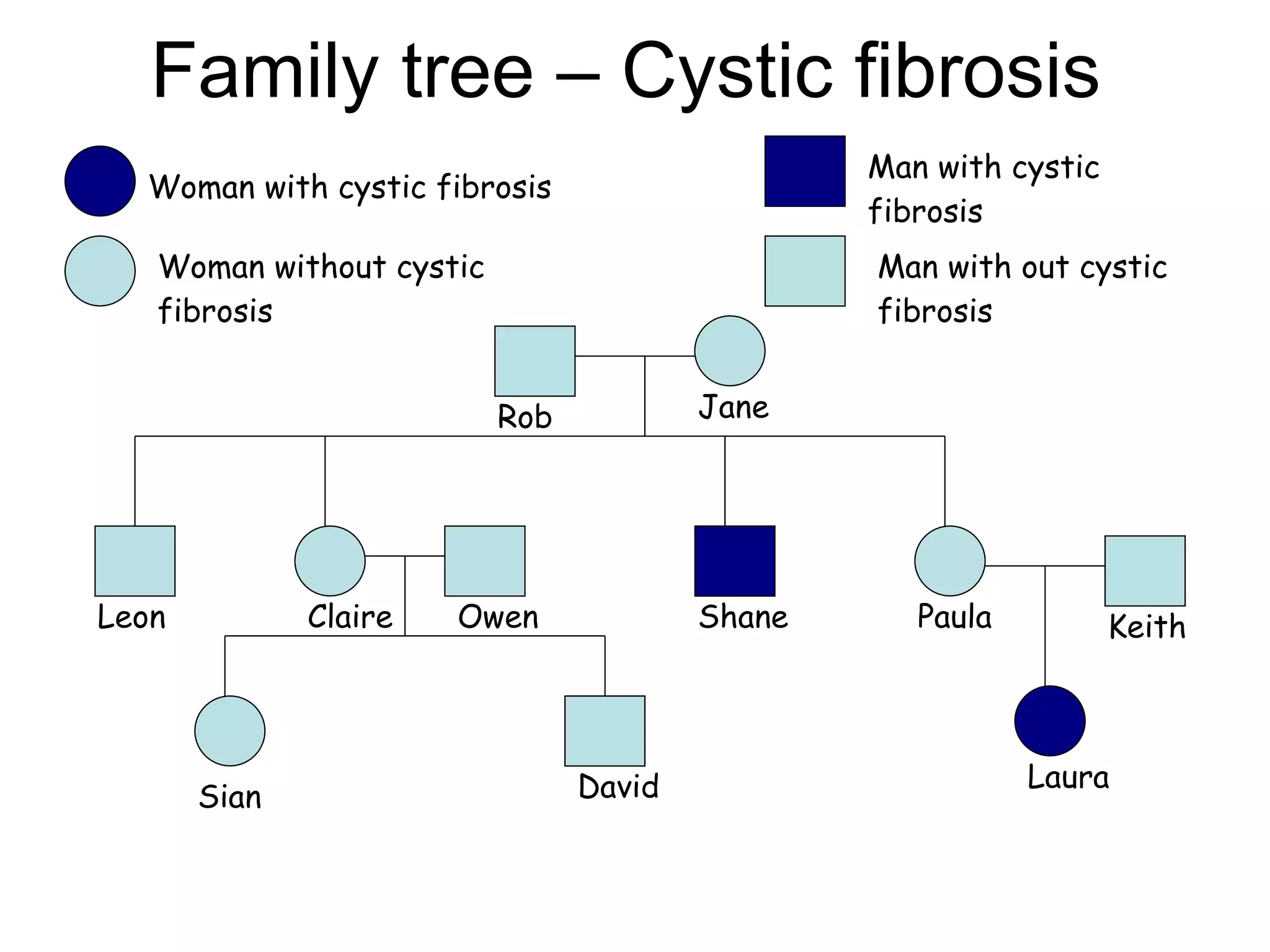
Cystic fibrosis pedigree
Cystic fibrosis (cf) is a genetic disorder that affects the respiratory system and digestive system. It is a serious health issue and can be debilitating.
The gene for cf is recessive. This means:
- A person with just one gene for cf will not have the disorder
- That person is known as a carrier and can pass that gene on to their children
- A person needs two genes for cf to actually have the disorder
Note
This pedigree chart shows how cystic fibrosis is inherited through a family. We can see which family members are affected and which are carriers. Carriers have one copy of the recessive gene but do not show symptoms of the disorder.
Sickle cell anaemia pedigree
Sickle cell anaemia is an inherited human disease. It causes the body to produce red blood cells that have an irregular shape.
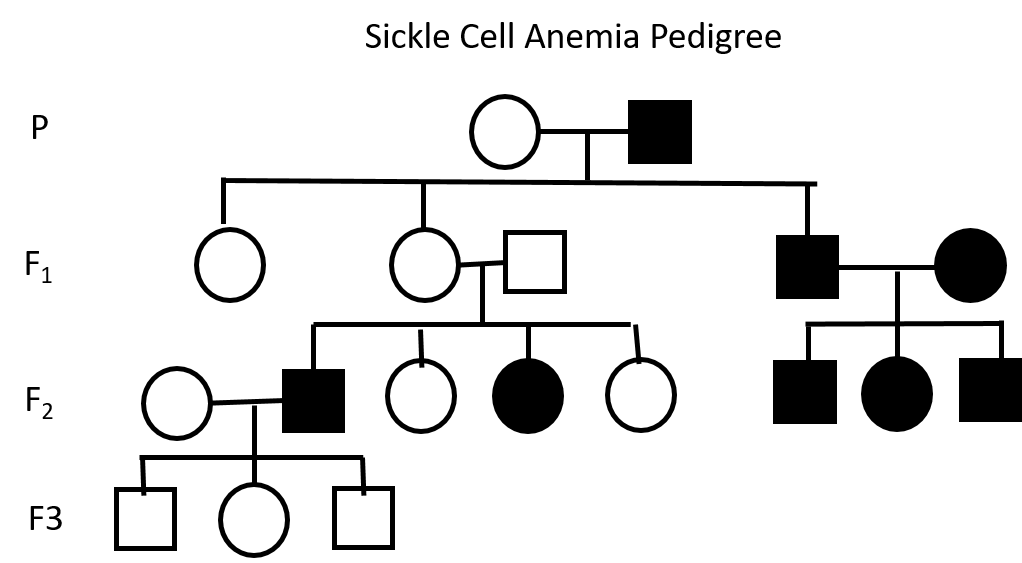
This pedigree chart tracks sickle cell anaemia through three generations of a family, showing the inheritance pattern of this genetic disorder.
Important
Pedigree charts help us understand which people are sufferers and which are non-sufferers. They also help identify carriers - people who have the gene for a disorder but do not suffer from the disease themselves.
Investigation: DNA extraction from kiwi fruit
This practical investigation allows you to extract DNA from kiwi fruit and see it with your own eyes.
Materials needed
- Kiwi fruit
- Salt solution
- Washing-up liquid
- Beaker
- Kitchen paper or fine mesh sieve
- Test tube
- Ice-cold alcohol (such as methylated spirits)
- Pineapple juice (optional)
Procedure
Step 1: Add salt to a beaker of water and stir to create a salt solution.
Step 2: Add washing-up liquid to the beaker and stir. The washing-up liquid breaks down the fat in the cell membrane of the kiwi cells.
Step 3: Peel, chop and mash a kiwi fruit to break down the fruit into smaller pieces.
Step 4: Add the extraction liquid to the mashed kiwi. The salt helps break away the protein that the DNA is wrapped around.
Step 5: Line a fine mesh sieve with three layers of kitchen paper and place on top of a large beaker.
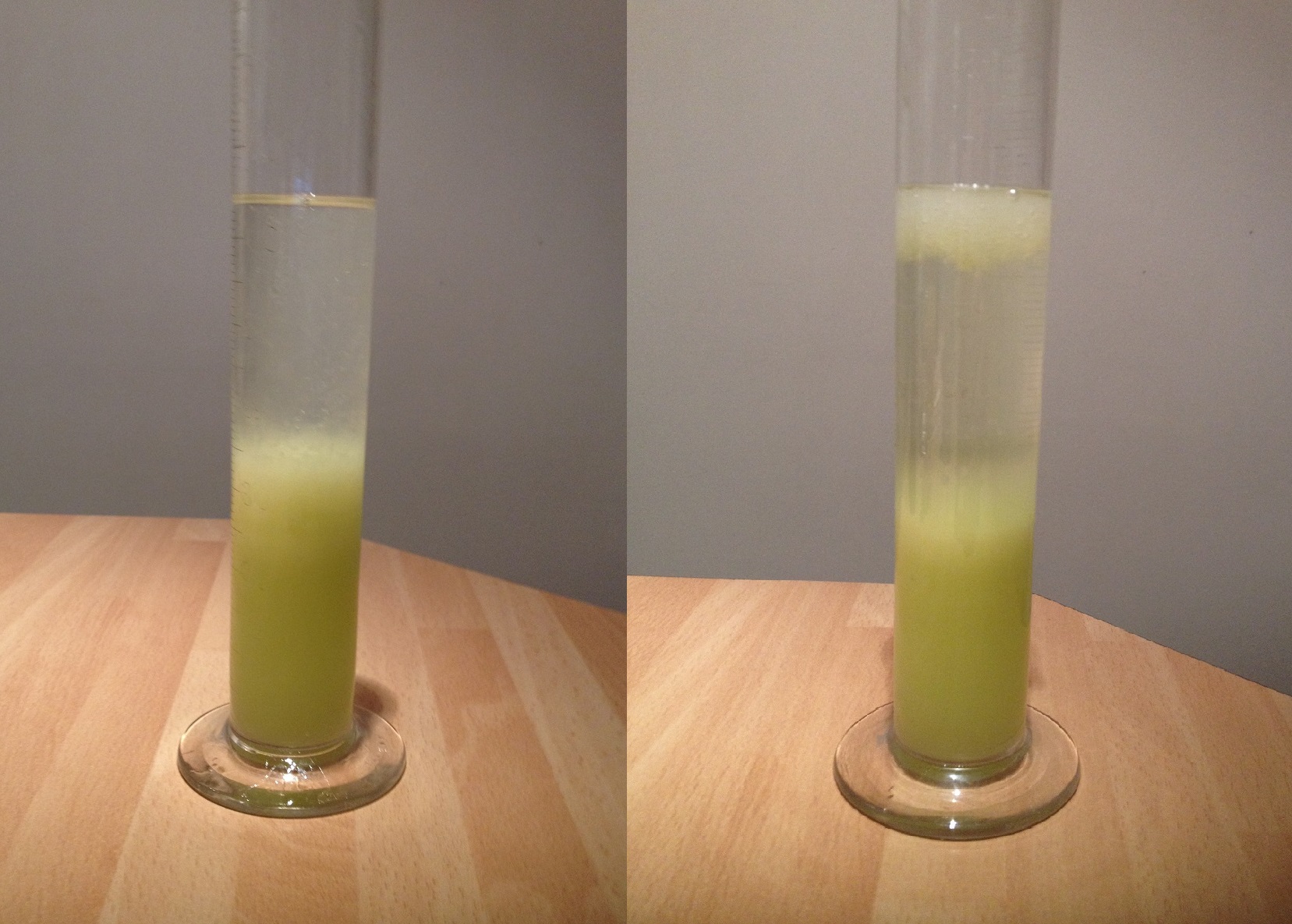
Step 6: Strain the kiwi mixture through the lined sieve to collect the filtrate. A green liquid mixture (the fruit pulp and seeds) is collected in the beaker. This is the filtrate. DNA from the kiwi is dissolved in the filtrate.
Step 7: Place some of the green filtrate in a test tube.
Step 8: Pour ice-cold alcohol down the inside of the test tube so it sits on top of the DNA solution. There is an enzyme in the pineapple juice that is added to the filtrate with the DNA - it breaks down the proteins that the DNA is wound around.
Step 9: The DNA is insoluble in ice-cold alcohol, so it comes out of solution and can be seen as a white, stringy substance.
Step 10: Add some pineapple juice to the green filtrate (optional step to help separate DNA).
Note
This investigation demonstrates that DNA is a real substance that can be extracted and observed, helping make the concept of genetic material more concrete and understandable.
Summary
Key Points to Remember:
-
Sexual reproduction involves two parents and produces offspring with variation, while asexual reproduction involves one parent and produces genetically identical offspring.
-
DNA is a double helix structure that carries genetic information and controls all cell activities. It was discovered by James Watson, Francis Crick, and Rosalind Franklin.
-
Variation describes how members of the same species differ. Some characteristics are inherited (controlled by genes), while others are acquired (learned during life).
-
Chromosomes are structures in the nucleus made of DNA wrapped around proteins. Humans have chromosomes ( pairs). Genes are sections of DNA that control the production of specific proteins.
-
In genetic crosses, dominant genes prevent recessive genes from being expressed. Genotype refers to the genes an organism has, while phenotype refers to the physical traits we can see.
-
Pedigree charts track how genetic disorders are inherited through families and help identify carriers who have the gene but don't show symptoms.