Barley, Wheat & Oats (Leaving Cert Agricultural Science): Revision Notes
📚Revision Notes
Barley, Wheat & Oats
Overview of cereal crops
Cereal crops in Ireland are classified based on when they are planted during the year. This timing determines whether they are called winter cereals or spring cereals.
Winter cereals are drilled (planted) in the autumn months and include wheat, barley and oats. Spring cereals consist of spring barley, spring oats and spring wheat, which are drilled from February to March.

Note
The key distinction between winter and spring cereals lies in their planting timing, which directly affects their growing period and ultimate yield potential.
Winter cereals
Winter cereals refer to crops that are planted in autumn, typically around October/November. The area under winter cereals in Ireland has grown significantly from around 100,000 hectares to approximately 150,000 hectares in recent years. This increase is mainly due to expanded winter barley production.
Winter wheat and winter barley are the dominant crops, with around 70,000 hectares each being planted annually. Winter oats cover a much smaller area of only 10,000 hectares per year.
Advantages of winter varieties
Winter varieties offer several significant benefits over their spring counterparts:
- Longer growing period resulting in 25% higher yields than spring varieties
- Spreads out the workload as spring can be busy with lambing and calving
- Reduces risks from poor spring weather conditions
Important
The 25% higher yield advantage of winter cereals makes them particularly attractive to farmers, despite the additional autumn workload and weather risks during establishment.
Spring cereals
Spring cereals are planted from February to March and harvested from August to September. The three main spring cereal crops are barley, oats and wheat.
Spring barley
Spring barley dominates Ireland's spring cereal production with impressive statistics:
- Largest spring crop with approximately 120,000 hectares planted annually
- Average yield: 7.2 tonnes per hectare over the last five years
- Primary use: Feed production (87% goes to livestock sector)
- Secondary use: Premium malting and roasting (13%)
Spring wheat
Spring wheat occupies a smaller but significant portion of Irish cereal production:
- Approximately 12,000 hectares planted each year
- Average yield: 7.9 tonnes per hectare
- Primary use: Animal feed production (94% of output)
- Secondary use: Milling for human consumption (6%), though this varies yearly due to difficulties meeting milling standards in Irish climate
Spring oats
Spring oats have experienced renewed interest in recent years:
- Area has increased in recent years to around 10,000 hectares annually
- Average yield: 7.3 tonnes per hectare
- Main uses:
- Horse feed and other animal feeds
- Milling for human consumption
- Seed for export
- Growing demand for food grade oats in domestic and international markets
Note
The increasing demand for food-grade oats reflects changing consumer preferences towards healthier breakfast options and functional foods.
Winter and spring varieties
Planting times
Understanding the specific timing requirements is crucial for successful cereal production:
- Spring varieties: Sown February to March, harvested August to September
- Winter varieties: Sown October/November, harvested in July
- Ideal winter planting date: October 1st - crops must be 8-10 cm tall before winter to become frost resistant
- Risk: Sowing too early increases lodging risks
Important
Winter cereals must reach 8-10 cm in height before winter sets in to develop adequate frost resistance. This critical growth stage determines crop survival through harsh weather conditions.
Certified seed
Certified seed is produced by the Department of Agriculture under strictly controlled conditions to ensure quality and performance.
Properties of certified seed
Quality assurance standards for certified seed include:
- Minimum germination rate: 85%
- Minimum analytical purity: 98%
- Completely free of wild oats
- Seed treatment: Treated with fungicide and insecticide for protection
Variety recommendations
The Department of Agriculture produces an annual list of recommended cereal varieties. Examples include Cocktail and Centurion varieties, which are tested extensively for:
- Yield capacity
- Shortness of straw (reduces lodging risk)
- Strength of straw
- Resistance to disease
- Earliness of ripening
Note
Variety performance is measured against control varieties (set at 100), with relative yields expressed as percentages. Disease resistance is rated on a scale of 1-9, where higher numbers indicate better resistance.
Growth stages of cereals
Cereal development follows a standardised coding system from GS00 to GS99, tracking the crop from germination to ripening:
Note
Cereal Growth Stage Classification System:
- Germination: GS00-GS09
- Seedling growth: GS10-GS19
- Tillering: GS20-GS29
- Stem elongation: GS30-GS39
- Booting: GS40-GS49
- Ear emergence: GS50-GS59
- Flowering: GS60-GS69
- Milk development: GS70-GS79
- Dough development: GS80-89
- Ripening: GS90-GS99
Barley production
Barley is grown in two main forms in Ireland: two-row barley (2 rows of seeds on the ear) and six-row barley (6 rows of seeds on the ear). Spring barley is always two-row, while winter barley can be either type.

Uses of barley
Understanding the different applications helps farmers choose appropriate varieties and management practices:
Feed barley: Used for animal feed suitable for all livestock. Most farmers sell to feed manufacturers who mix it with other ingredients.
Malting barley: Used for brewing and distilling, grown under contract on the best soils only. Requirements include:
- High grain quality essential
- Embryo must not be damaged during harvest or storage
- Protein content between 8.8-10.8% (excess nitrogen must be avoided)
Important
Malting barley requires precise protein content management. Excessive nitrogen application can push protein levels above the acceptable 8.8-10.8% range, making the grain unsuitable for brewing and distilling purposes.
Cultivation requirements
Soil and climate
Successful barley cultivation depends on appropriate environmental conditions:
- Malting barley: Requires the best soils (e.g., Grey Brown Podzols)
- Feed barley: Can grow on a range of soils but performs best on quality soils
- Good drainage essential
- Ideal pH: 6.5
- Dry conditions needed at sowing and especially at harvest
- Steady moisture supply required during growing season - drought reduces yields
Rotation
Barley demonstrates good flexibility in rotation systems:
- Not seriously affected by soil-borne diseases or pests
- Can be grown continuously
- However, higher yields are achieved in rotation systems
Seedbed preparation
The type and intensity of soil cultivation impacts multiple production factors:
- Crop establishment
- Nutrient uptake
- Yield
- Weed growth
- Soil structure
- Greenhouse gas emissions
- Production costs
Ploughing remains the most reliable establishment system for spring crops on most soils.
Min-till systems offer benefits including faster work and reduced costs, but require careful management to avoid grass weed, compaction, and yield loss challenges.
Sowing
Proper sowing technique is fundamental to achieving target plant populations and optimal yields:
- Timing: Spring barley should be sown as early as possible (January-April)
- Depth: 3-5cm deep using a one-pass seeder
- Row spacing: 18cm apart lines
- Seed rate: 125-140 kg/ha
- Target plant population: 300 plants per square metre, tillering to 900 ears at harvest
- Early sowing produces higher yields
Calculating seed rate
Accurate seed rate calculation ensures optimal plant establishment and resource efficiency:
Example
Worked Example: Calculating Seed Rate
Use this formula to determine the correct seeding rate:
Given values:
- TGW = 50
- Target plant population = 280
- % Establishment = 70
Calculation:
Weed control
Effective weed control is crucial as weeds compete with barley for light, water and nutrients. Understanding the competitive impact helps farmers prioritise control strategies:
- Significant weed challenges can result in yield responses over 1.2 t/ha from herbicides
- Early herbicide applications provide maximum effect
- Ear number is a key yield determinant - weed competition reduces shoot numbers during early tillering
- Barley can tolerate low weed levels when plant numbers are high
Weed competitiveness classification:
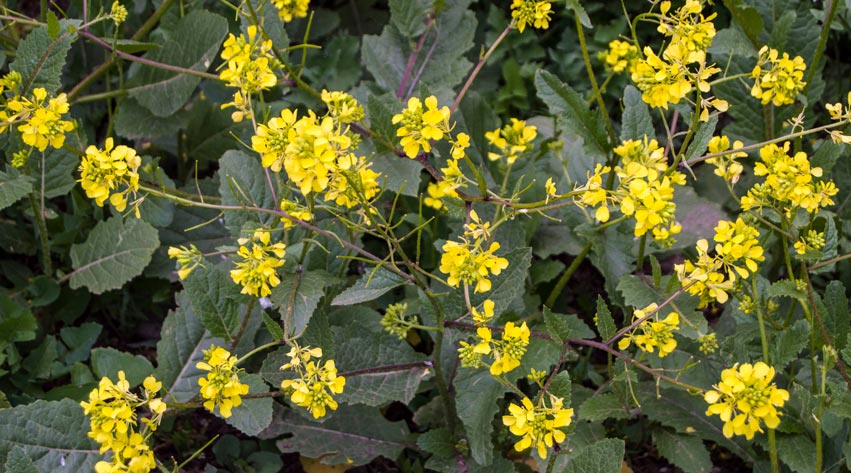
- Most competitive weeds: Wild oats and charlock
- Less competitive: Corn marigold, poppy, fat hen, fumitory, chickweed, redshank, knotgrass
- Least competitive: Dead nettles and field pansy
Important
Early herbicide applications are critical for maximum effectiveness. Weed competition during early tillering significantly reduces ear numbers, which are a key determinant of final yield.
Disease management
Major barley diseases require integrated management approaches:
Important barley diseases include:
- Rhynchosporium (leaf blotch)
- Net blotch
- Ramularia
- Powdery mildew

Disease control strategy
Important
Integrated Disease Management Approach:
- Use integrated pest management - don't rely on just one control method
- Select varieties with good disease resistance (refer to recommended variety lists)
- Use certified, disease-free seed
- Fungicide timing and choice is crucial for optimal control
- Avoid creating a "green bridge" by destroying volunteers from previous crops early
Fertiliser application
Nutrient management requires careful timing and rate consideration:
- P and K rates are determined by soil test results
- Nitrogen timing: Only applied in spring and summer when crops are actively growing (no N when sowing winter cereals)
- N application rate depends on recent cropping history and soil organic matter levels
- Maximum at sowing: No more than 75kg/ha of N
- Split dressings: Additional N applied when 2-3 leaves are produced
Effects of excessive nitrogen
Important
Risks of Excessive Nitrogen Application:
- Can cause lodging (stem breaks and plants fall over)
- Makes crop more susceptible to disease
- Increases protein content (unsuitable for malting barley)
Pest management
Common barley pests require targeted control strategies:
- Wireworms: Problem after grass - spray insecticide before sowing
- Leatherjackets: Controlled with insecticides
- Aphids/greenfly: Use insecticides and encourage beneficial ladybirds
- Birds: Attack ripening crops causing lodging - controlled by baits, scarecrows, bangers and shotgun
- Rabbits: Eat emerging plants - controlled by baits and rifle
Harvesting
Recognising optimal harvest timing ensures maximum yield and quality:
Barley is ready to harvest when:
- Straw becomes dry and bleached yellow
- Grain becomes dry and hard (moisture below 20%)
- Ear bends over and lies parallel to the stem
Harvesting method: Combine harvester that threshes the crop (separates seeds from stem)
Timing and yields by variety:
- Spring barley: August-September, 5-7 tonnes per hectare
- Winter barley: July, 10 tonnes per hectare plus approximately 3 tonnes/ha straw
Note
The earlier harvest timing of winter barley (July vs August-September) allows farmers to establish following crops earlier and reduces weather-related harvest risks.
Storage
Proper storage prevents quality deterioration and economic losses:
Proper storage prevents:
- Germination
- Bacterial, fungal or pest attack
- Quality deterioration
Key storage factors:
- Moisture risk: Highest when moisture content is high
- Drying: Grain must be dried to 14% moisture content
- Payment: Farmers receive higher prices for grain with moisture content closer to 14%
Acid treatment: Used by farmers storing smaller grain quantities
- Propanoic or sulphuric acid dripped onto grain at 3-5 litres per tonne
- Kills the embryo and stops germination
- Acidity protects against bacteria, fungi and pests
- Not used on malting barley
Important
Acid treatment cannot be used on malting barley as it kills the embryo, which must remain viable for the malting process in brewing and distilling.
Feeding value
Processing requirements vary depending on the livestock species:
Barley grain processing for livestock:
- Ruminants: Grain is rolled to break outer shell/husk, allowing starch inside to be digested
- Monogastrics: Grain must be ground into flour before it can be digested
Summary
Key Points to Remember:
-
Winter cereals are planted in autumn (wheat, barley, oats) while spring cereals are planted February-March, with winter varieties yielding 25% more than spring varieties.
-
Spring barley is Ireland's largest spring cereal crop covering 120,000ha annually, primarily used for livestock feed (87%) with some premium malting uses (13%).
-
Certified seed must have minimum 85% germination rate, 98% purity, be free of wild oats, and treated with fungicides and insecticides.
-
Barley cultivation requires good drainage, pH 6.5, early spring sowing (Jan-April), and careful management of nitrogen to avoid lodging and maintain grain quality for malting.
-
Effective crop management involves integrated approaches to weed control, disease prevention using resistant varieties and fungicides, and proper storage at 14% moisture content to maintain quality.