Chemical Properties (Leaving Cert Agricultural Science): Revision Notes
📚Revision Notes
Overview
Understanding soil chemistry is fundamental to successful agriculture. The chemical properties of soil determine how well plants can access essential nutrients and how effectively crops will grow. This comprehensive overview examines the key chemical features that make soil fertile and productive.
Note
Soil chemistry forms the foundation of plant nutrition. Without understanding these chemical processes, farmers cannot make informed decisions about fertilisation, pH management, and soil improvement strategies.
Essential plant nutrients
Plants depend on receiving nutrients in specific chemical forms that their roots can easily absorb. These nutrients must be dissolved in soil water to become available to plants.
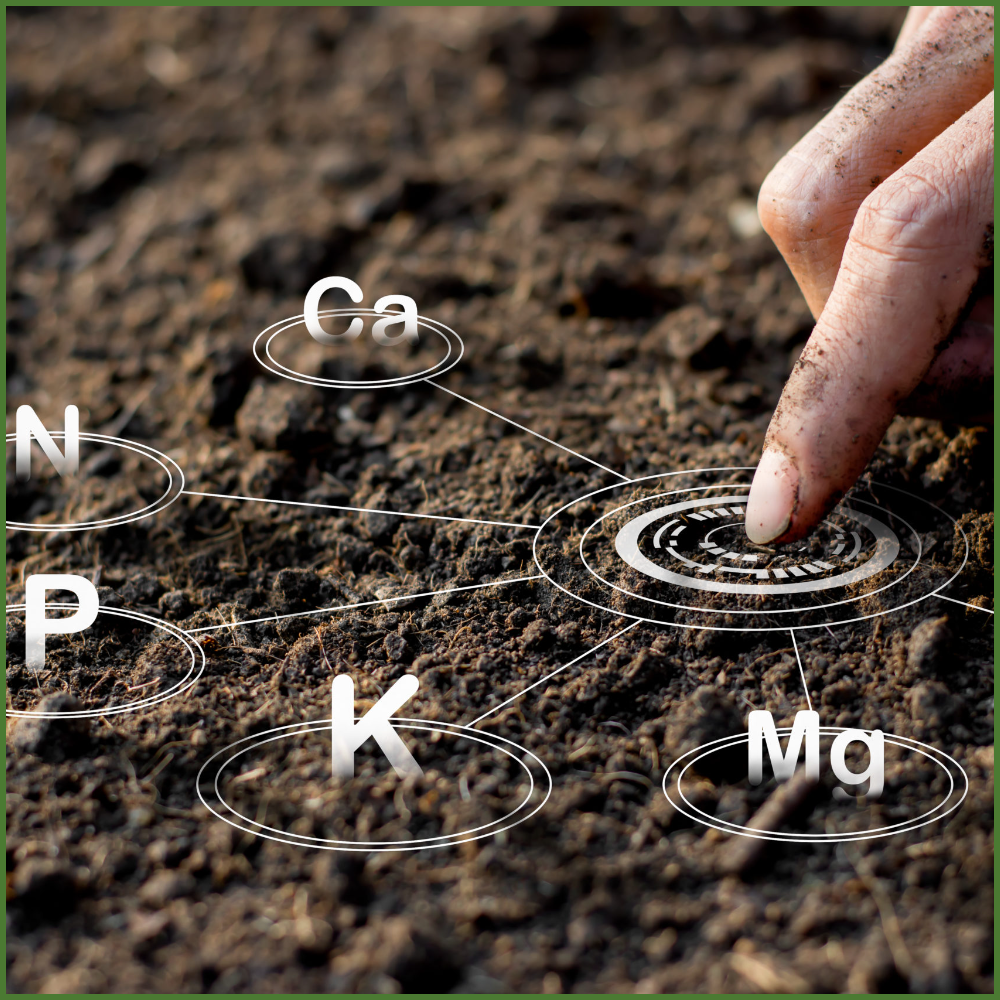
Macronutrients - the big three plus extras
Nitrogen (N) appears in soil as nitrate ions () or ammonium ions (). This nutrient drives leaf development and helps create the green chlorophyll that powers photosynthesis. Without adequate nitrogen, plants become stunted with yellowing leaves.
Phosphorus (P) exists as phosphate compounds (, ). It's absolutely critical for root development and energy transfer within plant cells. Young plants especially struggle without sufficient phosphorus.
Potassium (K) is found as potassium ions () and helps regulate many plant processes. It strengthens plant stems, improves disease resistance, and helps plants cope with environmental stresses like drought.
Example
Worked Example: Nitrogen Forms in Soil
When organic matter decomposes, nitrogen goes through several chemical transformations:
Step 1: Organic nitrogen → Ammonium () through mineralization Step 2: Ammonium () → Nitrite () → Nitrate () through nitrification
Plants can absorb both and , but nitrate is more mobile in soil and more readily available.
Other important macronutrients include:
- Calcium () - strengthens cell walls and aids nutrient uptake
- Magnesium () - essential component of chlorophyll molecules
- Sulphur as sulphate () - needed for protein formation
Micronutrients - small but mighty
These trace elements are needed in tiny amounts but are still essential for healthy plant growth:
- Iron (Fe) - prevents leaf yellowing between veins
- Copper (Cu) - involved in enzyme functions
- Zinc (Zn) - crucial for growth hormone production
- Manganese (Mn) - helps with photosynthesis
- Boron (B) - important for cell wall formation
- Molybdenum (Mo) - aids nitrogen fixation in legumes
Note
Understanding Micronutrient Importance
Even though micronutrients are needed in parts per million (ppm), their deficiency can be just as limiting to plant growth as macronutrient deficiencies. A single missing micronutrient can halt important biochemical processes entirely.
The availability of all these nutrients depends heavily on soil pH, organic matter content, microbial activity, and the soil's cation exchange capacity.
Soil pH and lime application
Understanding soil acidity
Soil pH measures how acidic or alkaline your soil is on a scale from 0 to 14, where pH = 7 represents neutral conditions. Most agricultural crops perform best in slightly acidic to neutral soils with pH values between 6 and 7.
Important
Problems with acidic soils (low pH):
- Phosphorus becomes locked up and unavailable to plants
- Beneficial soil microorganisms become less active
- Toxic levels of aluminium and manganese can harm plant roots
- Overall nutrient availability decreases significantly
Issues with alkaline soils (high pH):
- Iron, zinc, and manganese availability becomes restricted
- Plants may develop nutrient deficiency symptoms despite adequate soil levels
The liming solution
Applying agricultural lime (calcium carbonate - or dolomitic lime - ) to acidic soils provides multiple benefits:
- Neutralises excess acidity by raising soil pH to optimal levels
- Improves phosphorus availability, making this crucial nutrient more accessible to plants
- Supplies calcium (and magnesium if using dolomitic lime) as essential plant nutrients
- Enhances soil structure through improved flocculation processes
Note
Regular soil testing helps determine when liming is needed and how much lime to apply for optimal results. Most soils should be tested every 3-4 years to monitor pH changes.
Cation exchange capacity (CEC)
The soil's nutrient storage system
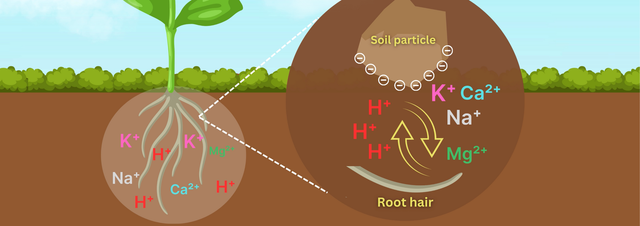
Think of CEC as your soil's "nutrient bank account". It represents the soil's ability to hold onto and exchange positively charged nutrient ions (cations) such as , , , , , and .
Clay particles and organic matter (humus) act as the main storage sites for these nutrients. The tiny surfaces of these materials carry negative charges that attract and hold positively charged nutrients.
How CEC works in practice
Plant roots release hydrogen ions () which can swap places with nutrient cations stuck to clay and humus particles. This exchange process allows plants to access stored nutrients as needed.
Example
Worked Example: Cation Exchange Process
When a plant root needs potassium:
Step 1: Root releases ions into soil solution Step 2: ions move to clay particle surface Step 3: ions are displaced from clay particle: Clay- + → Clay- + Step 4: Released ions are absorbed by plant roots
This exchange maintains nutrient availability while preventing nutrient loss.
Factors affecting CEC:
- Clay type and content - certain clays (2:1 clays) have much higher CEC than others
- Organic matter levels - humus significantly increases CEC
- Soil pH - affects the availability of exchange sites
Benefits of higher CEC:
- Better nutrient storage capacity reduces fertiliser losses
- Decreased nutrient leaching protects groundwater quality
- More stable nutrient supply for plants throughout the growing season
Flocculation and soil structure
Creating stable soil aggregates
Flocculation occurs when negatively charged clay particles clump together to form larger, stable soil crumbs. This process is essential for creating good soil structure.
Key promoter of flocculation:
- Calcium ions () are particularly effective at binding clay particles together
- Magnesium ions () also contribute but to a lesser extent
Benefits of good flocculation
When clay particles flocculate properly, the soil develops:
- Improved porosity allowing better air and water movement
- Enhanced aeration supporting root respiration and beneficial microorganisms
- Better drainage preventing waterlogging problems
- Easier root penetration allowing plants to explore more soil volume
- Improved workability making cultivation operations more effective
The sodium problem
When sodium ions () dominate the exchange sites, deflocculation occurs. This causes clay particles to disperse, leading to serious soil problems.

Important
Consequences of Sodium Dominance:
- Poor drainage and waterlogged conditions
- Surface sealing that prevents water infiltration
- Difficult working conditions for farm machinery
- Reduced plant growth and yield potential
Soils with high sodium levels require special management, often including gypsum application to displace sodium ions.
Summary
Key Points to Remember:
- Nutrient availability depends on having nutrients in the right ionic forms (like , , ) and maintaining proper soil pH
- Liming acidic soils is crucial for sustained fertility and improved phosphorus availability
- CEC acts as the soil's nutrient bank - higher CEC soils from humus and certain clays store more nutrients
- Calcium-promoted flocculation creates the good soil structure needed for drainage, aeration, and root growth
- Regular soil testing helps monitor pH, nutrient levels, and CEC to guide management decisions